

















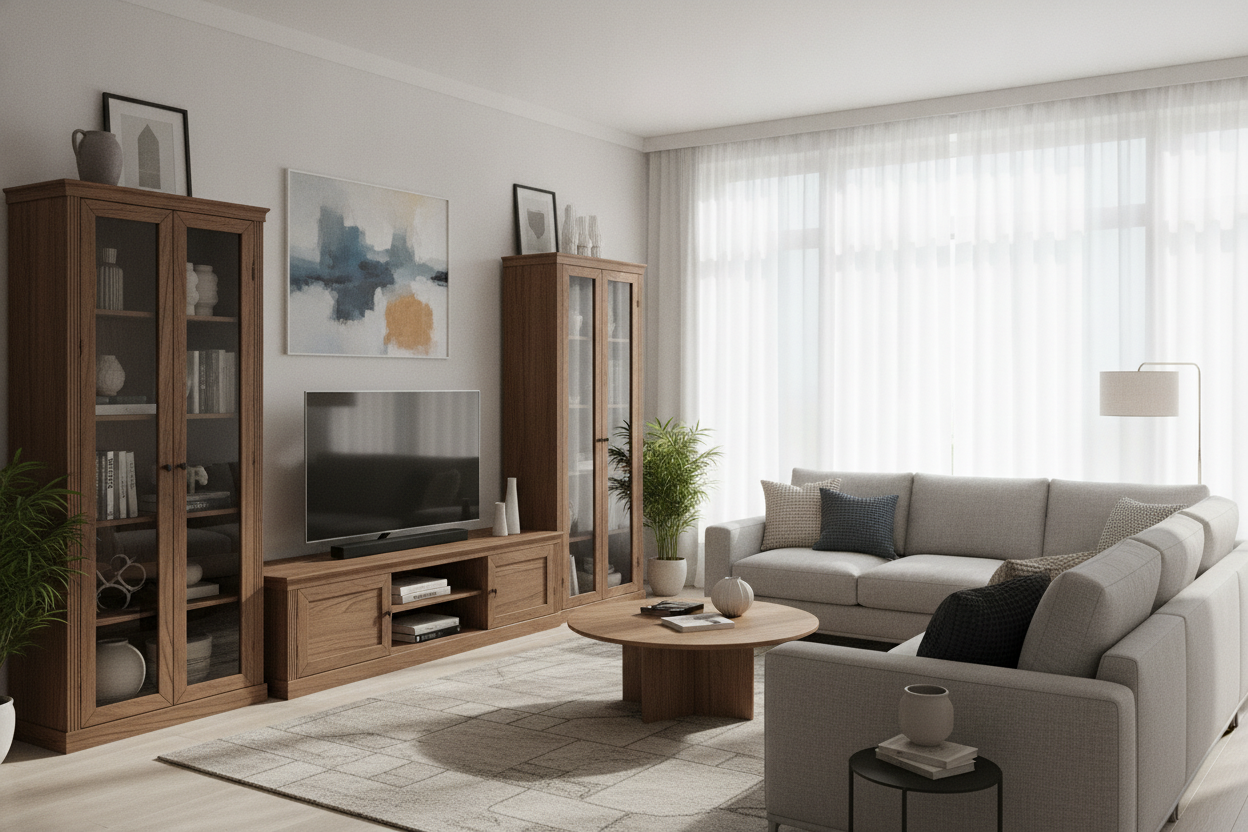
I spent three months staring at forty-seven open browser tabs, convinced I could find a coffee table that didn't make my media console look like an accidental Craigslist leftovers pile. My floor was covered in wood samples that all claimed to be 'honey oak' but looked like four different species of tree when the afternoon sun hit them. That’s when I finally admitted defeat and looked for a living room set tv stand.
We've been told that 'matching' is the ultimate design sin—that it’s something you only do when you've given up and bought the whole showroom floor. But after a decade of trying to mix-and-match my way to a curated home, I realized that the line between 'eclectic' and 'chaotic' is thinner than the veneer on a cheap bookshelf.
- Visual cohesion stops the eye from jumping around a messy-looking room.
- Built-in scale ensures your coffee table doesn't dwarf your TV console.
- Coordinated sets provide a neutral base for more daring decor choices.
- It saves dozens of hours of browsing and returning mismatched pieces.
The 'Eclectic' Lie: Why Mixing Woods Got Exhausting
I used to be a design purist. I believed every piece of furniture should have a story, a different origin point, and a slightly different finish. In theory, it sounds like a cool Brooklyn loft. In practice, in a standard 12x14 living room, it usually just looks like you can't commit to a color palette.
The breaking point for me was trying to pair an ash wood coffee table with a walnut media console. On their own, they were beautiful. Together? They looked like they were having a silent argument. One was too cool-toned, the other was too red, and the grain patterns were fighting for dominance. It wasn't 'curated'; it was exhausting to look at.
When you try to mix woods, you have to get the undertones exactly right. If one is slightly more yellow and the other is slightly more pink, the whole room feels off-balance. I realized I was spending my weekends hunting for the 'perfect' match that didn't exist, all while my living room felt like a temporary staging area instead of a home.
Waving the White Flag: Buying Living Room TV Furniture Sets
I finally stopped the madness and started looking for cohesive living room furniture. The moment I unboxed a matching set, the visual relief was instant. Suddenly, the room had a foundation. Because the TV stand and the coffee table shared the same DNA—the same kiln-dried oak and the same matte black hardware—the space felt intentional.
There is a specific kind of peace that comes with knowing your furniture actually speaks the same design language. You aren't wondering if the legs on the console are too modern for the rustic vibe of the table. You just set it up and move on with your life. I spent a lot of time researching how to pick a living room furniture TV stand that wouldn't feel like a flimsy piece of fast-furniture, and it paid off.
Buying living room tv furniture sets doesn't mean you're boring; it means you're smart. You're outsourcing the math of design to professionals who understand wood grain and finish chemistry better than you do. It’s not about losing your personality; it’s about creating a canvas where your personality can actually show up without being drowned out by clashing wood tones.
The Secret Benefit: Perfect Proportions
One of the biggest DIY design mistakes I see is a scale mismatch. People buy a massive, 85-inch TV and try to balance it on a tiny, delicate console they found at a flea market. It looks top-heavy and, frankly, a little dangerous. When you buy a set, the designers have already done the heavy lifting on proportions.
I opted for an adjustable TV stand for living room use because it allowed me to anchor the wall properly. A wider stand provides a much-needed visual weight that balances out the giant black rectangle of the TV. When your coffee table and stand are scaled to work together, the whole room feels larger because the proportions are 'correct' to the human eye.
How to Keep Your Matched Set From Looking Like a Catalog
The fear of matching sets is that your house will look like a page from a big-box catalog. The secret to avoiding that isn't mixing the wood—it's mixing everything else. You break up the uniformity with heavy textures, oversized art, and bold upholstery choices.
I paired my matching wood set with a massive, textured corduroy cloud couch. The soft, chunky ribs of the corduroy provide a sharp contrast to the smooth, hard lines of the oak furniture. If I had a wood coffee table, wood TV stand, and a flat, mid-century sofa, the room would feel sterile. But by adding that heavy texture and a few ceramic lamps, the matching set just looks like high-end custom cabinetry.
Think about your textiles. A thick wool rug or a velvet throw pillow does more to 'de-catalog' a room than a mismatched side table ever could. Use your matching set as the stable 'boring' part of the room so that your art and your seating can be the stars of the show.
The Final Verdict: Is Coordinated Furniture Actually Better?
If you have the time and the eye to hunt through vintage shops for three years to find pieces that perfectly complement each other, go for it. But for most of us, taking the guesswork out of the media center and coffee table pairing is the ultimate life hack. It's about efficiency and visual peace.
I don't regret my matching set for a second. It gave me back my weekends and finally made my living room feel like it was finished. Sometimes, the best design choice is the one that lets you stop worrying about the furniture and start actually living in the room.
FAQ
Does matching furniture make a room look smaller?
Actually, the opposite is usually true. When pieces match, they create a continuous visual line that makes the room feel more expansive and less cluttered than a space filled with competing colors and styles.
Can I add a different wood piece later?
Yes, but keep it to one 'accent' piece. If your main set is a dark walnut, a light maple side table can work as a deliberate contrast, but don't try to add a third or fourth wood tone into the mix.
Should my TV stand be wider than my TV?
Always. Ideally, your stand should have at least 3 to 6 inches of breathing room on either side of the TV screen. This prevents the 'lollipop' look where the TV looks like it's about to tip over its base.

Leave a comment
This site is protected by hCaptcha and the hCaptcha Privacy Policy and Terms of Service apply.