

















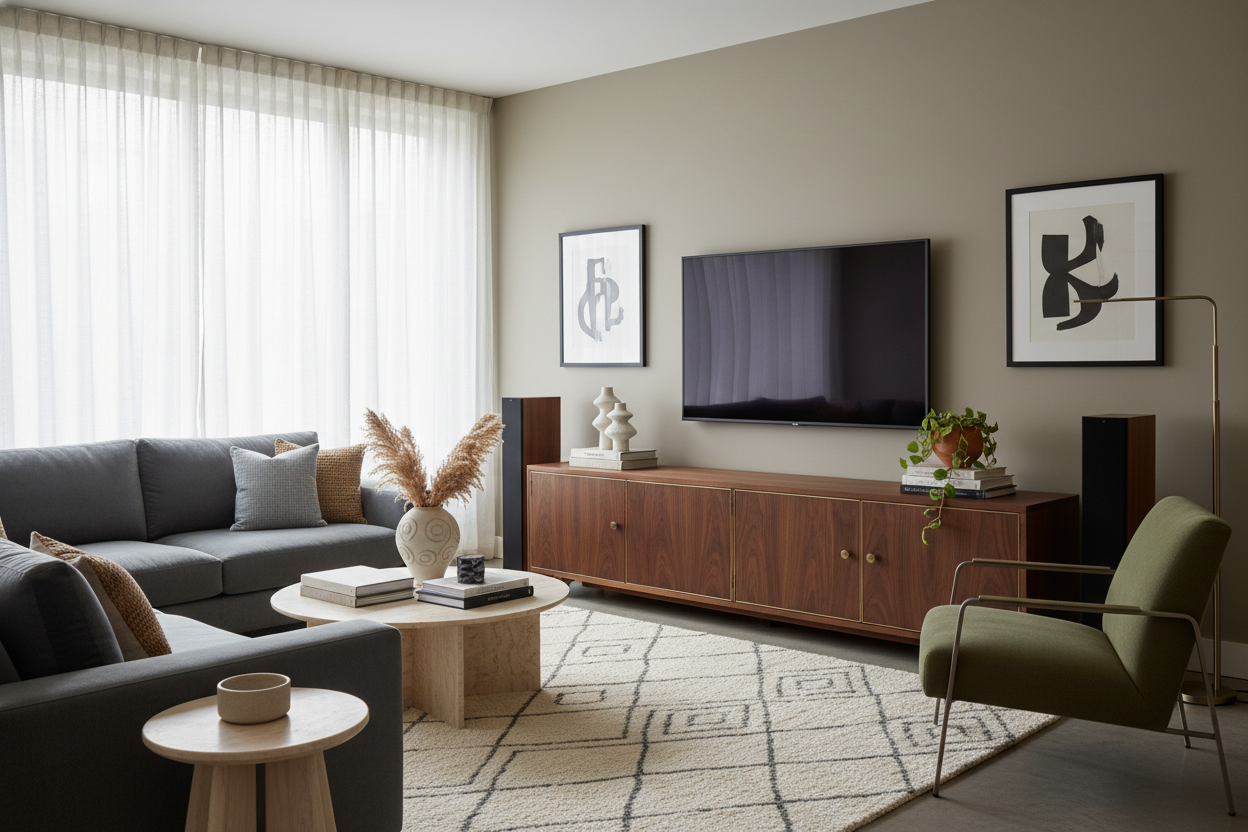
I’ve spent weeks agonizing over the exact shade of 'greige' for a performance fabric sofa, only to realize my 65-inch TV was still sitting on a stack of moving blankets two months after move-in. It’s the classic decorator’s fatigue. We put so much energy into the 'soft' side of the room that the living room furniture tv stand becomes an afterthought, usually resulting in a panic buy that looks like it belongs in a dorm room.
The problem is that a bad media unit acts like aesthetic poison. It doesn't matter if you have a designer rug; if your TV is perched on a wobbly, paper-thin laminate shelf with a rat’s nest of wires peeking out the back, the whole room feels unfinished. I’ve learned the hard way that the piece holding your tech needs to be just as intentional as the chair you sit in.
Quick Takeaways
- Always aim for a stand at least 10-12 inches wider than your TV screen.
- Prioritize closed storage to hide the inevitable plastic clutter of routers and remotes.
- Avoid 'matching sets'—mix wood tones for a more curated, high-end feel.
- Check weight capacities; cheap MDF will bow under the weight of a modern soundbar and screen.
The Giant Black Screen Dilemma (And Why We Settle)
We’ve all been there. You just dropped two grand on a sectional, and the thought of spending another eight hundred on a cabinet feels painful. So, you grab the cheapest thing with four legs and a flat top. But here’s the thing: the TV is often the focal point of the room, whether we want to admit it or not. When you settle for subpar tv furniture for living room setups, you’re basically framing your most-used wall with something you hate.
I once bought a glass-and-metal rack because it was 'minimalist.' In reality, it was a dust magnet that showed every fingerprint and wire. It made my entire living room feel like a doctor’s waiting room. Choosing the right piece is about balancing that giant black rectangle with enough visual weight so it doesn't look like a hovering void on your wall.
Stop Treating It Like 'Tech Storage'
The biggest mistake is shopping in the 'electronics' department rather than the furniture department. If you only look for 'furniture for tv stand' use cases, you’ll find a lot of ugly, utilitarian boxes. Start looking at credenzas, sideboards, and buffets instead. These pieces are built with better materials and actual style in mind.
Ask yourself: Can a TV Cabinet for Living Room Actually Look Like Real Furniture? The answer is yes, but only if you stop looking for 'media centers' and start looking for quality cabinetry. Look for solid wood legs, interesting door textures, or mid-century silhouettes that could stand alone even without a TV on top.
The Scale Rule You're Probably Breaking
Scale is where most people fail. A 65-inch TV has a physical width of about 57 inches. If you put that on a 60-inch stand, it looks top-heavy and cramped. You want 'breathing room' on either side of the screen. I generally recommend a wide tv stand entertainment stand that gives you at least 6 to 10 inches of extra surface on both sides.
If your wall is massive, a tiny tv stand furniture for living room walls will look like a postage stamp. In those cases, you need to go big. A full living room furniture entertainment center—one that perhaps incorporates shelving or a longer low-profile base—fills the vertical or horizontal volume of the room, making the TV feel like a deliberate part of the design rather than a tech intrusion.
Wood Tones Don't Need to Match (But They Need to Talk)
Please, I beg you, step away from the 5-piece living room set tv package. Nothing screams 'I bought this in one hour at a big-box warehouse' like a matching coffee table, end table, and TV stand. Your home should look like it was collected over time, not delivered in one shrink-wrapped pallet.
When browsing for your living room, look for tones that complement each other. If your floors are a cool-toned oak, maybe go for a walnut stand to add warmth. The 'conversation' between pieces happens through shared undertones or contrasting textures. If everything is the exact same shade of 'Espresso,' the room loses all its depth and character.
Three Alternatives to the Standard Open-Shelf Console
Open shelving is a trap. Unless you are a minimalist monk with zero cables and one single remote, those shelves will eventually be filled with junk. I always advocate for closed storage. A solid wood sideboard or a versatile console table for living room use offers a much cleaner look.
First, consider a vintage-style sideboard; they are usually the perfect height (around 28-32 inches) for comfortable viewing. Second, try a low-slung 'floating' unit if you want a modern, airy vibe. Third, look for units with fabric or mesh door fronts—these allow your remote signals to pass through while keeping the messy tech hidden from view. I personally use a buffet with cane-front doors; it hides my Playstation perfectly while letting the heat escape.
My Biggest Mistake
A few years ago, I bought a gorgeous, ultra-thin console. It looked amazing in photos. What I didn't account for was the depth of my actual receiver and the 'bend' radius of HDMI cables. I couldn't close the back panel without crushing the wires. Now, I never buy a unit less than 15 inches deep. Measure your deepest piece of tech before you hit 'buy,' or you'll end up cutting holes in the backboard with a steak knife like I did.
FAQ
How high should my TV stand be?
For most sofas, you want the center of the TV at eye level when seated. This usually means a stand height between 22 and 30 inches. If you’re mounting the TV, the stand should still be low enough to leave a 4-8 inch gap between the bottom of the screen and the top of the furniture.
Can I use a dresser as a TV stand?
Absolutely, but watch the height. Standard dressers are often 36 inches or taller, which might leave you with a literal pain in the neck if you're watching from a low sofa. If you have a high-profile bed, a dresser is a perfect choice for a bedroom TV setup.
How do I hide all the ugly wires?
Look for units with 'cable management' holes. If they don't have them, you can drill your own with a hole saw bit. Use velcro ties (not zip ties) to bundle cables together behind the legs of the stand so they stay out of sight.

Leave a comment
This site is protected by hCaptcha and the hCaptcha Privacy Policy and Terms of Service apply.