

















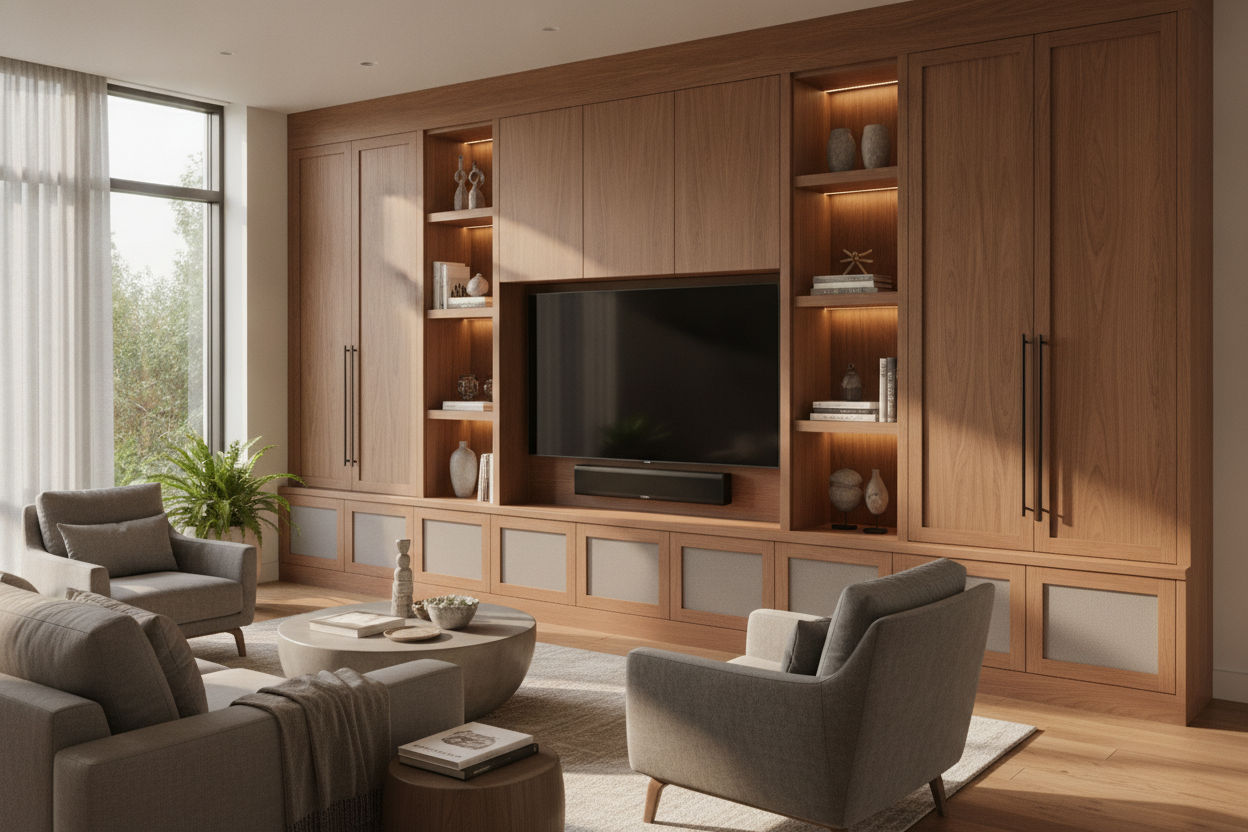
I once spent three hours wrestling a heavy Marantz receiver into a beautiful mid-century sideboard I bought on sale. It looked fantastic for exactly twenty minutes—until I realized the back panel was trapping heat so effectively I could have baked a tray of cookies on top of the chassis. By the time I forced the cables to bend at a 90-degree angle just to shut the doors, I had already ruined a $150 HDMI cord.
Most people treat home theater cabinetry as an afterthought, picking whatever matches the coffee table. But if you own a real receiver, a center channel speaker, or a gaming console, a standard living room credenza is basically a coffin for your electronics. You need something built for the heat and the bulk.
- Standard furniture is usually 16 inches deep; you need at least 20.
- Heat is the number one killer of high-end AV gear.
- Acoustically transparent doors let sound out without showing the mess.
- Cable management should be a feature, not a DIY project with a hole saw.
Why Your Current TV Stand is Probably Baking Your Tech
Standard living room furniture is designed for books, extra blankets, or maybe a stray board game. It is not designed to dissipate the 100-plus degrees of heat generated by a 7.1 channel amplifier. When you shove high-performance gear into a sealed wooden box, the internal temperature skyrockets, shortening the lifespan of your capacitors and causing your processor to throttle.
Then there is the cable nightmare. I’ve seen $2,000 setups ruined because someone tried to jam a thick power cable against a solid back panel. If your furniture doesn't have a recessed back or a generous cable alley, you’re putting physical stress on the ports of your equipment. It’s a recipe for a flickering signal and a very expensive repair bill.
The 3 Things That Make It Actually 'Home Theater Cabinetry'
There is a massive difference between a decorative console and real cabinets for home theater. Specialized units are engineered from the inside out, prioritizing airflow and accessibility over just looking pretty on a showroom floor.
Depth: The 20-Inch Rule
If you take away one thing from this, let it be the 20-inch rule. Most media consoles from big-box retailers are 14 to 16 inches deep. A standard AV receiver is often 17 inches deep. Once you plug in your RCA cables or those beefy HDMI connectors, you need another 2 or 3 inches of clearance so the cables don't crimp. I always look for home theatre cabinets that offer a minimum of 20 inches of internal depth. Anything less and you'll be leaving the back panel off, which looks terrible and lets in all the dust.
Active vs. Passive Ventilation
Passive ventilation means the cabinet has slots in the bottom and vents in the top to let hot air rise naturally. It’s okay for a basic streaming box, but for a PS5 or a dedicated amp, you want more. High-end cabinetry often features 'active' ventilation—built-in, ultra-quiet fans that pull cool air across the components. If you don't want fans, look for cabinetry with fully slotted shelves and a removable back panel to maximize natural convection.
Acoustically Transparent Doors
The biggest design hurdle is the center channel speaker. If you put it behind a solid wood door, your dialogue will sound like the actors are talking through a thick wool blanket. Specialized cabinetry uses perforated metal, louvers, or speaker cloth. This allows the sound to pass through clearly and allows infrared signals from your remote to reach the gear without you having to keep the doors wide open all night.
How to Style Home Theatre Cabinets (Without the 'Man Cave' Vibe)
We’ve all seen those bulky, black-ash units that look like they belong in a 1998 basement. Thankfully, you can find home theater cabinets that aren't hideous. The trick is to look for 'stealth' features. A cabinet with a walnut veneer and perforated steel doors can look like a high-end sideboard while still being a functional tech hub.
I like to style the top of the cabinet with low-profile decor—think a tray for remotes or a few coffee table books—to draw the eye away from the screen. If the cabinet is large, choose a model with legs rather than a solid plinth base. Seeing the floor underneath the unit makes a heavy 84-inch cabinet feel much lighter in a small living room.
Are Specialized Cabinets Actually Worth the Price Tag?
I will be honest: specialized media furniture is expensive. You are often looking at $1,500 to $4,000 for a quality unit. But consider what you’re protecting. If you’ve spent $3,000 on a TV and another $2,000 on audio gear, putting it in a $200 particle-board stand is a bad investment. Proper cabinetry ensures your gear stays cool and organized. To me, that is worth the investment.
My Biggest Cabinetry Mistake
A few years ago, I bought a vintage credenza for my setup. It was gorgeous, but it had zero ventilation. I thought I could just leave the doors open while watching movies. Not only did my toddler eventually try to climb the open doors, but the heat ended up warping the internal shelf within six months. I eventually had to drill four-inch holes in the back with a hole saw, which completely ruined the furniture. Learn from my mistake: buy the right tool for the job.
FAQ
Can I just drill holes in a regular cabinet?
You can, but it is rarely enough. Most regular cabinets lack the internal depth and the slotted shelving needed for air to actually circulate. You will solve the cable problem, but not the heat problem.
Do I really need a fan?
If you keep your cabinet doors closed and run a gaming console or a powerful receiver, yes. If you leave the doors open or use low-heat devices like a Roku, passive venting is usually fine.
How do I hide the cables behind the cabinet?
Look for cabinets with cable management alleys or a recessed back. This allows the unit to sit flush against the wall while leaving space for the wires to run vertically without getting crushed.

Leave a comment
This site is protected by hCaptcha and the hCaptcha Privacy Policy and Terms of Service apply.