
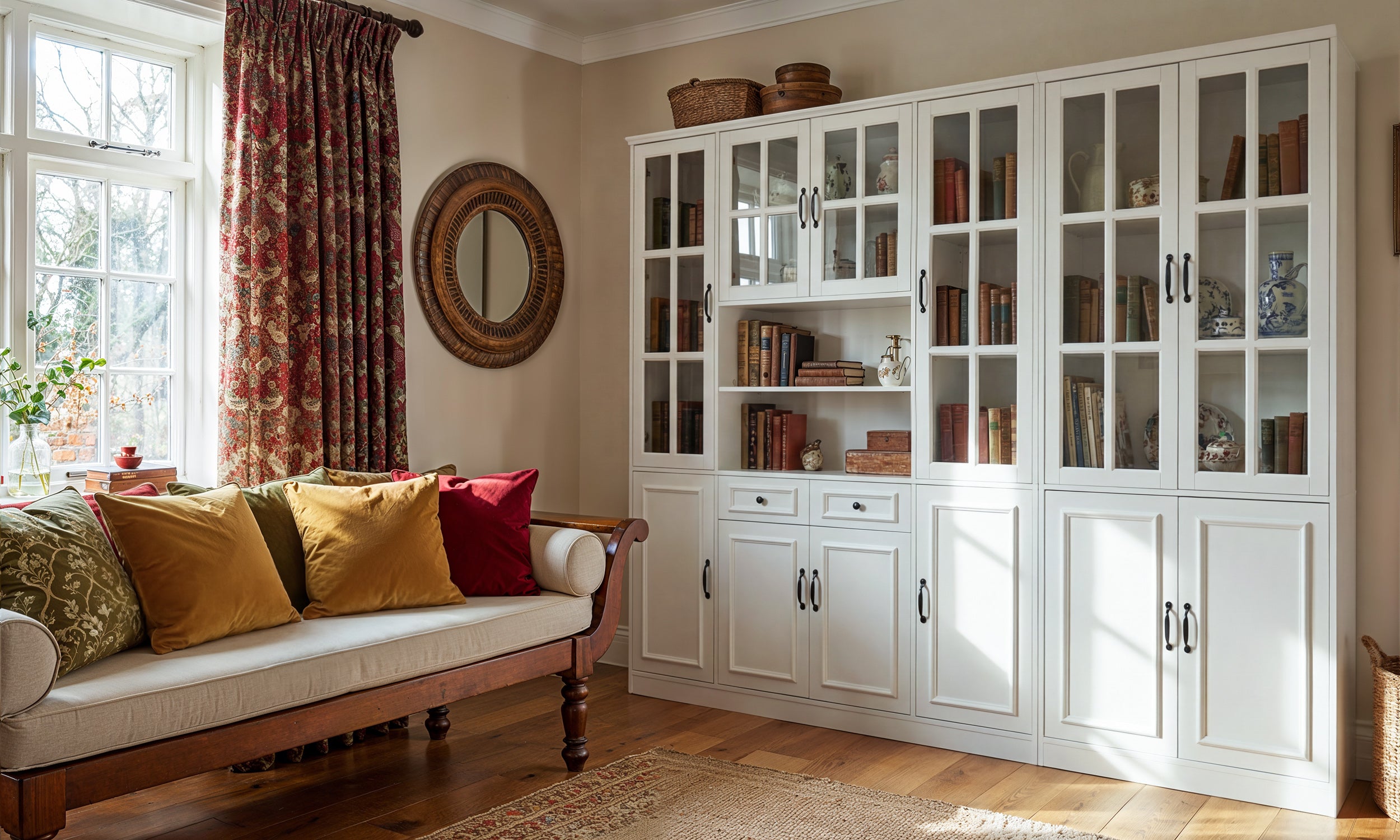
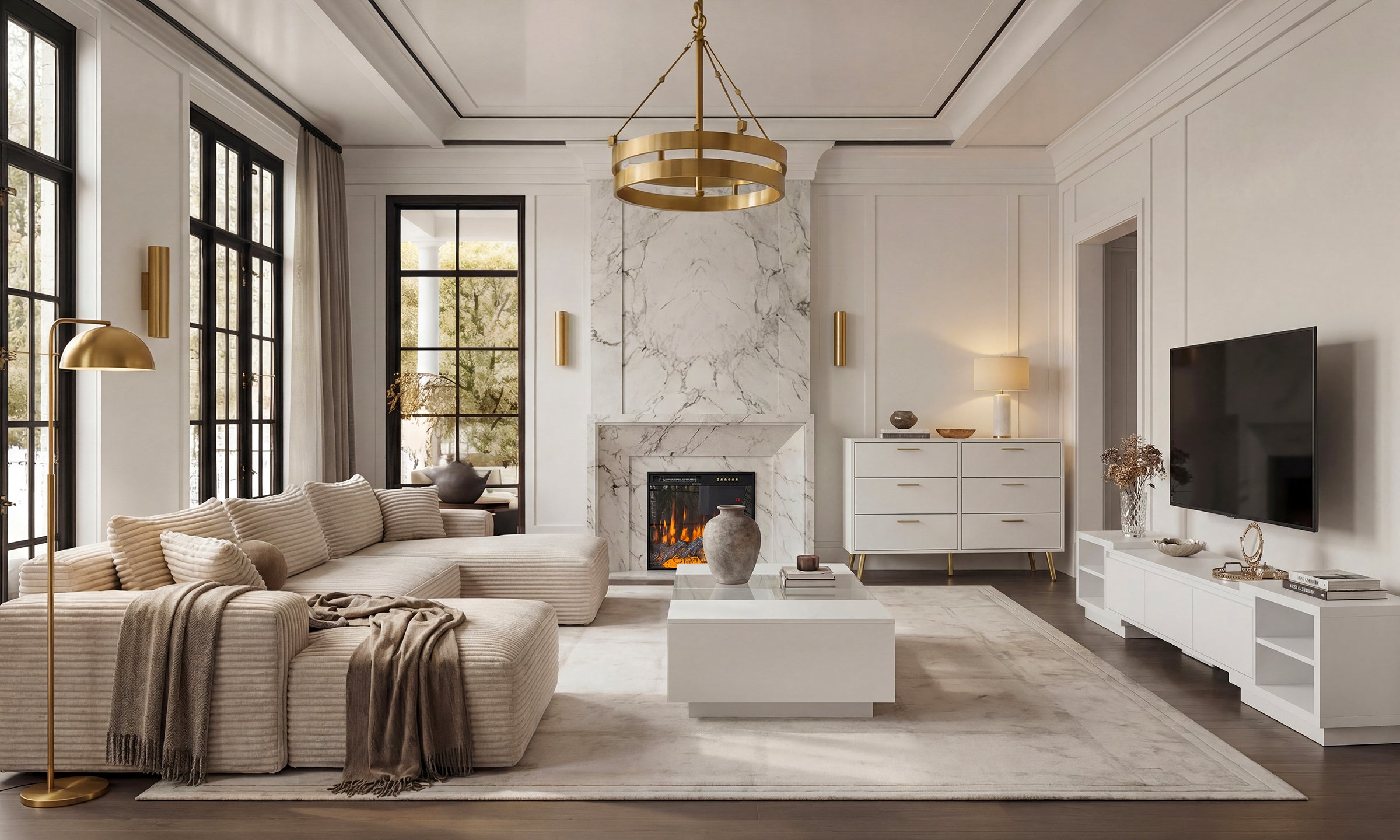
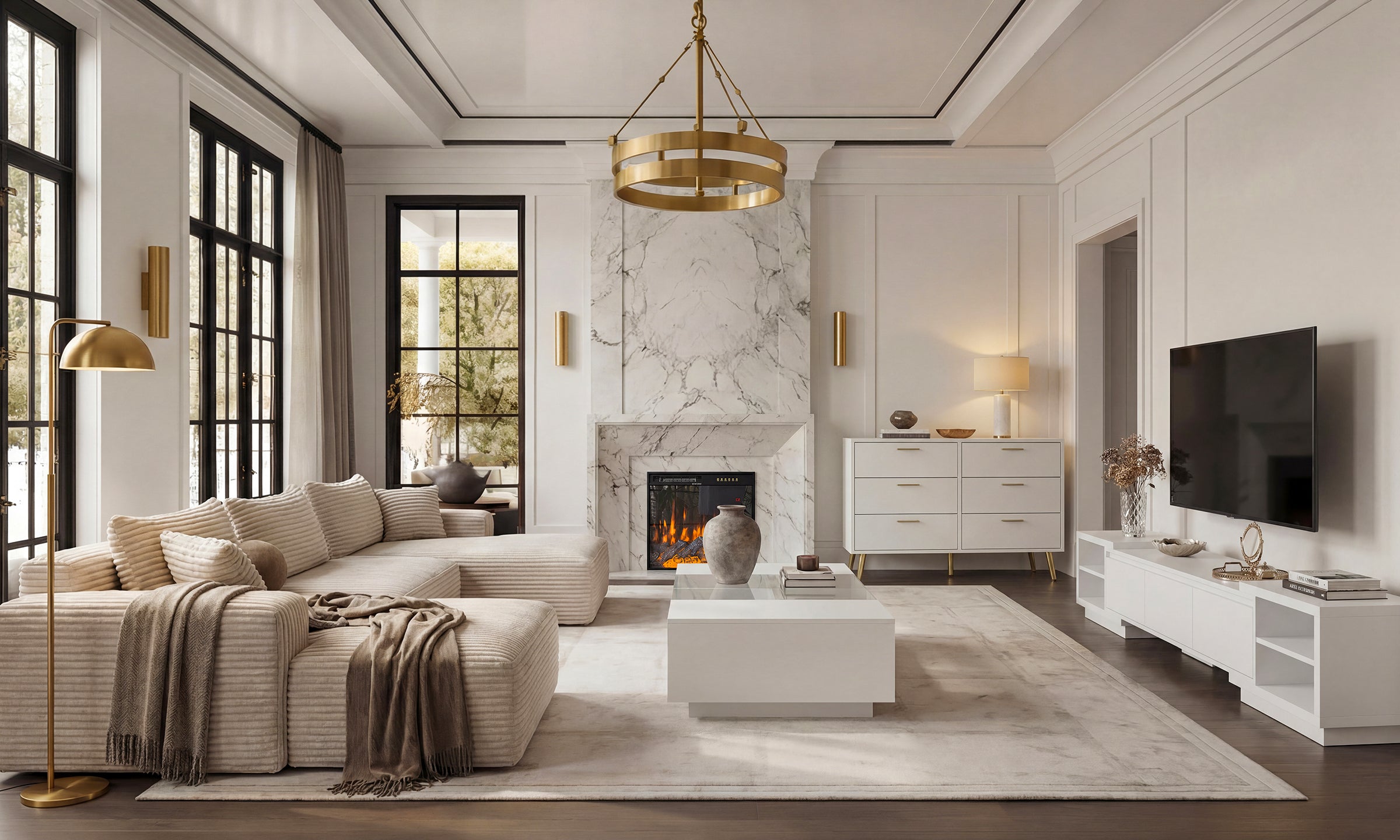
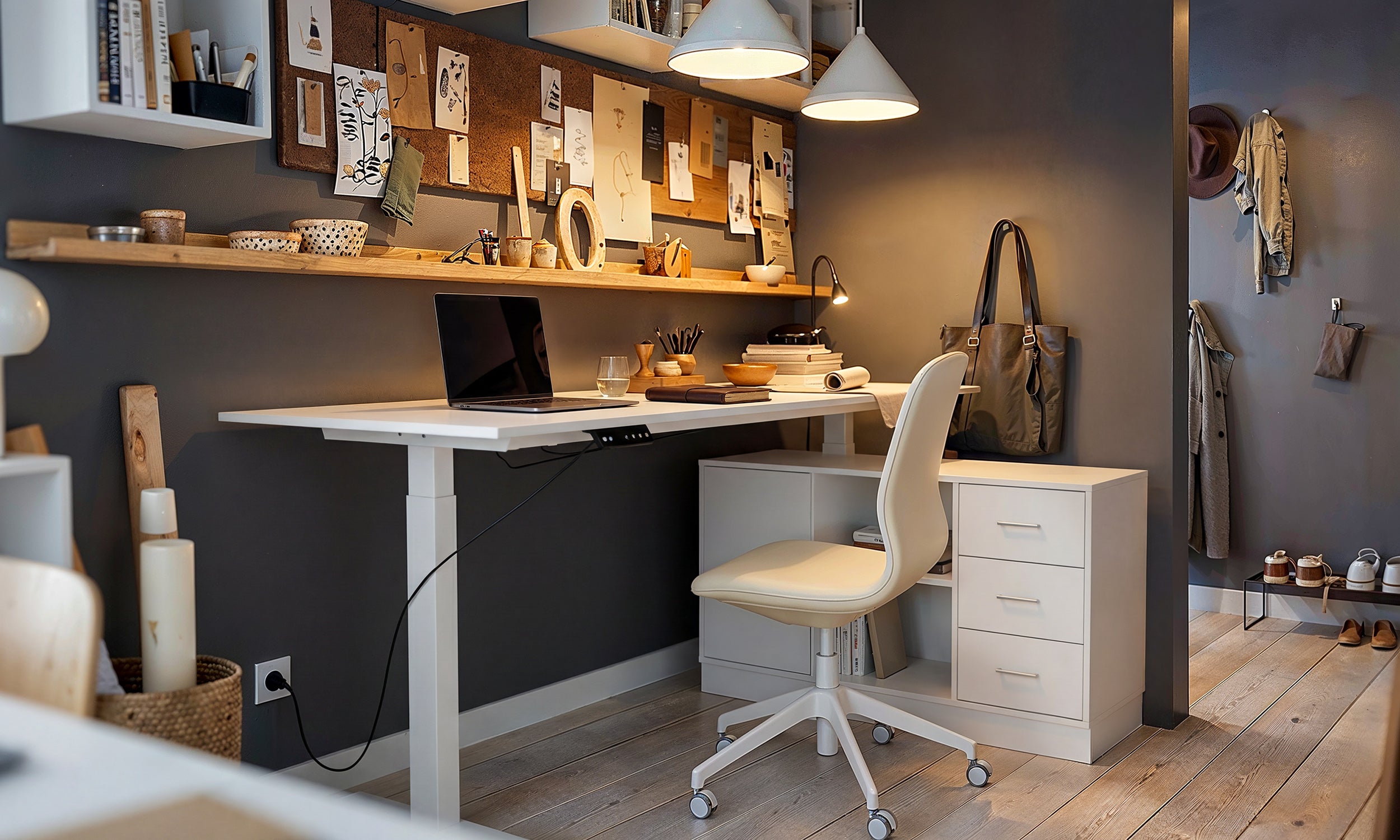
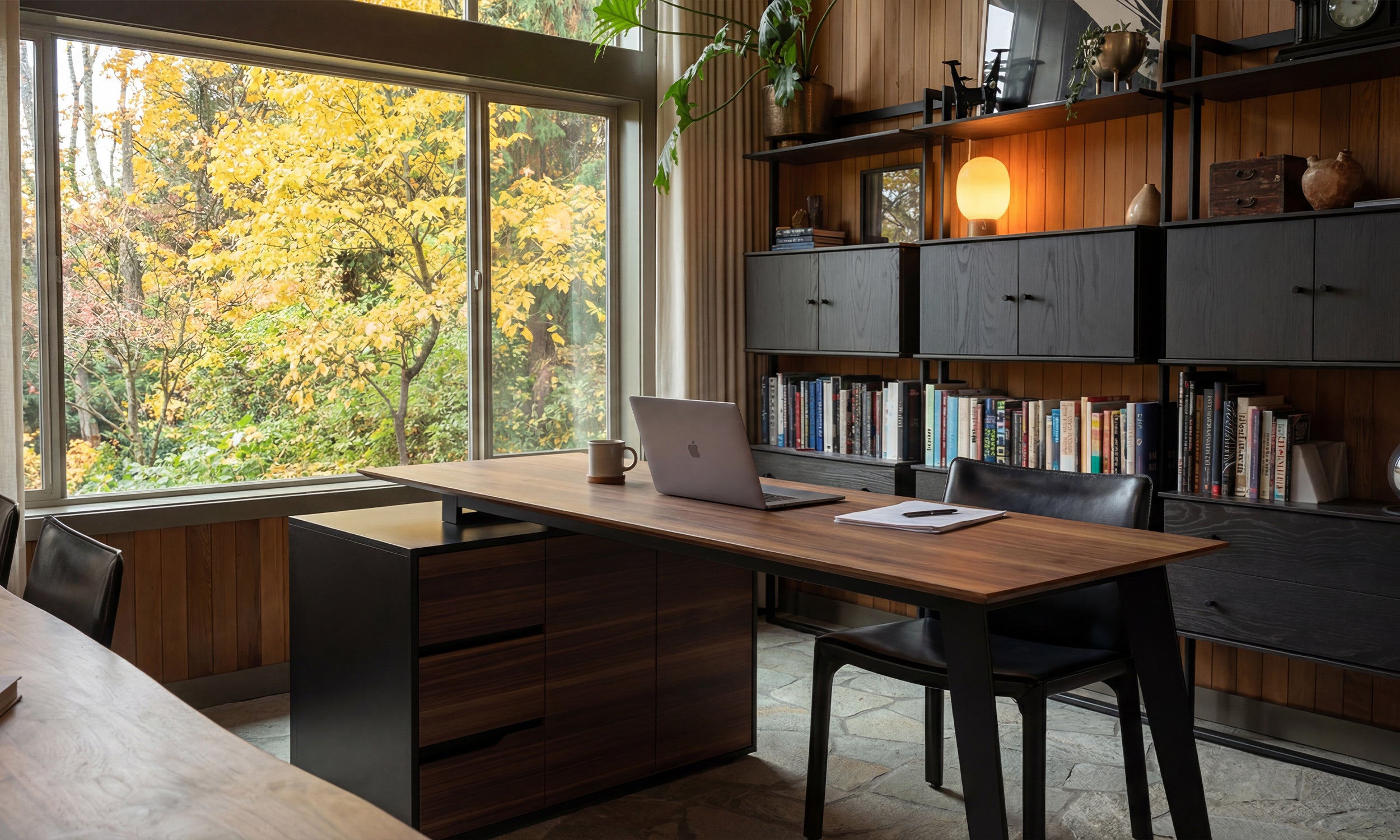


An armoire desk, also called a computer armoire, is a tall cabinet whose doors close over a work surface, shelves and often a pull-out keyboard tray. It suits a living room or bedroom office that has to disappear at the end of the day. Its limits are a shallow work surface, the monitor width that fits between the side panels, legroom, and heat when electronics run inside a closed cabinet.
One thing to know up front: none of the desks FUFU&GAGA sells closes fully behind doors. The picks below are the closest alternatives in our home office collection, and each says plainly what sits behind doors and what stays in view.
Quick answer
- Monitor fit: a 24-inch monitor is about 21.3 inches wide and a 27-inch about 24.1. Two side by side need 42.6 or 48.2 inches between the side panels.
- Floor space: a hinged door swings out by its own width, and a rolling chair needs 36 to 42 inches.
- Viewing distance: at least 20 inches from eye to screen, which is why shallow armoires use a pull-out tray.
- Heat and safety: shut the computer down before closing the doors, and anchor the cabinet to the wall.
What is an armoire desk?
An armoire desk is "a writing-table built within a large cabinet, usually 1.5–2.0 metres (5–7 feet) high", closed by two to four full-height doors that keep out dust and hide the cluttered work surface (Wikipedia, Armoire desk).
"Computer armoire", "armoire computer desk", "office armoire" and "armoire with a hidden desk" all describe the same piece. Cable holes connect the equipment stored above and below the main surface, and modern versions add slide-out surfaces for a keyboard and mouse. There are two basic designs:
- Fixed work surface. It stays in place when the doors close, so you can shut the cabinet on work in progress.
- Movable or hinged surface. An armoire with a pull-out desk or fold-down front gives more room to work, but the surface must be cleared before the doors will shut.
Two related forms keep the desk in the open and put only the storage behind doors. They are what we stock:
| Form | What the doors cover | Work surface |
|---|---|---|
| Armoire desk (computer armoire) | Everything: surface, shelves, equipment | Inside the cabinet, often with a pull-out tray |
| Desk with hutch | Some hutch cabinets and drawers | Open, full desk depth |
| Storage cabinet with a desk bay | The storage around the desk | Open bay, as deep as the cabinet |
Who is an armoire desk right for?
An armoire desk is right for a desk that shares a room. In a living room, bedroom or guest room, closing the doors ends the workday and takes the monitor and paperwork out of view. Shelves above the surface put wall height to work.
It is the wrong choice for a full workday at two large monitors. The desk can be no deeper than the cabinet, a second screen either fits between the side panels or it does not, and legroom is often tight. OSHA says leg clearance under a desktop should generally be 20 to 28 inches high and stay free of files, CPUs, books and storage (OSHA, Desks).
How wide must an armoire desk be for one or two monitors?
An armoire desk must be wider inside than your monitor, or pair of monitors, measured between the side panels and clear of the door hinges. These figures are from one maker's spec pages; check your own.
| Monitor | Width | Height with base | Base depth | Two side by side |
|---|---|---|---|---|
| 24-inch class (BenQ GW2490) | 21.3 in | 16.1 in | 7.2 in | 21.3 x 2 = 42.6 in |
| 27-inch (BenQ GW2790) | 24.1 in | 17.7 in | 7.2 in | 24.1 x 2 = 48.2 in |
Measure three things inside the cabinet:
- Inside width. An armoire desk for 2 monitors needs 42.6 inches for a pair of 24-inch screens and 48.2 inches for a pair of 27-inch screens. OSHA advises that monitors sit no farther than 35 degrees to the left or right (OSHA, Monitors).
- Height above the surface. A shelf above must clear the monitor on its base: 16.1 to 17.7 inches here, more with a monitor arm.
- Closing depth. The monitor base and its cables must sit behind the line of the closed doors.

How deep and how high should the work surface be?
The work surface should be deep enough to keep the screen at least 20 inches from your eyes. OSHA's preferred viewing distance is 20 to 40 inches, with the top of the screen at or slightly below eye level.
Depth is where armoires struggle. In a cabinet 15.7 inches deep, a monitor base 7.2 inches deep leaves 15.7 - 7.2 = 8.5 inches in front for a keyboard, with nowhere to rest your forearms. A pull-out tray or fold-down front adds working depth and moves you back from the screen. OSHA says a keyboard tray should adjust in height and tilt, leave leg and foot clearance, and have space for a keyboard and a mouse (OSHA, Keyboards).
For height, Dimensions.com, an architectural drawing reference, gives desks 28 to 30 inches (office workstation clearances), and the Wikipedia entry puts modern armoire desks at 30 inches. A fixed surface cannot adjust, so compare its listed height with the desk you use now.
Armoire desk doors: which type, and how much floor space?
An armoire desk with doors needs clear floor in front equal to the door width, plus room for the chair. A cabinet 36 inches wide with two hinged doors has doors 18 inches wide (36 / 2). Each sweeps a quarter circle with an 18-inch radius and, opened square to the cabinet, stands 18 inches into the room.
| Door type | Space when open | Watch for |
|---|---|---|
| Hinged pair | Each door swings out by its own width | Open doors stand beside your chair and can block side light, unless the hinges let them fold back flat against the sides |
| Bifold | About half the door width (18 / 2 = 9 inches) | More hinges to keep aligned |
| Pocket doors | None: the doors slide back into the cabinet | The pockets use inside width |
Then add the chair. Dimensions.com allows 36 to 42 inches behind a desk for a chair that rolls back, measured from the front edge of the surface or the extended tray. A cabinet 15.7 inches deep needs 15.7 + 36 = 51.7 inches from the wall; a desk unit 21.1 inches deep needs 21.1 + 36 = 57.1 inches.
A computer armoire with pocket doors avoids the swing altogether. With a corner armoire, check that both doors clear the two walls.
Cords, heat and ventilation inside a computer armoire
A computer should not run inside a closed armoire. Lenovo's safety guidance is direct: "Do not store or operate your computer inside furniture, as this might increase the risk of overheating." It adds that air flowing into the computer should not exceed 95 degrees F (35 degrees C) (Lenovo, Heat and product ventilation). Check the manual for your own machine. In practice:
- Work with the doors open, and shut the computer down before you close them.
- Keep a tower out of a sealed compartment and never block its vents.
- Look for cable holes and an open or vented back panel, so cords leave the cabinet without being pinched in a door.
For power, the CPSC says extension cords should only be used temporarily, should not run under furniture, and may be overloaded if any part feels hot in use (CPSC safety alert). Place the armoire where its equipment can reach a wall outlet.
Will a computer armoire fit a small space?
A computer armoire for a small space works when the wall can hold its width and the floor can hold its depth plus the chair: about 52 inches from the wall for a 15.7-inch-deep unit and about 57 inches for a 21.1-inch-deep one. Our small home office dimensions guide works through full room sizes.
In a bedroom, keep the door swing and the chair out of the path to the bed; our desk in a small bedroom guide has the walkway clearances. Shelves above the surface shade it, so plan for a built-in light or a lamp.
Can you turn a wardrobe or armoire into a desk?
Yes, a wardrobe or clothing armoire can become a simple laptop station, but only within what the piece was built to carry.
- Use a shelf as the surface only if its weight limit is listed, and stay under it.
- Do not remove fixed shelves, dividers or the back panel. They hold the cabinet square. Move a shelf only if it is adjustable.
- Check legroom. A wardrobe has no kneehole, so you sit with your knees outside it. That suits short laptop sessions, not a full workday.
- Run cords through an existing opening or work with the doors open. Never shut a running computer inside.
- Anchor it to the wall, as with any tall furniture.
Tip-over safety for tall desk cabinets
Tall desk cabinets should be anchored to the wall, the same as bookcases and dressers. The CPSC reports that U.S. emergency departments treated an average of 17,800 tip-over injuries a year from 2020 to 2022 (CPSC, February 2026). Its Anchor It! campaign says: "Anchoring all furniture with drawers, doors, and shelves to the wall prevents tip-over injuries and deaths" (AnchorIt.gov).
The CPSC also advises keeping heavier items on lower shelves. Our guide to anchoring a bookcase to the wall shows the method; it is the same for a desk hutch.
Armoire desk buying checklist
- Inside width and height that clear your monitor: over 21.3 inches wide for one 24-inch screen, 24.1 for one 27-inch, 42.6 or 48.2 for two.
- Surface height near 28 to 30 inches, with 20 to 28 inches of open leg clearance.
- Depth or a pull-out tray that keeps the screen 20 inches or more from your eyes.
- Door type matched to your floor: door width in front, plus 36 to 42 inches for a rolling chair.
- Cable holes and an open or vented back, within reach of a wall outlet.
- Weight limits stated in the listing, and anti-tip hardware in the box or a plan to buy your own.
Our picks: the closest alternatives to an armoire desk
None of these closes fully behind doors. On every FUFU&GAGA piece below, the work surface stays in view and the doors cover the storage around it. The three tall pieces are 62 inches wide or more; the fourth is the small-room option. If the whole workspace must vanish, you need a true armoire desk; if hiding the supplies and files is enough, these do that. Outside sizes come from each listing's spec table; measurements marked "diagram" come from its size diagram.
Office Storage Cabinet With Desk, 4 Drawers and 6 Doors
The nearest in form to an armoire: a cabinet wall with a desk bay set into it. The spec table gives 62.4 inches wide, 15.7 inches deep and 78.7 inches high; the diagram shows 63 inches wide, so allow 63. The diagram gives the desk bay as 30.4 inches wide, with 30 inches above the surface and 25.5 inches of leg clearance below.
Behind doors: seven adjustable shelves rated at 40 lb each, behind six hinged doors. In the photos four doors have clear panes, so their contents stay visible, and two are slatted. Four drawers add closed storage. Open: the desk bay. A tipover restraint is included.
Best for: a laptop or one monitor on a living room wall, with supplies behind doors.
Skip it if: you want two monitors or a full-depth desk. At 15.7 inches deep the bay suits a laptop best. The drawers are listed at 6 inches high, so check before planning on hanging files.
62.2" Traditional Writing Desk with Bookcase, 9 Drawers and LED Lighting
The look of a classic armoire desk, with the desk left open. It is 62.2 inches wide, 21.1 inches deep and 82.7 inches high, with a 59.1-inch-wide desktop. The diagram shows 52.8 inches between the hutch sides and 19.5 inches of clear height under the hutch.
Behind doors: the hutch cabinets (two solid doors in the photos), plus nine drawers with safety stops. Open: the desktop and the center hutch shelves. The built-in LED lights switch between warm, natural and cool, and the listing says wall anchoring hardware comes in the box.

Best for: a study or living room where the desk should look like furniture. Two 27-inch monitors (48.2 inches) fit the 52.8-inch opening.
Skip it if: you want to stretch out or raise a monitor on an arm under the 19.5-inch hutch clearance. The diagram shows a kneehole 23.2 inches wide and 24.2 inches high, and the listing does not state the desktop height.
68.5" Modern White Standing Desk with Hutch and Storage Cabinet
A sit-stand desk joined to a storage hutch in an L shape, 68.5 inches wide and 55.1 inches deep overall. The desktop is 31.5 inches deep and rises from 29.5 to 44.5 inches. The hutch is 68.9 inches high, 55.1 inches wide and 15 inches deep, and installs on the left or the right.
Behind doors: glass-door cabinets, where contents stay visible, and two lower cabinets, plus three drawers. Open: the desktop and the hutch compartments.

Best for: standing for part of the day with supplies put away. The 31.5-inch depth makes the 20-inch viewing distance easy.
Skip it if: the desk must be hidden, or exact desktop width matters for your monitors: the listing is unclear on it, so confirm before ordering. It does not mention anti-tip hardware, so plan your own wall anchor for the hutch.
55.1" Modern White Corner Computer Desk with Large Storage
The small-room option, and not an armoire: a low desk with one closed cabinet. As an L it is 55.1 inches wide, 41.3 inches deep and 29.5 inches high, with a 55.1-inch by 23.6-inch desktop rated for 200 lb. The two sections rotate into an L, a straight line, or an overlapped position that saves space.
Behind doors: one soft-close cabinet, plus one drawer. Open: the desktop and two shelves.
Best for: a bedroom or studio where a tall cabinet would crowd the wall.
Skip it if: you want storage above the desk or anything close to a closed-up office. Monitor and paperwork stay in view.
The four picks compared
| Pick | W x D x H | Work surface | Behind doors |
|---|---|---|---|
| Office storage cabinet with desk | 62.4 x 15.7 x 78.7 in | 30.4 in bay (diagram) | Shelves behind 6 doors |
| 62.2" traditional writing desk | 62.2 x 21.1 x 82.7 in | 59.1 in wide | Hutch cabinets |
| 68.5" standing desk with hutch | 68.5 x 55.1 in; hutch 68.9 in high | 31.5 in deep | Glass-door and lower cabinets |
| 55.1" corner desk | 55.1 x 41.3 x 29.5 in | 55.1 x 23.6 in | One cabinet |
See these and the rest of the desks, hutches and office cabinets in the FUFU&GAGA home office collection.
FAQ
Can an armoire desk hold two monitors?
Only if it is wide enough inside. Two 24-inch monitors need about 42.6 inches between the side panels and two 27-inch monitors about 48.2 inches, based on monitors 21.3 and 24.1 inches wide. Measure inside the hinges, and check the height under any shelf above the surface.
How does an armoire with a pull-out desk work?
An armoire with a pull-out desk has a surface or keyboard tray on slides that extends into the room when the doors are open and pushes back before they close. It adds working depth to a shallow cabinet, and it has to be cleared before the doors can shut.
Is it safe to close the doors with the computer on?
Not while it is running. Lenovo's safety guidance says not to store or operate a computer inside furniture because of the overheating risk; check the manual for your own machine. Shut the computer down before closing the doors, and keep its vents clear while it works.

Leave a comment
This site is protected by hCaptcha and the hCaptcha Privacy Policy and Terms of Service apply.