

















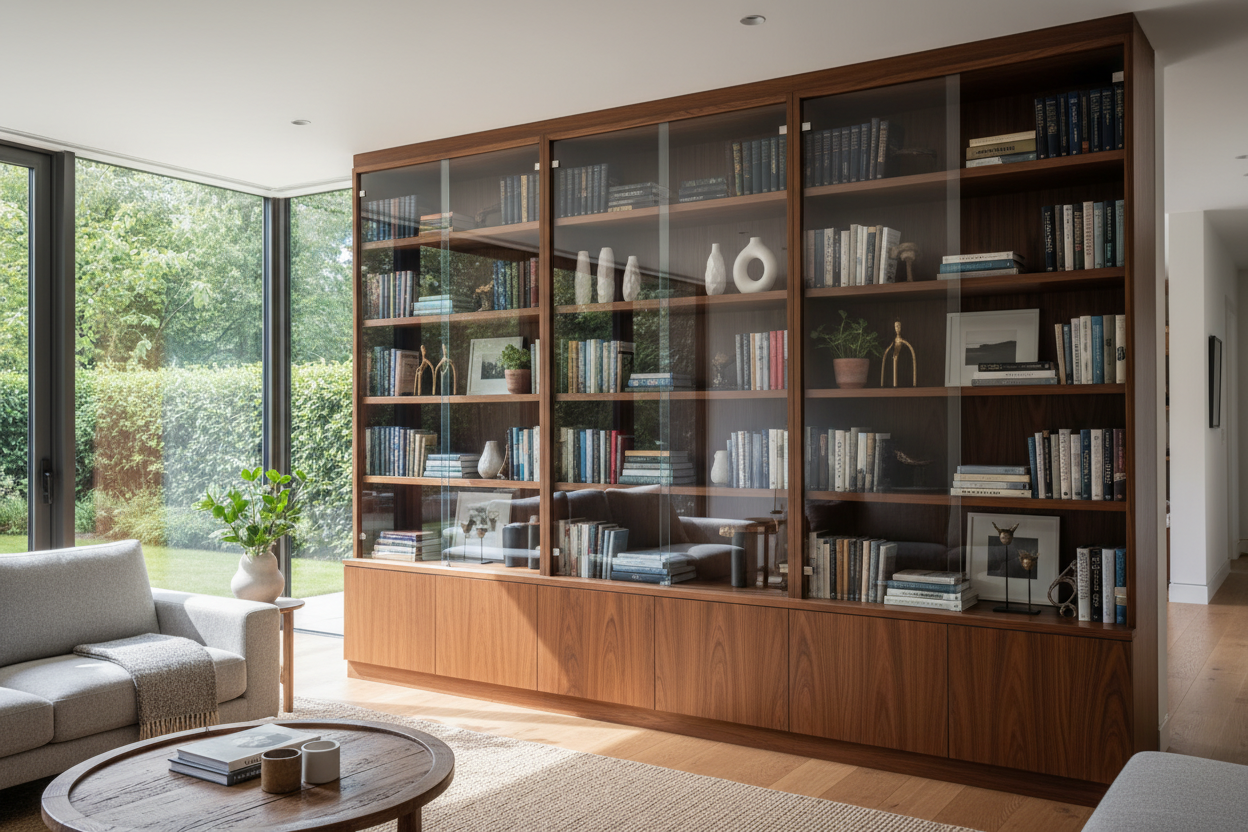
I spent years thinking that if I just bought more shelves, my clutter would magically become a 'collection.' It didn't. Instead, my living room looked like a disorganized used bookstore where everything was covered in a fine layer of gray dust. When I finally swapped my open shelving for a glass bookcase cabinet, I realized that doors change the entire psychological game of storage.
Quick Takeaways
- Stick to the 60/40 ratio: 60% items, 40% empty space.
- Place heaviest items on the bottom third to anchor the unit.
- Use adjustable shelves to avoid 'dead air' gaps above books.
- Mix textures like wood, brass, and greenery to offset the coldness of glass.
Why Enclosed Shelves Change the Styling Math
Adding glass doors to a shelf is like putting a frame around a painting. It immediately signals that whatever is inside is intentional. This is why a glass bookshelf cabinet requires a different strategy than a standard open unit. On an open shelf, things can spill over the edges or look a bit casual; behind glass, every tilted book or plastic toy looks like it is on display at a museum.
I’ve heard people argue that a wood bookcase with glass doors too dated for a contemporary home, but that’s a total myth. The reality is that glass-front units are the most practical way to display high-value items without spending your Saturdays with a microfiber cloth. It turns a simple storage piece into a glass case bookshelf, elevating the contents from 'stuff' to 'curated objects.'
The 60/40 Rule: Books vs. Breathing Room
The biggest mistake I see is the 'stuffing' method. You have a wood and glass bookcase, so you fill every square inch of the wood glass bookcase with books. Suddenly, the room feels five feet smaller. To keep the look airy, you need to follow the 60/40 rule: 60 percent of your shelf space should be occupied by books and large objects, while 40 percent is left as negative space.
This 'breathing room' allows the eye to rest. If you have a wood bookcase with glass shelves, the transparency of the shelves themselves helps, but you still shouldn't crowd them. Group your books by color or size, and then leave a gap. That gap is where the magic happens—it makes the items you actually kept look important rather than just crammed in.
Ground the Bottom, Lighten the Top
Visual weight is real. If you put a row of heavy, dark encyclopedias at the top of a tall glass bookcase, the whole thing will feel like it’s about to topple over onto your coffee table. You want to 'ground' the piece. Put your massive art books, heavy ceramic crocks, or storage baskets on the bottom two levels.
A piece like this vintage wood bookcase with tempered glass doors is perfect for this because it often features a solid bottom drawer or a thicker base. As you move up the glass case bookshelf, the items should get smaller and lighter. Think delicate glassware, thin paperbacks, or a single small sculpture. This gradient of weight keeps the piece from feeling top-heavy.
Warming Up the Hard Edges
Glass and wood are great, but they can feel a bit 'hard' if you don't balance them out. A wooden bookcase with glass shelves is essentially a box of rectangles. You need organic shapes to break up those lines. I always tell people to add something that 'grows'—even if it's just a high-quality faux trailing plant like a pothos.
If you are styling a large freestanding wood bookcase, use the 40% 'breathing room' to tuck in a piece of unglazed pottery or a stack of vintage brass bells. These textures absorb light, whereas the glass reflects it. This contrast is what makes a room feel lived-in and cozy rather than like a sterile furniture showroom.
The Secret Weapon: Staggered Heights
Nothing kills the vibe of a wood bookcase with glass shelves faster than perfectly symmetrical, evenly spaced shelves. It looks like a grocery store aisle. If your unit allows it, always opt for adjustable shelf storage. I like to set one shelf high enough for a 14-inch vase and the next one low enough for a horizontal stack of books.
Staggering the heights creates 'vignettes.' Instead of one long line of books, you have a series of small, interesting scenes. It makes a standard manufactured piece look like a custom-built architectural feature. It’s also practical—I once bought a beautiful glass cabinet only to find my favorite photography books were half an inch too tall for the fixed shelves. I had to store them sideways, and it bothered me for three years until I finally replaced the unit.
My Honest Mistake
I once bought a gorgeous, dark espresso glass cabinet for my small apartment. It looked stunning in the 2,000-square-foot showroom. In my 600-square-foot living room? It looked like a black hole. I didn't account for how much light the dark wood would soak up. I eventually had to install battery-operated puck lights inside just so I could see my books. If you have a small space, go for a lighter oak or a walnut finish—don't go too dark unless you have massive windows.
FAQ
Is glass shelving safe for a lot of books?
Tempered glass is incredibly strong, but it has limits. Most 6mm glass shelves are rated for about 20-25 lbs. If you have a massive collection of heavy hardcovers, stick to a wooden bookcase with glass shelves where the frame does the heavy lifting.
How do I prevent glare on the glass?
Position the cabinet perpendicular to your windows rather than directly opposite them. If you're still getting reflections, interior cabinet lighting actually helps 'push' the light out, making the glass appear more transparent from the outside.
Should I organize books by color?
Only if it makes you happy. Personally, I think a strict rainbow order looks a bit 2015. I prefer organizing by category (fiction, history, art) but keeping the heights somewhat consistent within those groups to avoid visual chaos.

Leave a comment
This site is protected by hCaptcha and the hCaptcha Privacy Policy and Terms of Service apply.