
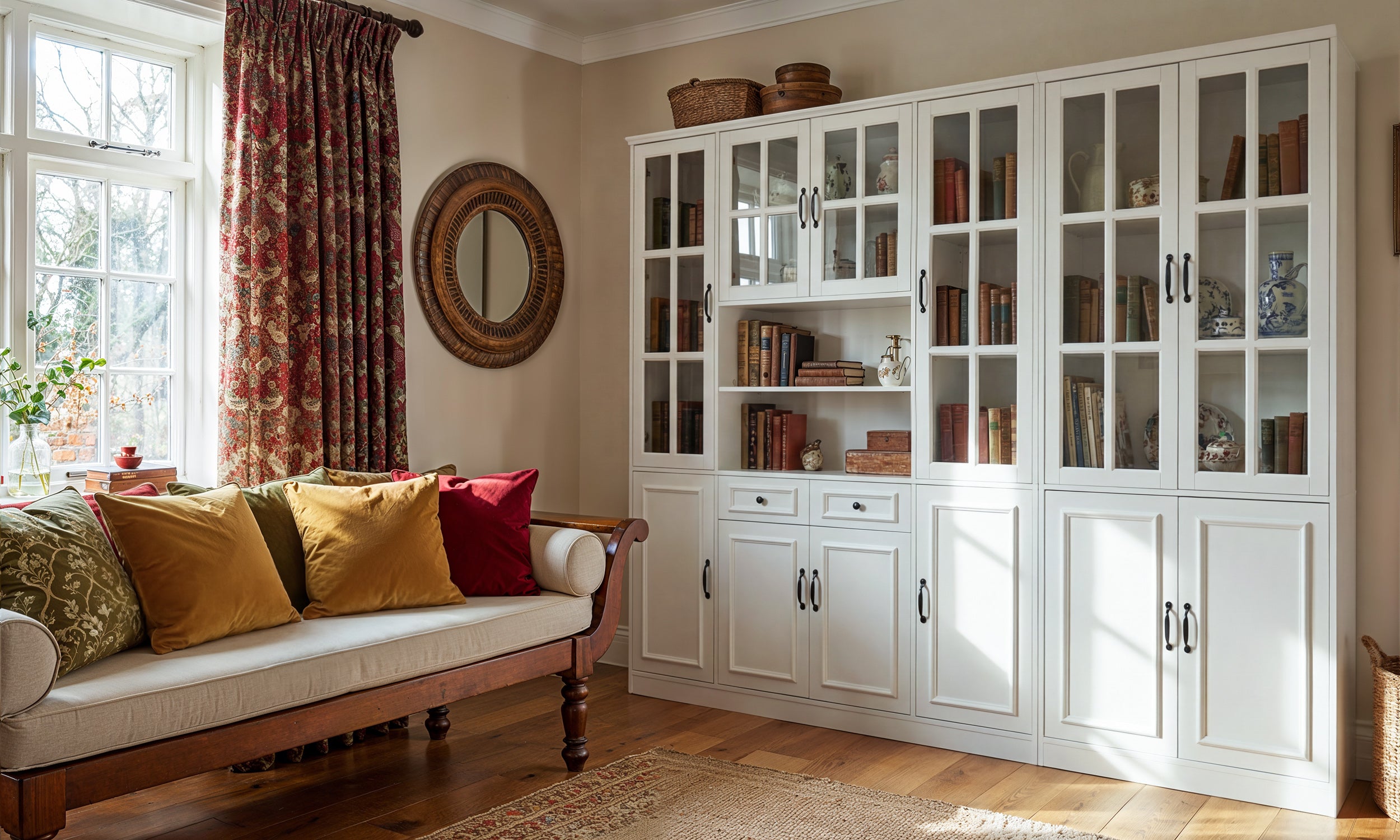



A hallway bookshelf works when it is shallow enough to leave a clear walkway and is anchored to the wall. Plan on keeping about 36 inches of floor clear between the front of the bookcase and the opposite wall, so the deepest bookcase a hall can take is its width minus 36 inches: a 48-inch hall fits a bookcase about 12 inches deep, and a 46-inch hall fits one about 10 inches deep. Most paperbacks and standard hardcovers need only 4.5 to 6.5 inches of shelf depth, so a shallow bookcase for a hallway gives up very little.
This guide is for apartments, townhouses and any home where the only free wall is in a hall or by the front door, and for readers searching for a place to put the books that no longer fit in the living room. Below: the arithmetic, shelf depth for books, tall vs low, glass doors, lighting, styling and anchoring, then five picks with the hallway width each needs. To compare sizes while you read, open the FUFU&GAGA book and media storage collection.
Key takeaways
- Hallway width minus bookcase depth equals your clear path. Aim for 36 inches or more.
- Book depth is small: a mass-market paperback is about 4.25 to 4.4 inches wide and a standard US hardcover about 6 inches, and that width is the depth it takes on a shelf.
- Low units double as a drop zone in an entryway; tall units hold more books on the same floor area.
- Anchor every hallway bookcase. A shallow, tall bookcase tips more easily than a deep, low one.
Can you put a bookshelf in a hallway?
Yes, if the hall is wide enough to keep a comfortable path after the bookcase goes in. The U.S. Access Board's guide to the ADA Standards gives a minimum 36-inch continuous clear width for accessible routes, which may narrow to 32 inches only at points such as doorways, for no more than 24 inches (U.S. Access Board). Those rules apply to public buildings, not private homes. For houses, the 2021 International Residential Code sets a minimum hallway width of 3 feet under Section R311.6, according to this code summary (Building Code Trainer). So a home hallway can be as narrow as 36 inches, and in a hall that narrow any bookcase on the side wall cuts the path below what the code starts from.
For those halls, look at the alternatives. Wall-mounted shelves hung high on the wall keep the floor completely clear, and a recessed hallway built-in sits flush with the wall, though both are a carpentry project with its own cost. For renters, a freestanding slim bookcase on a wider stretch of wall, or at the end of the hall, is the flexible choice.
How deep should a hallway bookcase be?
Measure the hall wall to wall at floor level and at hip height, then subtract 36. Here is the arithmetic, with what fits from the FUFU&GAGA range.
| Hallway width | Deepest bookcase for a 36 in path | What fits from our range |
|---|---|---|
| 42 in | 6 in | No floor bookcase; wall shelves or the end wall |
| 44 in | 8 in | Still no floor bookcase in our range |
| 46 in | 10 in | Low 3-tier open bookshelf, 9.4 in deep (leaves 36.6 in) |
| 48 in | 12 in | Arched bookcase 10.6 in, slim glass-door bookcase 11.5 in, wide open bookcase 12 in |
| 51 in | 15 in | Varda lighted glass-door cabinet, 14.2 in |
| 52 in or more | 16 in | Most standard bookcases, about 15.5 to 15.7 in deep |
Three things eat into that number. Baseboards push a bookcase away from the wall, so measure the depth from the wall surface, not the baseboard, and add the gap. Door swings matter too: a bedroom or closet door that opens into the hall needs to clear the bookcase, and the bookcase's own hinged doors stick out into the path by roughly their width while open. Light switches, vents and thermostats must stay reachable, so mark them before you shop.
The old rule of thumb for a thin bookcase for hallway use, 10 inches deep or less, matches the arithmetic for a 46-inch hall. If two people often pass each other, keep more: the same Access Board guide sizes a passing space at 60 by 60 inches.
How shallow can bookshelves be for books?
Books stand spine out, so the width of the cover becomes the depth a book needs on the shelf. Standard sizes come from Wikipedia's book size and paperback pages (cover sizes; trimmed pages are slightly smaller):
| Book type | Cover width x height | Shelf depth it needs |
|---|---|---|
| Mass-market paperback | about 4.25 to 4.4 x 6.5 to 7 in | about 4.5 in |
| Smaller trade paperback, crown octavo | 5.1 to 5.4 x 7.75 to 8 in | about 5.5 in |
| Standard US hardcover (octavo) | 6 x 9 in | 6 in |
| Royal octavo | 6.25 x 10 in | 6.25 in |
| Quarto: large art and photo books | 9.5 x 12 in | 9.5 in |
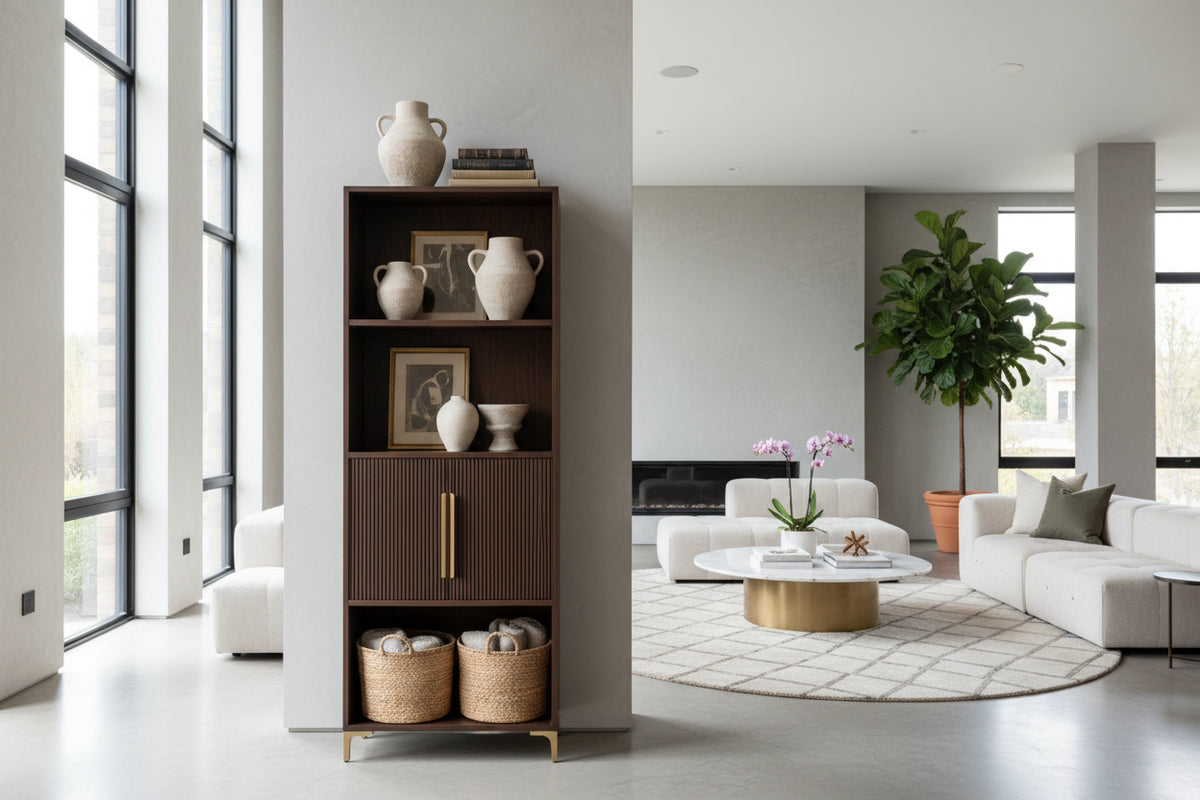
So the minimum depth for a bookcase that holds a normal mixed library is about 6.5 inches of usable shelf, enough for everything up to royal octavo. Shelves 10 inches deep or more take oversized books lying flat or standing up. Every shallow unit in our picks below, from 9.4 to 14.2 inches deep, clears a standard hardcover with room to spare. For full height, width and depth charts, see our bookcase dimensions guide.
Tall or low: which hallway bookcase design works better?
A tall bookcase stores the most books per square foot of floor. Along a long hall, a row of tall narrow units can read like a hallway built-in, and tall shelves draw the eye up, which can make a low ceiling feel taller. The trade-off: weight sits high, so anchoring is essential.
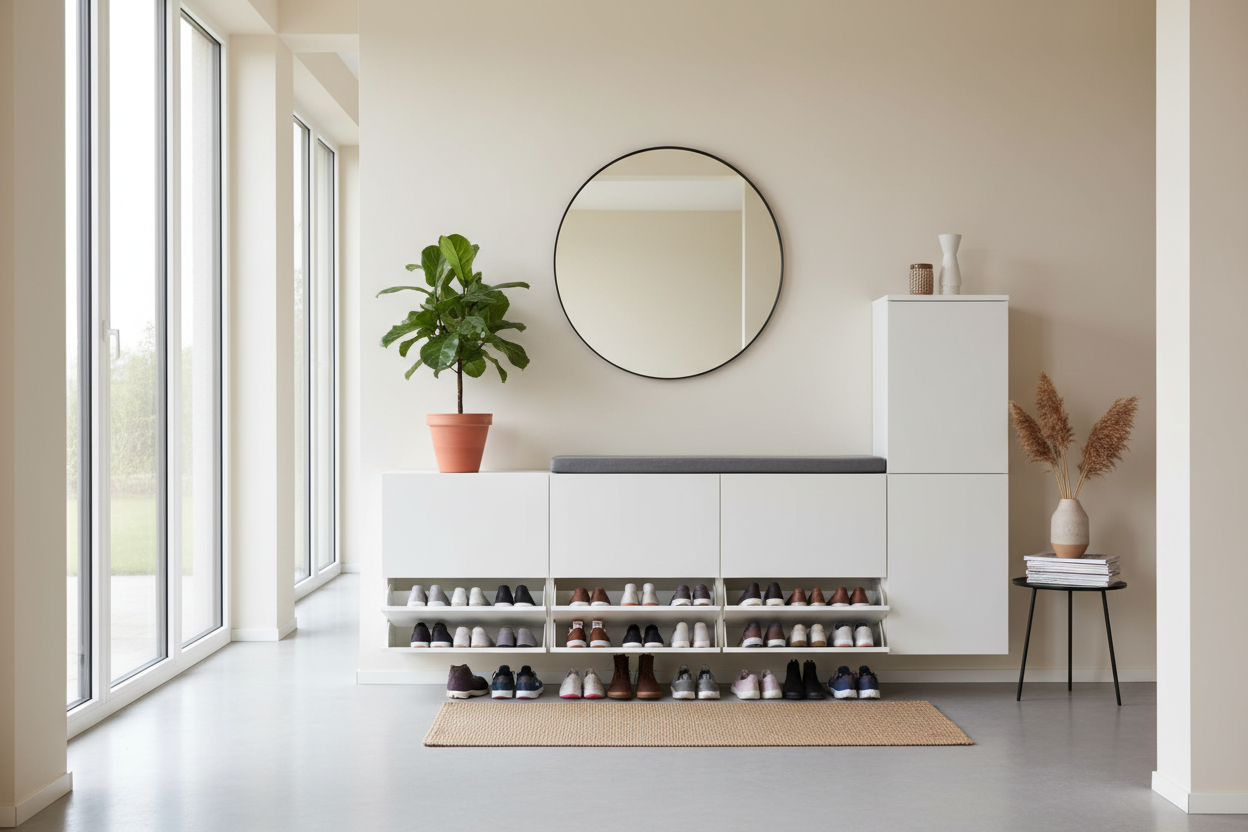
A low bookcase, about waist height like our 41-inch 3-tier unit, gives you something a tall unit can't: a top surface at hand height. In an entryway that top becomes the drop zone for keys, mail and sunglasses, with books below. A mirror or art above it keeps the wall from looking empty.
A practical entryway bookshelf idea: books and display pieces up top, daily things lower down, with baskets on the bottom shelf for shoes, dog leashes or winter gear. If the entry needs real shoe and bag storage, a shallow cabinet may suit it better than a bookcase; our narrow entryway cabinet guide covers those.

Open shelves or glass doors in a dusty entry?
An entry gets more dust and grit than most rooms. Open shelves are quick to use and feel light, but need regular dusting. Glass doors keep dust off the books while leaving them on view, which suits collectible editions or anything you don't reach for every day.
A hinged glass door needs swing room, so check it against the path and any door opposite. And glass alone isn't sun protection: the Library of Congress notes that light damage to paper is cumulative and that sunlight is high in UV, which drives fading and yellowing (Library of Congress). Keep spines out of direct sun from a hall window either way. Hinged vs sliding doors, glass types and shelf ratings are covered in our bookcase with glass doors guide.
Lighting a hallway bookshelf
One overhead fixture lights the floor and leaves shelves in shadow. Ways to fix that:
- Built-in lights: some display bookcases have LED strips behind glass doors. Plan an outlet nearby and a route for the cord that doesn't cross the walkway.
- Battery puck or strip lights under a shelf need no wiring at all, which suits a rental or a hall with no outlet where you want it.
- A small lamp on a low bookcase gives a warm glow at the end of the day, if there is an outlet close by.
Hallway bookshelf ideas: styling a narrow space
A cluttered shelf in a narrow space feels heavy, so keep styling simple:
- Leave negative space. Empty spots on a few shelves let the eye rest as you walk past.
- Group books by color or size to cut visual noise along a long wall.
- Contain small things. Keys, sunglasses and mail go in trays or bowls so the shelves don't look messy.
- Match the wall. A bookcase in the same color as the wall, white on white for example, recedes into the architecture and leaves the books on display; black or a wood tone against a light wall makes it a design feature.
- Use the end of the hall. An end-of-hallway bookshelf faces you as you walk, so it doesn't narrow the path, and it can be deeper than a side-wall unit.
- Face a few books out. Picture ledges show covers like art and take very little depth.
- Use boxes and baskets. On open shelves they hide toys, papers, gloves and chargers, which is a lot tidier than loose things.
- Add a little life. A plant, framed photos or one piece of art per shelf is enough to decorate a hall; remember the path stays the priority.
Anchoring and safety in a high-traffic hall
A hallway bookcase gets bumped by bags, laundry baskets and children running past, and a shallow bookcase has a small base for its height. A quick comparison is height divided by depth. It's arithmetic, not a safety rating, but the higher the number, the more the bookcase relies on its anchor:
| Bookcase | Height x depth | Height ÷ depth |
|---|---|---|
| Low 3-tier open bookshelf | 40.9 x 9.4 in | 4.4 |
| Varda 47 in lighted glass-door cabinet | 78.7 x 14.2 in | 5.5 |
| 15.7 in slim glass-door bookcase | 70.9 x 11.5 in | 6.2 |
| 70.9 in wide open bookcase | 78.7 x 12 in | 6.6 |
| 71 in arched bookcase | 71 x 10.6 in | 6.7 |
Anchor all of them. The U.S. Consumer Product Safety Commission reports an average of 17,800 emergency department visits a year for tip-over injuries from 2020 to 2022, and advises anchoring furniture like bookcases securely to the wall and keeping heavier items on lower shelves (CPSC). Its Anchor It campaign puts it plainly: anchoring all furniture with drawers, doors and shelves to the wall prevents tip-over injuries and deaths (Anchor It).
In a hall, put the heaviest books on the bottom shelf, keep the top for light display pieces, and fix the anchor into a stud where you can. If the baseboard holds the bookcase off the wall, add a spacer block behind the top so the strap doesn't pull it out of plumb. Our step-by-step guide to anchoring a bookcase to the wall covers studs, drywall anchors and strap tension.
Buying checklist for a hallway or entryway bookcase
- Hallway width minus bookcase depth is 36 inches or more, measured at the baseboard and at hip height.
- No door, switch, vent or thermostat is blocked.
- Hinged doors on the bookcase can open without hitting another door.
- Shelf depth is at least 6.5 inches for a normal mix of books, more for art books.
- Compartment height clears your tallest books.
- Low unit if you need a drop zone; tall unit if you need capacity.
- There is a plan to anchor it into a stud or with the right wall anchor.
Our picks: the best shallow bookcases for a hallway
Dimensions and features come from each product's listing. The hallway width shown is the depth plus 36 inches, before door swing.
39.4"-55.1" White 3-Tier Open Bookshelf
The shallowest of these picks, and the low option: about 9.4 inches deep and about 41 inches tall, per the size options and product diagram, in widths of 39.4, 47.2 or 55.1 inches. Three tiers of cubbies hold books and baskets, and the top works as an entryway drop zone. Each shelf holds 25 lb, the back is finished, a tipover restraint is included, and one person can assemble it.
Best for: halls about 46 inches wide or more, and entries that need a console-height surface with books below.
Skip it if: you have large art books; the cubbies are under 9.4 inches deep, so quarto-size books won't stand in them.
71" Mid-Century Milky Yellow Arched Bookcase with Cabinet
A tall bookcase only 10.6 inches deep, with 10-inch-deep shelves: plenty for paperbacks and hardcovers. Compartments are 11.5 inches high, so 12-inch art books lie flat. It is 34.6 inches wide and 71 inches tall, with three open shelves above a closed cabinet that has its own shelf, so the bottom can hide shoes or bags. Shelves hold 44 lb each, the back is finished, and anti-tip hardware is included. The arched crown makes it a natural focal point at the end of a hall.
Best for: halls about 47 inches wide or more, or an end wall where you want a statement piece.
Skip it if: you want a neutral white or wood finish; it comes only in milky yellow. Its height-to-depth figure of 6.7 is the highest here, so it must be anchored.

15.7" Slim White Bookcase with Glass Door
The skinniest unit here: 15.7 inches wide, 11.5 inches deep and 70.9 inches tall, with 11-inch-deep shelves. A glass upper door covers three shelves, and the top one adjusts for taller books; a solid lower door hides two more. Each shelf holds 35 lb, and a tipover restraint is included.
Best for: halls about 48 inches wide with a short free wall, such as between two doorways, and readers who want dust protection.
Skip it if: you have a large collection; each shelf is only 14 inches wide, so it suits a small set of favorites, not a library.
70.9" Tall Bookcase with 3-Cabinet Base and Open Shelves
The high-capacity pick for a long hall: 70.9 inches wide, 78.7 inches tall and 12 inches deep. Twelve open shelves, each 22.8 inches wide and 11.5 inches deep, sit above three cabinets with six fluted doors for files and clutter. A 3-inch base helps on uneven floors, and an anti-tipping device is included. Natural or white finish; the photos show natural.
Best for: a long hall about 48 inches wide or more, or a hallway library with a built-in look.
Skip it if: you plan to load it with heavy hardcovers; shelves are rated 20 lb each, the lowest here. Its six cabinet doors also swing into the hall.
Varda 47" Display Cabinet with LED Lights and Glass Doors
The glass-door pick for a wider hall or foyer, and one of our most-ordered display cabinets. It is 47.2 inches wide, 78.7 inches tall and 14.2 inches deep, with 13.5-inch-deep shelves rated 30 lb each. Six push-to-open glass doors have no handles to catch a sleeve, built-in LED strips switch between cool, warm and neutral white, and an open middle shelf plus three drawers hold keys and small things. Wall-mounting hardware and a tipover restraint are included, and installation is required. Black or white.
Best for: foyers and halls about 51 inches wide or more, especially dark ones where lit shelves help.
Skip it if: there is no outlet near the spot; plan power for the lights before you buy. It is also the deepest pick here.

Picks compared
| Pick | W x D x H (in) | Shelves | Hallway width for a 36 in path |
|---|---|---|---|
| 3-tier open bookshelf | 39.4 to 55.1 x 9.4 x about 41 | Open cubbies, 25 lb | 45.4 in |
| 71 in arched bookcase | 34.6 x 10.6 x 71 | 10 in deep, 44 lb, lower cabinet | 46.6 in |
| 15.7 in slim glass-door bookcase | 15.7 x 11.5 x 70.9 | 11 in deep, 35 lb, glass upper door | 47.5 in |
| 70.9 in wide open bookcase | 70.9 x 12 x 78.7 | 11.5 in deep, 20 lb, 3 cabinets | 48 in |
| Varda 47 in lighted cabinet | 47.2 x 14.2 x 78.7 | 13.5 in deep, 30 lb, glass doors, LED | 50.2 in |
FAQ
What is a good thin bookcase for a hallway?
One about 9 to 12 inches deep, so a 46- to 48-inch hall keeps a 36-inch path. Shelves that deep still hold standard hardcovers, which are about 6 inches wide. In our range, the low 3-tier bookshelf is 9.4 inches deep and the arched bookcase 10.6 inches.
What is the minimum depth for a bookcase?
For books, about 6.5 inches of usable shelf holds everything up to royal octavo hardcovers (6.25 inches wide). Mass-market paperbacks need only about 4.5 inches, while large art books need about 9.5 to 10 inches.
Where is the best place to put a bookcase in a hallway?
On the longest unbroken wall, clear of door swings, switches and vents, or on the end wall, where it doesn't narrow the path at all. In an entryway, keep it out of the front door's swing.
Can you put a bookshelf in an entryway?
Yes. A low, waist-height entryway bookshelf doubles as a drop zone for keys and mail, with books and baskets below. Glass doors help if the entry is dusty. Anchor it, and keep 36 inches clear to the door.
Is it cheaper to buy or build hallway bookshelves?
It depends on the project. A hallway built-in needs carpentry and finishing; a freestanding bookcase arrives ready to assemble and moves with you. Compare a quote with freestanding units of the same size.
Start with your tape measure: hallway width minus 36 inches tells you which of these fits. Then explore sizes, colors and finishes across the book and media storage collection.

Leave a comment
This site is protected by hCaptcha and the hCaptcha Privacy Policy and Terms of Service apply.