

















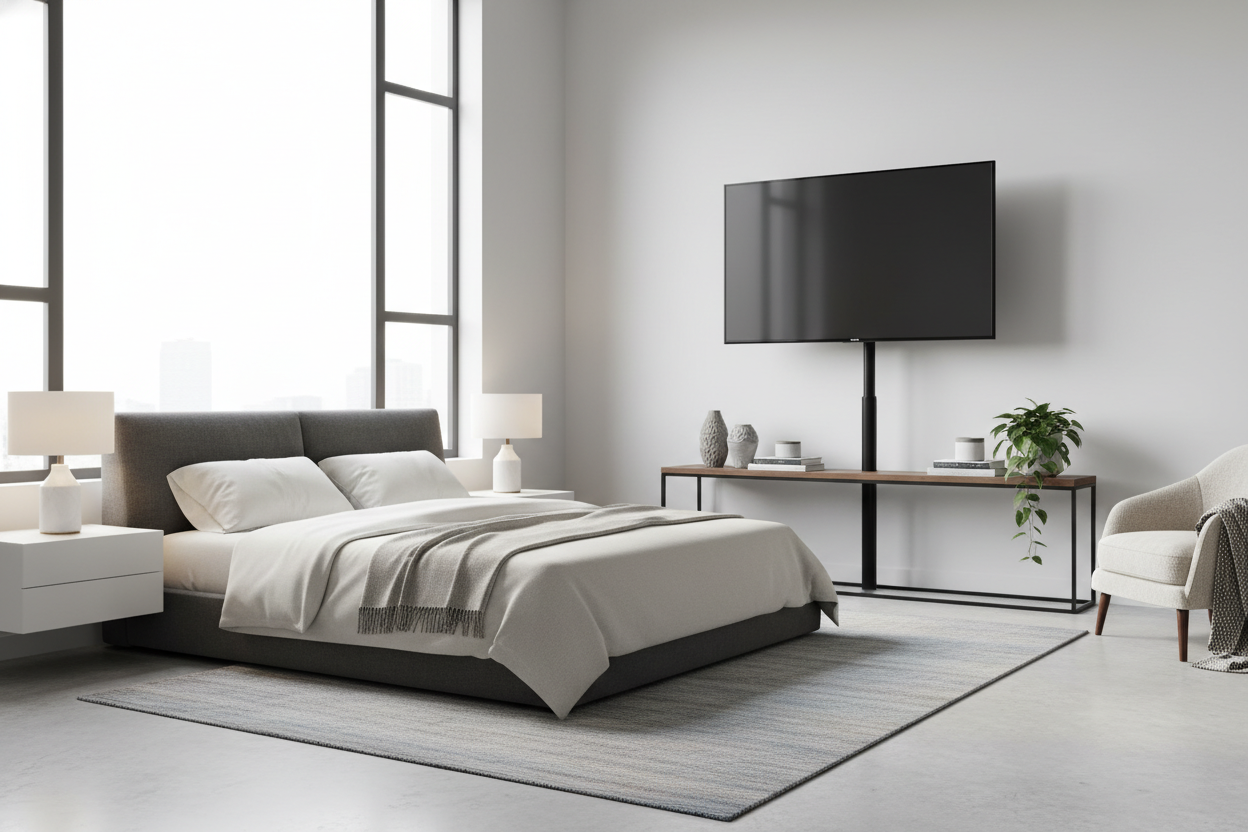
I spent three weeks propping myself up on four pillows every night just to see the bottom of my Netflix queue. My 14-inch hybrid mattress sat so high that my old living room console—a sleek, 22-inch mid-century piece—might as well have been on the floor. Every morning I woke up with a stiff neck that felt like I’d been in a minor fender-bender. That is when I realized I didn't need a new pillow; I needed a tall tv stand 55 inch setup that actually respected the height of my bed.
Quick Takeaways
- Standard media consoles (20-24 inches) are built for sofas, not high-profile mattresses.
- A bedroom TV stand should ideally be between 35 and 45 inches tall.
- Tall units provide double the storage of low-profile stands—think dressers for your tech.
- Avoid 'overhang' by ensuring your stand is at least 2-4 inches wider than your screen.
The 'Mattress vs. Media Console' Showdown
The biggest mistake we make in bedroom design is assuming a TV stand is a universal object. It isn’t. Most furniture brands design for the living room, where you sit on a sofa that is roughly 18 inches off the ground. But in a bedroom, you have a bed frame, a box spring, and likely a thick mattress. Your eye level is significantly higher, yet we keep buying these low-slung units and wondering why we’re squinting over our toes.
When I finally admitted my new TV stand probably feels too short, the relief was instant. I stopped trying to make a living room layout work in a space that demanded verticality. If you are viewing from a bed, you need to clear the 'footboard hurdle.' Anything under 30 inches is going to force you into a chin-to-chest posture that ruins your spine over time.
Finding the Right Height for a Tall TV Stand for 55 Inch TV
Ergonomics isn't just for office chairs. When you’re shopping for a tall tv stand for 55 inch tv, you have to account for the 'recline factor.' Unlike a desk where you sit upright, bedroom viewing is usually done at a 45-degree angle. This means the center of your 55-inch screen needs to be much higher than you'd think to stay in your natural line of sight.
I’ve tested dozens of setups, and for a standard 55-inch screen, the sweet spot for the top of the stand is usually around 36 to 42 inches. This places the middle of the screen roughly 50-55 inches off the floor. At this height, you can actually lay back against the headboard without having to tuck your chin or stack a mountain of pillows behind your head.
The Eye-Level Math Nobody Tells You
Here is the quick dirty math: Measure from the floor to the top of your mattress. Add 24 inches (the average height of a human torso when sitting up). Subtract 4 inches for the 'slouch factor.' That number is where the center of your TV should live. If you have a 55-inch TV, which is roughly 27 inches tall, your stand needs to be high enough to support that midpoint without making the TV look like it's hovering in the rafters.
How an Extra Tall TV Stand for 55 Inch TV Doubled My Storage
One thing I didn't expect when I swapped to an extra tall tv stand for 55 inch tv was how much floor space I reclaimed. Because these units are taller, they often borrow design cues from dining room sideboards or bedroom dressers. I went from having two tiny drawers to having six deep cubbies. I finally had a place for extra duvet covers, my mountain of physical books, and the messy nest of HDMI cables that used to spill across my carpet.
If you browse standard TV stands, you'll notice they are mostly 'open air' or have one skinny shelf. In contrast, the taller models are storage beasts. I chose a solid mango wood unit with cord management ports in the back. It’s sturdy, it doesn't wobble when I walk past it (unlike the cheap MDF unit I had in college), and it hides my ugly cable box completely behind closed doors.
Making It Look Intentional (Not Just Like a Random Dresser)
The risk with a tall unit is that it can look like you just grabbed a random chest of drawers and stuck a TV on it. To avoid the 'dorm room' aesthetic, look for pieces with intentional media features. We’re talking about infrared-friendly glass doors or ventilated back panels. You want it to look like a piece of architecture, not a piece of storage you're forcing to do double duty.
I spent a long time hunting for a 55 inch TV stand that didn't feel bulky. My trick? Look for tapered legs. A tall unit that sits flush to the floor can feel heavy and 'eat' the room. A tall unit on 6-inch legs feels airy and modern. I also suggest styling the top with a few low-profile objects—think a horizontal tray or a small stack of books—to ground the TV so it doesn't look like it's floating in a void.
FAQ
Is 40 inches too tall for a TV stand?
For a bedroom? Not at all. For a living room sofa? Probably. If your bed is high, 40 inches is actually the 'Goldilocks' height that prevents neck strain. Just make sure the stand is wide enough (at least 50 inches for a 55-inch TV) so it doesn't look top-heavy.
Can I use a dresser as a tall TV stand?
You can, but check the depth. Most dressers are 18-20 inches deep, while TVs only need about 12-14. You might end up with a lot of wasted space in front of the screen. Also, make sure you can drill a hole for cables, or you'll have wires draped over the side like a tech-nightmare waterfall.
What is the best material for a tall stand?
Avoid thin particle board. Because these units are top-heavy with a 55-inch screen, you want kiln-dried hardwood or a heavy-duty metal frame. If the base is flimsy, the whole thing will sway every time you open a drawer, which is a recipe for a tipped-over TV.


Leave a comment
This site is protected by hCaptcha and the hCaptcha Privacy Policy and Terms of Service apply.