

















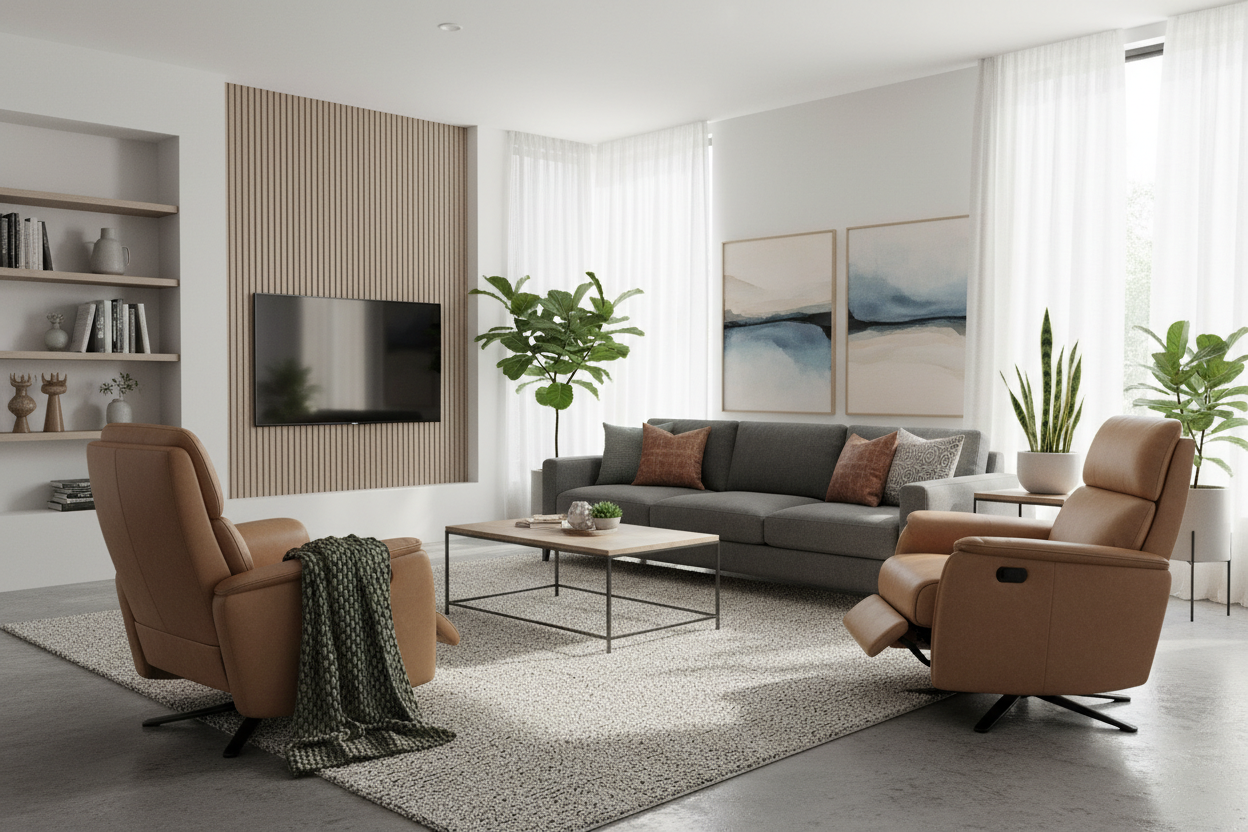
Merging the relaxed utility of motion furniture with a tailored, sophisticated aesthetic is one of the toughest challenges in residential design. Clients often feel forced to choose between the cinematic comfort of a couch with 2 recliners and the sleek silhouette of a stationary tuxedo sofa. However, the market has evolved. You no longer need to sacrifice your living room's visual integrity for the sake of kicking your feet up. The secret lies in selecting a piece that hides its functionality within a refined frame, ensuring the mechanism doesn't dictate the design.
Quick Decision Guide: Key Features to Look For
- Wall Clearance: Zero-wall or "wall-hugger" designs require only 2-4 inches of clearance, crucial for tight floor plans.
- Upholstery Durability: Look for full-grain leather or performance fabrics (like Crypton) with a rub count over 50,000 for longevity.
- Mechanism Quality: Power headrests and lumbar support offer superior ergonomics compared to manual gravity-fed reclining.
- Visual Weight: Opt for high-leg styles (open underneath) to reduce the bulky appearance typical of a sofa with recliners on both ends.
Balancing Visual Weight and Scale
The primary design offense committed by the average sofa and two recliners setup is visual heaviness. Motion furniture requires internal metal mechanisms, which often leads to a boxy, floor-heavy aesthetic that can make a room feel smaller. To counteract this, I advise clients to look for a "high-leg" silhouette.
By choosing a couch and 2 recliners that sits on exposed wooden or metal legs, you allow light to pass underneath the furniture. This negative space tricks the eye into perceiving the piece as lighter and less imposing. If you prefer a solid base, ensure the arms are track-style (square) rather than rolled, as this streamlines the profile.
Material Selection: Beyond Aesthetics
When selecting a sofa with 2 recliners, the friction caused by the moving parts necessitates higher-grade materials. In my showroom experience, lower-grade bonded leathers will peel between the seat cushions within two years due to the rubbing motion.
Leather vs. Performance Fabric
Top-grain leather is the gold standard for motion furniture because it moves with the mechanism without bunching. However, if you prefer the warmth of fabric, avoid loose weaves like linen. Instead, opt for a tight-weave chenille or a velvet microfiber. These textures hide the separation lines between the footrest and the seat, a detail that often ruins the look of a sofa with recliners on both ends.
Space Planning and Layout Considerations
Integrating a sofa with 2 recliners requires precise traffic flow management. Unlike a standard stationary piece, the footprint of this furniture changes dynamically. You must account for the "fully extended" depth.
If you are floating the furniture in the center of the room, be wary of the back view. Many reclining sofas have unsightly flaps or visible metal bars when viewed from behind. If your layout exposes the back of the sofa, look for models with a fully upholstered, finished back panel to maintain a polished look from all angles.
Lessons from My Own Projects
I want to share a specific headache I encountered during a project in a downtown loft, which changed how I specify these pieces. I ordered a high-end electric couch with 2 recliners for a client who wanted to float the piece in the middle of an open-concept living area.
We focused heavily on the leather quality and the comfort, but I completely overlooked the power source. When the sofa arrived, we realized we had no floor outlet beneath it. We were left with a thick black power cord snaking across a beautiful wool rug to the nearest wall. It looked messy and unfinished.
Since then, whenever I specify a power reclining unit that isn't against a wall, I insist on purchasing a rechargeable battery pack. These packs hide underneath the mechanism, eliminating trip hazards and unsightly cords. It is a small, unpolished detail that manufacturers rarely highlight, but it makes the difference between a showroom look and a cluttered reality.
Conclusion
Investing in a couch with 2 recliners does not mean you have to turn your living room into a generic home theater. By prioritizing streamlined silhouettes, durable upholstery, and smart space planning, you can achieve a space that is as inviting as it is elegant. Measure twice, check your power sources, and choose a style that complements your home's architecture.
Frequently Asked Questions
How much space do I need behind a reclining sofa?
It depends on the mechanism. Standard recliners need 8-12 inches. However, "wall-hugger" or "zero-clearance" models slide the seat forward as they recline, requiring as little as 2 to 4 inches of space from the wall.
Can I use a coffee table with a sofa that has recliners?
Yes, but shape and distance are key. An oval or round coffee table works best to soften the lines. Ensure there is at least 18 inches of clearance between the edge of the table and the sofa when the footrest is closed to allow for extension without collision.
Are power recliners more durable than manual ones?
Surprisingly, yes. Manual levers rely on spring tension and physical force, which can wear out the frame over time. High-quality power motors provide a smoother, controlled motion that puts less stress on the internal skeleton of the sofa.


Leave a comment
This site is protected by hCaptcha and the hCaptcha Privacy Policy and Terms of Service apply.