

















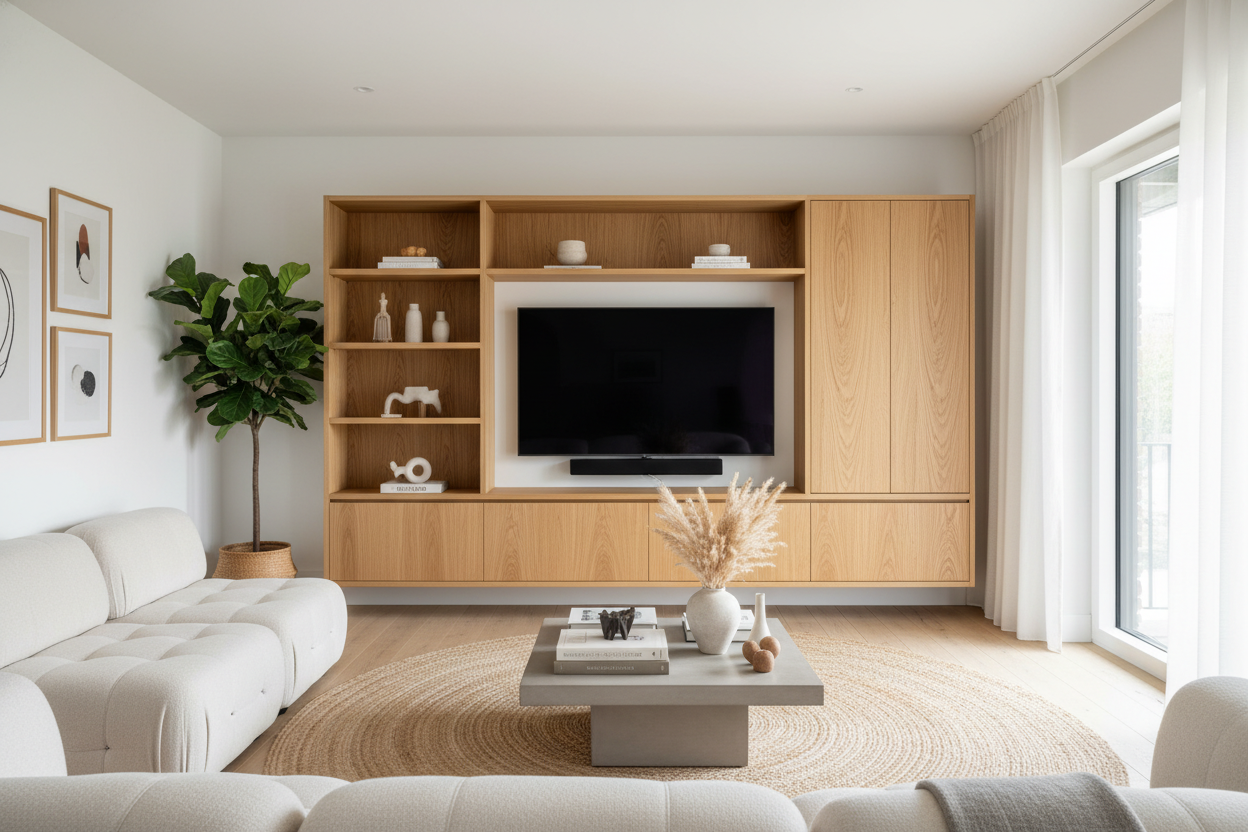
I spent three weeks staring at a 75-inch TV sitting on two stacked milk crates because I couldn't pull the trigger on a console. Every time I looked at an entertainment unit oak finish online, I had a visceral flashback to my childhood living room—the kind with dusty floral wallpaper and that shiny, orange-tinted 'honey oak' that seemed to coat every surface in the mid-90s. I was convinced that bringing oak into my home would immediately turn my aesthetic into a sitcom set from 1995.
Quick Takeaways
- Finish is everything: Modern oak is matte or wire-brushed, not glossy and orange.
- Undertones matter: Look for 'white oak' with cool or neutral tones to avoid the dated look.
- Solid vs. Veneer: Solid oak is heavy and durable, while high-quality veneers offer a more uniform grain.
- Hardware swap: Black or brass hardware instantly modernizes an oak piece.
My Deep-Seated Fear of 'Golden Oak'
For a long time, the phrase 'oak entertainment' felt like a threat. We all remember that specific shade of golden oak—the stuff that looked like it had been dipped in a vat of yellow highlighter and finished with a lacquer so thick you could see your reflection in it. It wasn't just the color; it was the bulk. Those old-school oak express entertainment centers were massive, towering units that felt like they were trying to swallow the room whole.
I was so scarred by that aesthetic that I spent my twenties buying nothing but white laminate or black metal. I wanted 'modern,' and to me, modern meant anything that didn't look like a tree. But after a few years, my living room felt cold. It lacked soul. It looked like a tech startup's waiting room rather than a home.
The Difference Between 90s Oak and Modern Oak
The breakthrough happened when I realized that wood isn't the enemy—polyurethane is. The reason we hate 90s furniture isn't the wood grain; it's the thick, oil-based finishes that ambered over time. Modern design treats an entertainment center in oak with much more respect. We're seeing raw, matte, and water-based finishes that preserve the actual color of the wood.
There is still a heated debate about whether an oak entertainment center wall unit still carries that dated stigma. Honestly? If it’s designed with clean lines and a low-sheen finish, it’s a completely different animal. Modern white oak has a gorgeous, sandy 'greige' tone that works with everything from Scandinavian minimalism to moody industrial lofts. It’s about the grain, not the gloss.
Why I Finally Chose a Large Oak Entertainment Unit
I eventually realized that my 75-inch TV looked ridiculous on a small, spindly stand. It needed visual weight to balance it out. I finally bit the bullet on a large entertainment center made of solid white oak with a wire-brushed texture. I was nervous when the boxes arrived, but the moment I slid that first shelf into place, the room felt grounded.
A large oak entertainment unit provides a warmth that metal or MDF just can't replicate. It doesn't feel like a piece of furniture; it feels like an architectural element. I chose a unit with slatted doors to hide the cable box and PlayStation, which kept the look clean but still let the remote signals through. One mistake I made? Not measuring the depth of my receiver. I had to cut a hole in the back panel because it was about a half-inch too deep. Measure your gear twice, folks.
What to Look for in an Oak Entertainment Stand
If you're hunting for an oak entertainment stand, don't just look at the price tag. Look at the joints. If you see dovetail joints or mitered corners, you're looking at a piece that will actually last a decade. Avoid anything that feels 'tacky' to the touch—that's a sign of a cheap topcoat that will eventually peel or yellow.
I always suggest browsing modern entertainment centers that specifically mention 'kiln-dried' wood. This prevents the unit from warping or cracking when your heater kicks on in the winter. Also, pay attention to the legs. A heavy oak cabinet lifted off the floor by slim tapered legs feels much lighter and more contemporary than a unit that sits flush on the carpet.
The Verdict: Is Oak Actually Back?
Oak isn't just back; it never really left—we just finally learned how to finish it properly. Choosing an oak entertainment wall unit is a timeless choice designers still love because it brings an organic, tactile element into a room filled with glass screens and plastic gadgets. It’s the easiest way to make a room feel 'finished' without trying too hard.
FAQ
Will an oak entertainment center turn yellow over time?
Only if it has an oil-based finish. Most modern units use water-based lacquers or oils that keep the wood looking like its natural, sandy self for years.
Is solid oak better than oak veneer?
Solid oak is more durable and can be refinished, but high-quality veneers are often more stable and less prone to warping in humid climates. Both are great if the craftsmanship is there.
How do I make an oak unit look more modern?
Go for matte finishes, avoid ornate carvings, and choose pieces with black or brass hardware. Keeping the styling on top minimal also helps avoid that 'cluttered' 90s look.

Leave a comment
This site is protected by hCaptcha and the hCaptcha Privacy Policy and Terms of Service apply.