

















I remember standing in the middle of my new apartment, staring at a living room that felt less like a home and more like a luxury parking garage. It was a cavernous, 30-foot stretch of open space where my sofa looked like a tiny, lonely island. I’d spent weeks scrolling through 40 different tabs of furniture, trying to figure out how to stop my dinner guests from staring directly at my messy TV cables while they ate their pasta, but nothing felt right.
The problem wasn't the square footage; it was the lack of 'zones.' Every piece of furniture I owned sat below waist level, leaving the top two-thirds of the room feeling cold and empty. That is when I realized I didn't need another rug or a bigger plant. I needed a contemporary tall cabinet that could act as a structural anchor, breaking up the flat eyeline and finally giving the room some much-needed architecture.
Quick Takeaways
- Low furniture keeps an open floor plan feeling like a bowling alley; you need vertical height to create 'rooms.'
- Floating a cabinet perpendicular to the wall creates a functional foyer or dining boundary without the cost of a renovation.
- Always check the back of the unit—most mass-market cabinets use unfinished particle board that looks terrible if it isn't against a wall.
- Safety is non-negotiable: if you float a tall piece, you must anchor it to the floor or a side wall.
The 'Bowling Alley' Curse (And Why Low Furniture Fails)
The biggest trap of open-concept living is the 'horizon line' problem. When your sofa, coffee table, and media console all hover at the same 30-inch height, the room lacks any visual rhythm. It feels like a bowling alley—long, flat, and utilitarian. I initially tried to fix this by shoving a modern wall cabinet against the only available long wall, but it just made the room feel even more like a hallway.
I needed a modern storage cabinet tall enough to actually interrupt the view. Most people are afraid of height because they think it will 'close off' the space. In reality, a piece that stands 72 inches or higher acts as a psychological boundary. It tells your brain, 'The living room ends here, and the dining room begins there.' Without that vertical break, your eyes just slide across the room without ever finding a place to rest.
Why I Floated a Contemporary Tall Cabinet Instead of Building a Wall
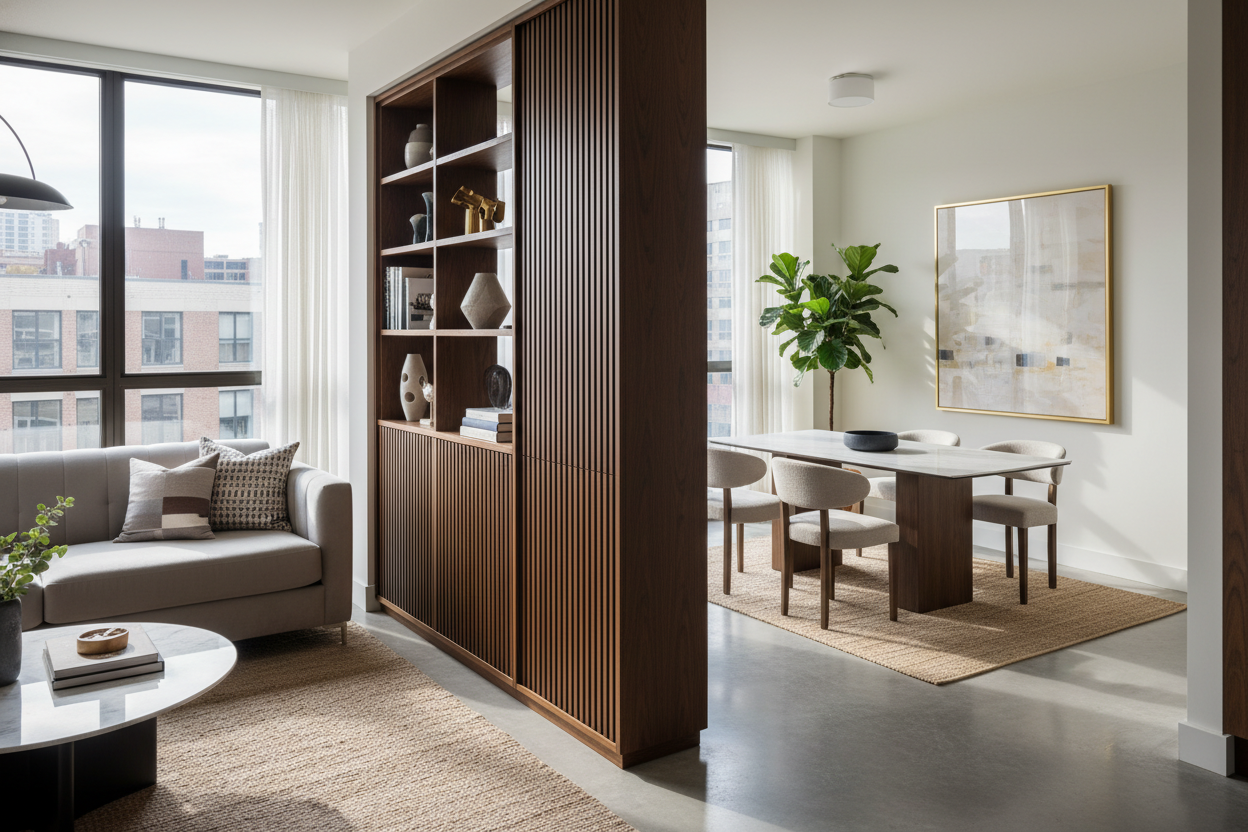
The 'aha' moment came when I pulled my storage unit away from the perimeter. I took a sleek, contemporary tall cabinet and placed it perpendicular to the wall, jutting out into the room. Suddenly, I had a pseudo-entryway. On one side, I had a cozy living nook; on the other, a designated dining area. It was a renter-friendly 'wall' that didn't require a permit or a contractor.
Compared to a standard modern sideboard, which usually tops out at 34 inches, the tall cabinet provided an actual sense of privacy. When I’m sitting on the sofa, I don’t want to see the pile of mail on the dining table. The verticality of the cabinet shields those messy 'life' moments, making the living area feel like a private sanctuary rather than a multipurpose thoroughfare.
The 3 Rules for Using a Modern Tall Cabinet as a Room Divider
If you’re going to float a piece of furniture in the middle of a room, you can't just buy the first thing you see on a budget site. Rule number one: the back must be finished. Most 'affordable' furniture uses a flimsy, unfinished piece of 3mm plywood on the back that is held on by tiny nails. If you’re floating a tall storage cabinet modern enough to be a focal point, that back panel needs to be solid wood or at least painted to match the rest of the frame.
Rule number two is safety. A 6-foot cabinet has a high center of gravity. Since I couldn't anchor mine to a wall, I used heavy-duty L-brackets hidden under the base to secure it directly into the floor joists. If you have kids or a 70-pound dog like I do, skip this step at your own peril. Finally, consider the 'visual weight.' A solid black monolith can feel heavy, which is why I often recommend a black cabinet with glass doors. The glass allows light to pass through the top half, so the room divider defines the space without making it feel like a dungeon.
What Actually Goes Inside (Because It's Not Just for Show)
The best part about this setup is the sheer amount of 'ugly' stuff it swallows. In my house, the bottom half of the cabinet is the tech graveyard. It hides the router, the messy nest of charging cables, and those board game boxes that are falling apart at the corners. Because it's positioned between the two zones, it's the perfect place to transform clutter with the right modern storage strategy.
On the dining side, the upper shelves hold my 'good' glassware and the heavy ceramic platters I only use twice a year. It’s functional at a 360-degree level. I’ve realized that a modern tall cabinet isn't just a piece of furniture; it’s a tool for organizational sanity. It took my apartment from a chaotic, open void to a structured, intentional home where every object—and every activity—finally has its own place.
FAQ
Will a tall cabinet make my small room feel smaller?
Usually, it’s the opposite. By creating distinct zones, you actually make the space feel like it has more 'rooms,' which can make a small floor plan feel more expansive and organized.
How do I hide the back of the cabinet if it isn't finished?
If you're stuck with an ugly back panel, you can apply peel-and-stick wallpaper, mount a large mirror, or even tack on a piece of painted pegboard to create a secondary functional surface.
Is glass or solid wood better for a room divider?
If your room is dark, go with glass doors to keep the light flowing. If you're trying to hide a massive amount of clutter (like a toy collection or office supplies), solid doors are your best friend.

Leave a comment
This site is protected by hCaptcha and the hCaptcha Privacy Policy and Terms of Service apply.