

















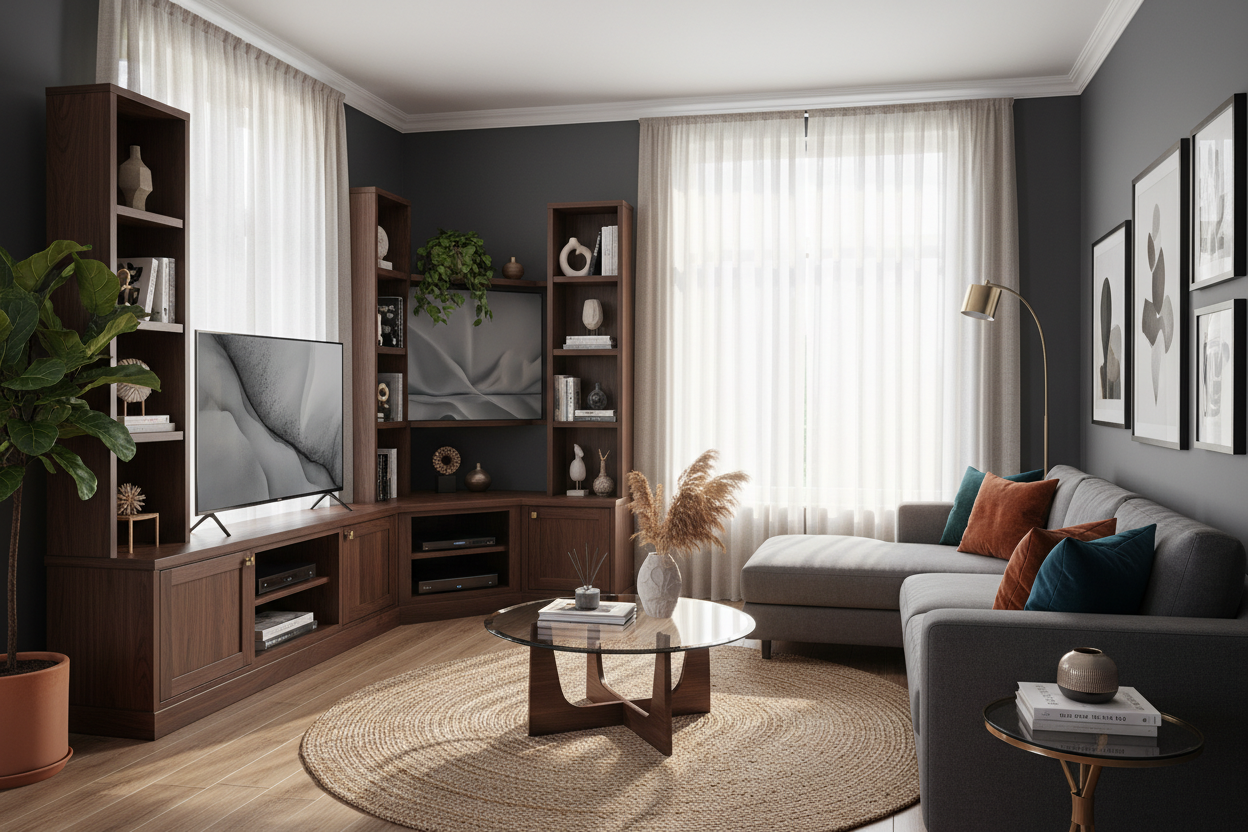
I remember the specific dread of staring at my first 'grown-up' apartment. It had a bizarre 45-degree wall in the living room that seemed designed specifically to ruin my layout dreams. I tried to force a standard rectangular console against it, but it looked like a glitch in the architecture. It wasn't until I finally caved and bought a corner tv stand dark wood unit that the room actually started to make sense. I’d spent years avoiding them because I associated 'corner units' with my parents’ dusty media towers, but I was wrong.
- Dark wood finishes like espresso or walnut hide cable shadows better than light oak.
- Modern corner silhouettes are significantly slimmer and lower than the bulky units of the 90s.
- Always measure your TV’s horizontal width, not the diagonal screen size, to avoid overhang.
- Pairing dark wood with brass hardware or trailing plants prevents the 'black hole' effect.
The '90s Basement Trauma We Need to Unpack
Let’s be honest: when we hear 'corner TV stand,' most of us over thirty have a visceral reaction involving honey oak and those weirdly specific slots for VHS tapes. We spent the last decade obsessed with mid-century modern hair-pin legs and floating white shelves, trying to distance ourselves from the chunky basement furniture of our youth. But the problem wasn't the corner placement; it was the execution. The old units were massive, towering monstrosities that swallowed the room.
Today, the design language has shifted. Modern collections of Tv Stands have completely reinvented the bulky corner profiles of the past. We’re seeing lower heights, tapered legs, and rich, moody stains that feel sophisticated rather than dated. A dark wood corner tv stand in a deep espresso or a charred walnut doesn't scream 'rec room.' It screams 'curated library.' By choosing a piece with a clean, minimalist frame, you’re utilizing that dead space without making the room feel like it’s closing in on you.
Why a Dark Wood Corner TV Stand Actually Looks Custom
There is a psychological trick to dark furniture. While light-colored pieces pop against a wall, dark wood tends to recede. In a corner—which is naturally a high-shadow area—a deep mahogany or walnut finish blends into the architecture. It anchors the television so it doesn't look like a giant black plastic rectangle floating in space. Instead, the whole setup feels like a purposeful, built-in feature of the home.
I’ve found that solid wood, rather than that flimsy paper-veneer particleboard, makes the biggest difference here. When you have the weight and grain of real timber, a tv corner unit dark wood setup looks intentional and expensive. It mimics the look of high-end millwork. It’s about turning a wasted, awkward corner into an intentional focal point. Your Dead Corner Looks Awkward (A Solid Wood Corner TV Stand Fixes It) because it provides a visual base that feels permanent and sturdy, rather than a temporary fix for a difficult floor plan.
How to Style a TV Corner Unit Dark Wood Style (Without the Gloom)
The biggest risk with dark furniture is the 'black hole' effect. If you shove a dark unit into a dark corner and put a black TV on top, the whole area just disappears into a gloomy void. The secret is contrast. I always swap out standard silver hardware for brushed brass or matte gold knobs. It catches the light and breaks up the heavy wood tones. I also suggest placing a trailing plant, like a Pothos, on one side. The vibrant green against a dark espresso finish is a classic combo that feels fresh.
Lighting is your best friend here. I’m a huge advocate for sticking a cheap LED bias light strip to the back of the TV. It glows against the corner walls and provides a soft halo that makes the dark wood pop. If you have the space and realize you actually want a flat-wall layout rather than a corner wedge, you might look at something like the Modern 3 Piece Entertainment Center With Overhead Cabinets And 69 Tv Stand Natural Wood And Black Finish. It offers that same moody, dark aesthetic but spreads the visual weight across a main wall instead of tucking it away.
The Geometry Problem: Measuring Angles for Flat Screens
This is where most people mess up. They see a '55-inch TV' and buy a '55-inch corner stand.' But a 55-inch TV is the diagonal measurement. The actual horizontal width is about 48 inches. If your corner stand is also exactly 48 inches wide, the corners of your TV are going to hit the walls before the stand is even pushed back all the way. You end up with this awkward 6-inch gap behind the stand that becomes a graveyard for dust bunnies and lost remote batteries.
You need a stand that is at least 5 to 10 percent wider than your TV's actual width to ensure a flush fit. Also, consider the depth. A corner unit is a triangle; the deeper the unit, the further out into the room it will sit. I always tell friends to tape out the footprint on the floor with blue painter's tape first. For those who need a deeper dive into the exact room layouts and floor plans that benefit most from angled furniture: Solid Wood Corner Tv Stand The Secret To Fixing Awkward Rooms.
My Personal Take: The Dust Factor
I’ll be real with you: I love my espresso-stained corner unit, but it shows dust like it’s its job. If you’re the type of person who only cleans once a month, a very dark finish might drive you crazy. I keep a microfiber cloth in the drawer of the console specifically for a 30-second wipe-down before guests come over. Despite that, I’d never go back to a light-colored stand. The dark wood makes my cheap 50-inch TV look like a much higher-end model because the bezel just disappears into the wood grain.
FAQ
Will a dark wood stand make my small room look smaller?
Actually, no. Because dark colors recede in shadows, a dark corner unit often 'disappears' more effectively than a bright white one, which would draw the eye directly to the corner and highlight the room's limits.
How do I hide cables on a corner unit?
Corner units are actually the best for cable management because there is naturally a 'hidden' triangle of space behind the unit. Use zip ties to bundle cables and drop them straight down the back into that void.
Can I mix dark wood with light wood floors?
Yes, and you probably should. Contrast is what makes a room look designed. A dark walnut stand on a light oak floor creates a beautiful 'layered' look that prevents the room from feeling one-dimensional.

Leave a comment
This site is protected by hCaptcha and the hCaptcha Privacy Policy and Terms of Service apply.