

















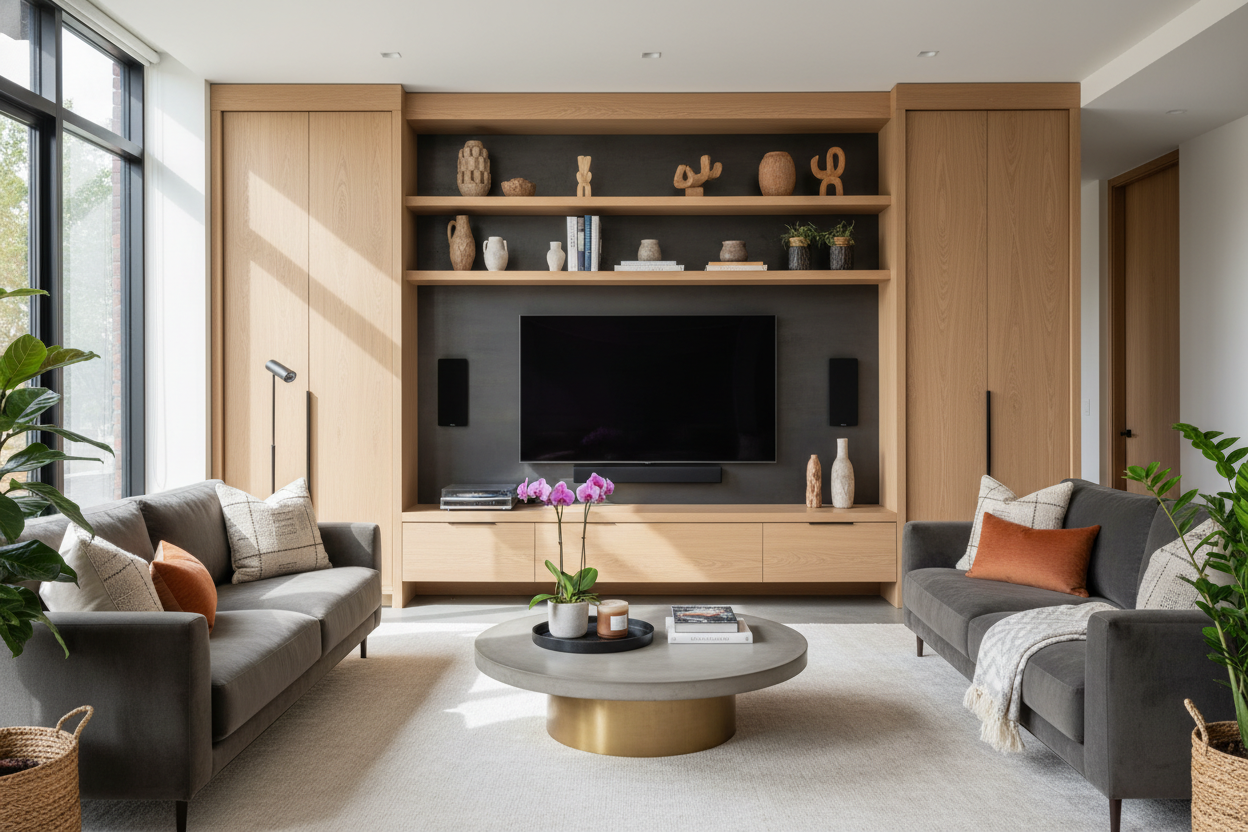
I remember staring at my first 'grown-up' living room and realizing I had accidentally built a laboratory. It was all white lacquer, sharp 90-degree angles, and high-gloss surfaces. I felt like I needed to scrub in before sitting down to watch Netflix. Finding contemporary entertainment center ideas that do not feel like a medical clinic is harder than it looks when you are scrolling through endless feeds of hyper-minimalist renders.
The problem is that 'modern' is often used as a synonym for 'empty.' We have been told that a clean space equals a clear mind, but in reality, a space with zero texture just feels lonely. I have spent a decade testing furniture that looks great in a catalog but feels like a cold slab of marble in a real house. You want a focal point that anchors the room, not a piece that makes the whole place feel like it is still under construction.
Quick Takeaways
- Avoid high-gloss white finishes if you want a cozy, lived-in feel.
- Mix natural wood grains with matte metals to create visual warmth.
- Choose grounded units over floating cabinets to give the room a sense of permanence.
- Use 'moody' dark tones like charcoal or black to help the TV screen blend in.
- Soften rigid lines with organic shapes like trailing plants or ceramic vases.
The 'Dentist Waiting Room' Effect
We have all seen it: the ultra-modern media setup that relies entirely on stark white surfaces and blinding blue-toned LED strips. It is the 'Dentist Waiting Room' effect. It looks hygienic, sure, but it is the opposite of inviting. When you are looking for modern living room entertainment center ideas, the goal should be to create a space where you actually want to spend four hours on a Sunday afternoon.
The mistake most people make is choosing materials that reflect too much light. High-gloss finishes bounce every glare from your windows and lamps right back at you, which is distracting when you are trying to watch a movie. Beyond the glare, these materials feel cold to the touch. A home should be tactile. If every surface in your living room is as smooth as a smartphone screen, the room loses its soul. I have learned the hard way that a room full of hard, reflective surfaces also creates an echo chamber that makes your expensive soundbar sound like a tin can.
Instead of going for that clinical look, focus on 'warm minimalism.' This means keeping the clean lines but swapping out the sterile materials for things that have a bit of history or texture. Think matte finishes instead of gloss, and soft-close doors that feel heavy and substantial rather than flimsy and plastic.
Wood Tones Are the Secret to Modern Living Room Entertainment Center Ideas
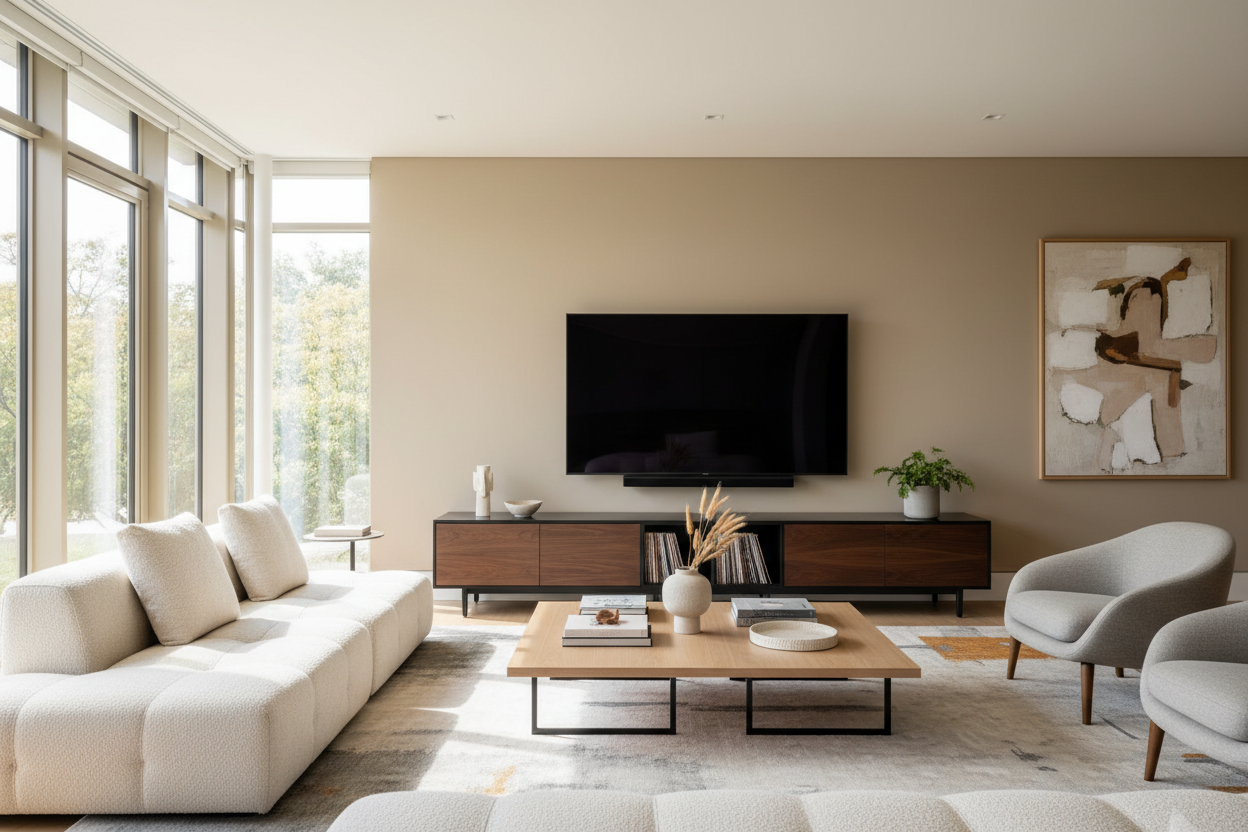
If you want to save a contemporary design from looking like an office cubicle, add wood. It is the oldest trick in the book because it works every single time. Natural wood grain introduces an organic pattern that breaks up the rigid geometry of entertainment center designs. Even in a room with concrete floors and grey walls, a walnut or oak media unit acts like a space heater for the eyes.
I recently helped a friend assemble a Modern 3 Piece Entertainment Center, and the difference it made was immediate. The unit mixed a natural wood finish with matte black accents. The black kept it looking sharp and current, but the wood grain provided that 'homey' touch that was missing. It did not just hold the TV; it made the whole wall look finished.
When picking wood, look for real veneers or solid wood where possible. The cheap 'paper' laminates often have a repeating pattern that looks fake the second the sun hits it. You want something with depth. A 70-inch console in a rich acorn or honey oak can support a massive TV without making the room feel like a sports bar. It bridges the gap between 'I live in a museum' and 'I actually live here.'
Please Stop Floating Every Single Cabinet
The trend of wall-mounting every single piece of furniture has gone a bit too far. While floating shelves look great in a 4,000-square-foot loft with 12-foot ceilings, in a standard 12x14 living room, they can feel a bit... flighty. There is something to be said for the 'visual weight' of a piece that actually sits on the floor. It feels anchored. It feels permanent.
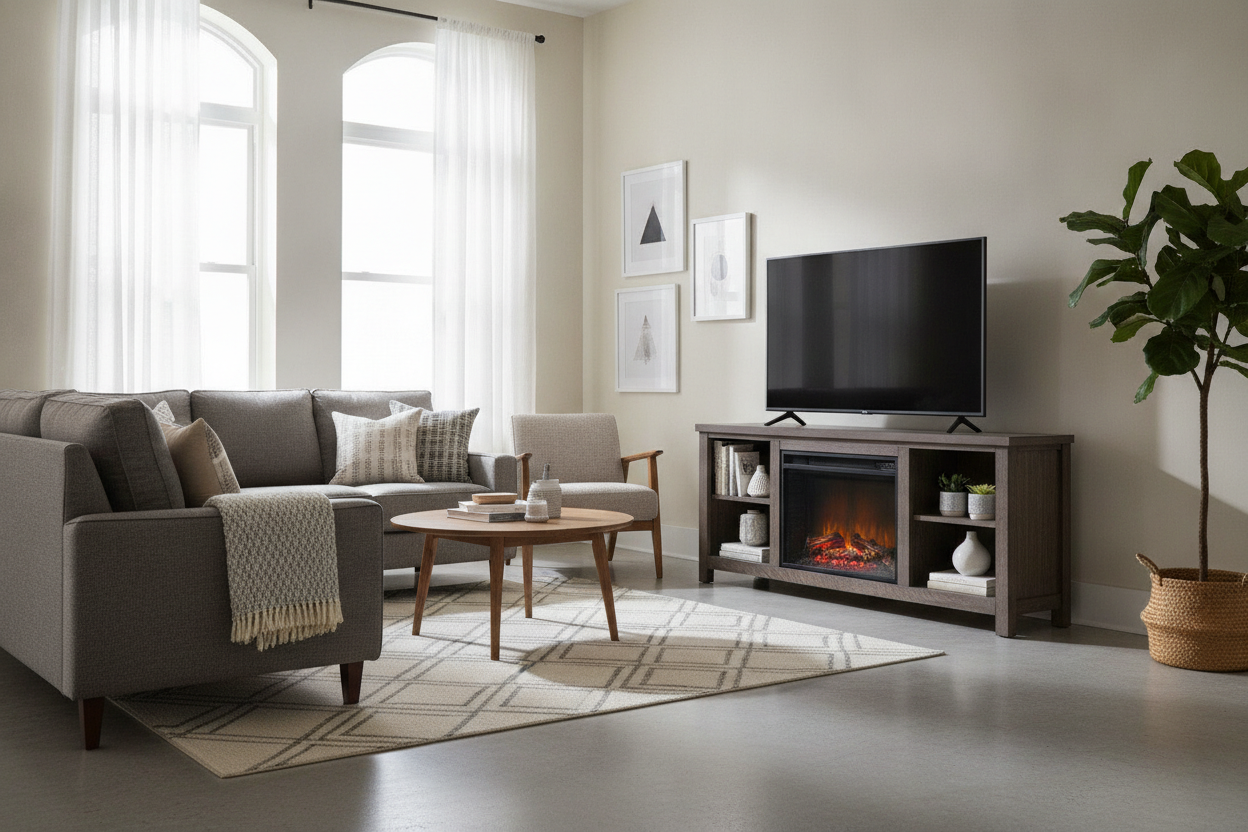
When you browse for a new Entertainment Center, consider units with recessed plinth bases or low-profile legs. These pieces still offer that sleek, modern silhouette but they feel more like a part of the architecture. A grounded unit also solves one of my biggest pet peeves: the 'cable waterfall.' No matter how many plastic clips you use, hiding wires behind a floating cabinet is a nightmare. A floor-standing unit gives you a dedicated 'basement' to hide all those power bricks and HDMI cables.
I have owned both, and I will always go back to a grounded unit. There is a psychological comfort in seeing a piece of furniture that looks like it belongs exactly where it is. It creates a 'hearth' effect. In the absence of a fireplace, your media center becomes the center of the home's gravity. It should look like it is strong enough to hold that weight.
Embrace the Dark Side for Cozier Entertainment Center Designs
For a long time, we were told that dark furniture makes a room feel smaller. That is a myth that needs to die. In a media room, dark colors are your best friend. A Stylish Black Tv Stand Entertainment Center is a masterclass in functional design because it makes the 'black hole' of the television disappear when it is turned off.
When you have a giant 75-inch screen on a white cabinet, it sticks out like a sore thumb. It is a giant black rectangle in a sea of white. But when you place that same TV against a dark charcoal or matte black unit, the screen recedes. The whole setup feels like a cohesive theater. It is moody, it is sophisticated, and it is incredibly cozy at night when the lights are low. This is how you master entertainment center designs without it feeling like a dorm room.
The key to pulling off dark furniture is texture. A flat, cheap black finish will show every fingerprint and speck of dust. Look for matte finishes or dark wood stains where the grain is still visible. This keeps the piece from looking like a giant plastic block. I once bought a high-gloss black stand, and I spent more time Windexing it than I did watching TV. Go matte, and you will never go back.
Softening the Edges with Intentional Decor
Once you have the big pieces in place, the 'sterile' vibe usually comes down to the styling. A large Modern Entertainment Center Wall Unit provides a lot of flat surface area. If you leave those surfaces empty, the room feels cold. If you clutter them with random junk, it looks messy. The middle ground is intentional, organic styling.
I like to use the 'Rule of Three' but with a twist. Mix a hard object (like a stack of books), a soft object (like a trailing Pothos plant), and a round object (like a ceramic bowl). The plant is non-negotiable. Greenery is the fastest way to breathe life into a contemporary setup. It breaks up the straight lines of the shelves and adds a bit of 'perfect imperfection' to the grid.
Lighting is the final touch. Please, I am begging you, stay away from the 'cool white' LEDs. They make everything look like a laboratory. Use warm-toned puck lights or LED strips (2700K is the sweet spot) to wash the wall in a soft glow. It creates depth and makes the unit feel integrated into the room rather than just pushed against a wall.
My Honest Mistake: The 'Cable Spaghetti' Nightmare
I once bought a stunning minimalist Italian media console. It was beautiful—thin lines, no visible hardware, pure white. But I failed to check the back. It had zero cord management. I ended up with a literal 'spaghetti mess' of black cables hanging down underneath this pristine white unit. I spent an entire Saturday with a drill and a hole-saw bit, praying I wouldn't crack the finish, just to make it usable. Always check for cord cutouts and 'internal alleys' for your wires. If the design is too minimalist to include a hole for a power cord, it isn't good design—it's just a box.
Contemporary Media FAQ
How high should my TV stand be?
Your eyes should be level with the middle of the screen when you are sitting on your sofa. For most people, this means a stand that is 18 to 22 inches tall. If you are mounting the TV above the center, don't go too high—'TV Too High' syndrome is real and your neck will hate you.
How do I hide the 'black box' of the TV?
Use a dark-colored entertainment center or paint the wall behind the TV a dark accent color. This reduces the contrast between the screen and the wall, making the TV feel like a part of the decor rather than an intruder.
Can I mix different wood tones?
Yes, as long as the undertones match. If your floor is a cool-toned grey oak, look for a media center with cool undertones. You don't need a perfect match, but you want them to 'talk' to each other. Mixing a very red cherry wood with a very grey floor usually clashes.

Leave a comment
This site is protected by hCaptcha and the hCaptcha Privacy Policy and Terms of Service apply.