

















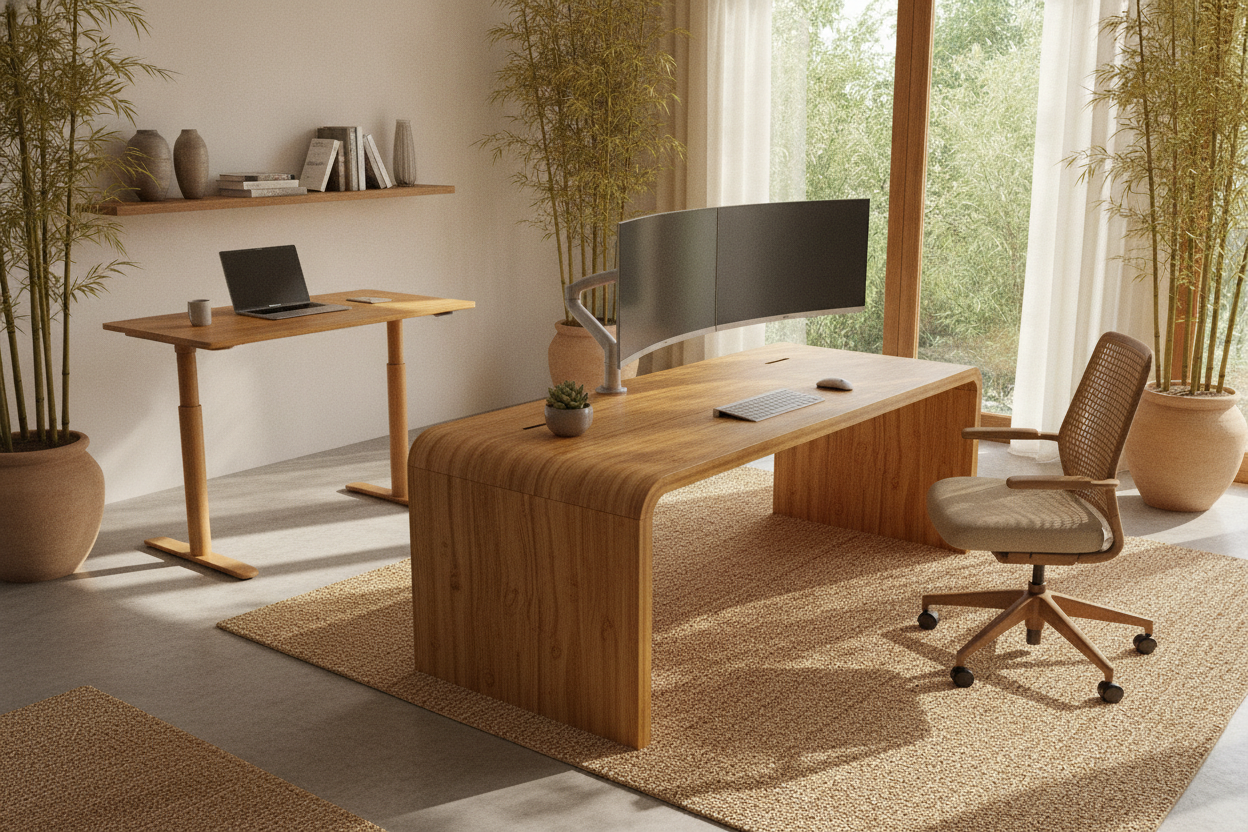
I used to think bamboo furniture was the 'live, laugh, love' of the home office world. I pictured those flimsy folding chairs at a beach wedding or a cheap cutting board that splits after three washes. When I started seeing bamboo desks everywhere, I assumed it was just a marketing play for people who want to feel eco-friendly without spending real money. I was wrong. I was very, very wrong.
- Bamboo is significantly harder than most hardwoods, resisting dings and scratches.
- It is surprisingly heavy and dense, providing a stable, vibration-free surface.
- The natural grain adds warmth to a room without the visual weight of dark mahogany.
- It is arguably the best material for motor-driven standing desks due to its strength-to-weight ratio.
My Completely Unfair Prejudice Against Bamboo
For years, I dismissed bamboo for desk use because I thought it was basically glorified grass—which, technically, it is. But I didn't realize that the manufacturing process for a bamboo desk top involves compressing those fibers into a material that is 40% harder than white oak. I had this vision of a bamboo office desk looking like a college dorm relic, something that would splinter if I looked at it too hard.
I wanted 'real' wood. I wanted the status of a heavy walnut slab. But the reality of my budget and the sheer weight of solid timber kept me stuck in a cycle of buying cheap alternatives. I assumed bamboo office furniture was a compromise for people who couldn't afford a 'real' workspace. It took a literal collapse of my previous setup to make me realize that density and durability don't always come from a 100-year-old tree.
The Particleboard Disaster That Forced My Hand
My breaking point came when my expensive-looking veneer desk started to fail. It looked great for six months, but then the edge banding began to peel like a bad sunburn. Even worse, the middle of the desk started to sag under the weight of my monitor. It was a pathetic sight. I spent weeks looking for a writing computer desk upgrade that wouldn't warp the moment I added a second screen.
The problem is that mid-range furniture is a minefield of 'manufactured wood' that is basically sawdust and glue. I needed something solid but didn't want to spend $2,000 on a custom build. That is when I finally caved and looked at a bamboo computer desk. The price was right, and the reviews promised it wouldn't bow like my previous disaster.
Is a Bamboo Desktop Actually Strong Enough for Dual Monitors?
This was my biggest concern. I run a dual-monitor setup with a heavy-duty clamp-on arm. On my old MDF desk, I could actually see the wood compressing where the clamp met the surface. A bamboo desktop is a different beast entirely. Because of the way the layers are laminated, it has incredible structural integrity. There is zero flex, even with two 27-inch monitors hovering over the back edge.
I have accidentally dropped my heavy mechanical keyboard on this bamboo tabletop more than once. On a pine desk, that would be a permanent dent. On this stand desk bamboo surface, there is not a mark. The density of the bamboo table top also dampens the sound of my typing, which was an unexpected bonus. It feels 'thuddy' and expensive rather than 'clacky' and cheap.
Nailing the 'Bamboo and White' Aesthetic
I eventually settled on a bamboo and white desk, and it completely changed the energy of my room. If you have a small office, a dark, bulky desk can make the space feel like a closet. A white bamboo desk reflects light and makes everything feel airy. It is the antithesis of a stuffy corporate law firm, but it still feels professional enough for a high-stakes Zoom call.
If you have a ton of gear, you might think you need something massive like an L shaped desk with 3 drawers. While those are great for storage, they can be overwhelming in a multi-purpose room. The slim profile of a bamboo wood desk gives you the same surface area without the visual clutter. It’s a minimalist's dream, especially when you pair it with some clean cable management.
Pairing a Bamboo Top With an Adjustable Frame
If you are building a bamboo sit stand desk, the weight of the top matters more than you think. A solid oak top is gorgeous, but it is incredibly heavy, which puts extra strain on the motors and can lead to that annoying 'monitor wobble' when the desk is at its highest point. A bamboo top standing desk is the sweet spot. It is rigid enough to stay stable but light enough that your motors will actually last.
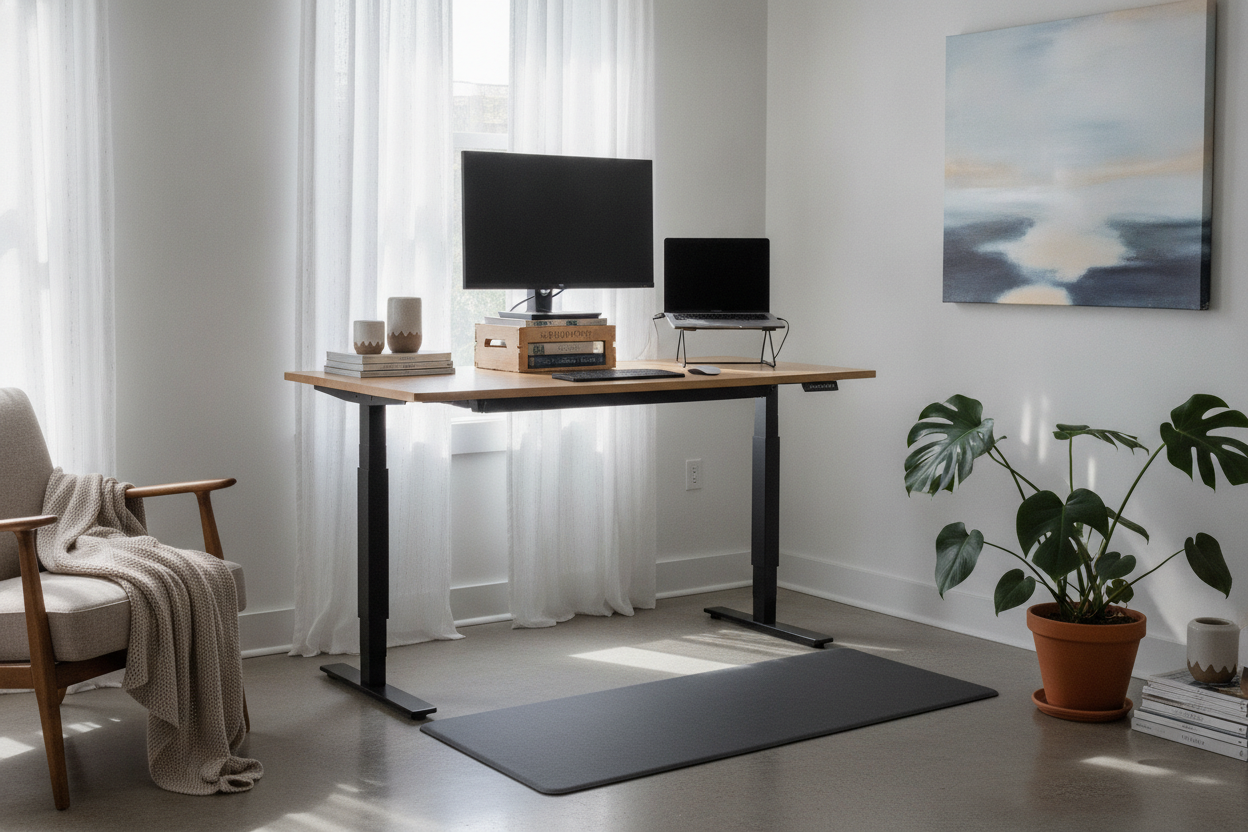
I paired my top with an ergonomic home office sit stand up desk frame. The result is a rock-solid workstation that transitions from sitting to standing without any of the jerky movements you get with heavier materials. Whether you are looking at a black bamboo uplift desk or a natural finish, the stability remains the same. It’s the most reliable bamboo adjustable desk setup I have ever used.
My Final Bamboo Desk Setup (And What I'd Change)
My current daily driver is a 60-inch natural bamboo tabletop. I chose the natural finish over a dark bamboo desk because I think it hides dust and micro-scratches much better. I have added a felt desk mat and a hidden cable tray underneath to keep things clean. It’s the first time in years I haven't felt the urge to browse for a new desk after six months.
The only thing I might change? I’ve been eyeing a small standing desk on wheels for my overflow projects. But for my main work, I am a bamboo convert. It’s not just 'good for the price'—it’s actually a better material for a modern workspace than the traditional woods I used to obsess over.
Does a bamboo desk top scratch easily?
Not easily. It is harder than most hardwoods like oak or maple. However, like any wood product, a sharp metal object dragged across it with pressure will leave a mark. For normal office use, it is incredibly resilient.
Is bamboo office furniture eco-friendly?
Yes, bamboo grows much faster than trees—reaching maturity in about 5 years versus 30-50 years for hardwoods. It also requires fewer pesticides and regrows from the same root system after harvesting.
Can I mount a keyboard tray to a bamboo desktop?
Yes, you can. Unlike particleboard, which crumbles when you screw into it, bamboo holds screws very securely. Just be sure to pre-drill your holes to prevent any splitting, as the material is very dense.

Leave a comment
This site is protected by hCaptcha and the hCaptcha Privacy Policy and Terms of Service apply.