

















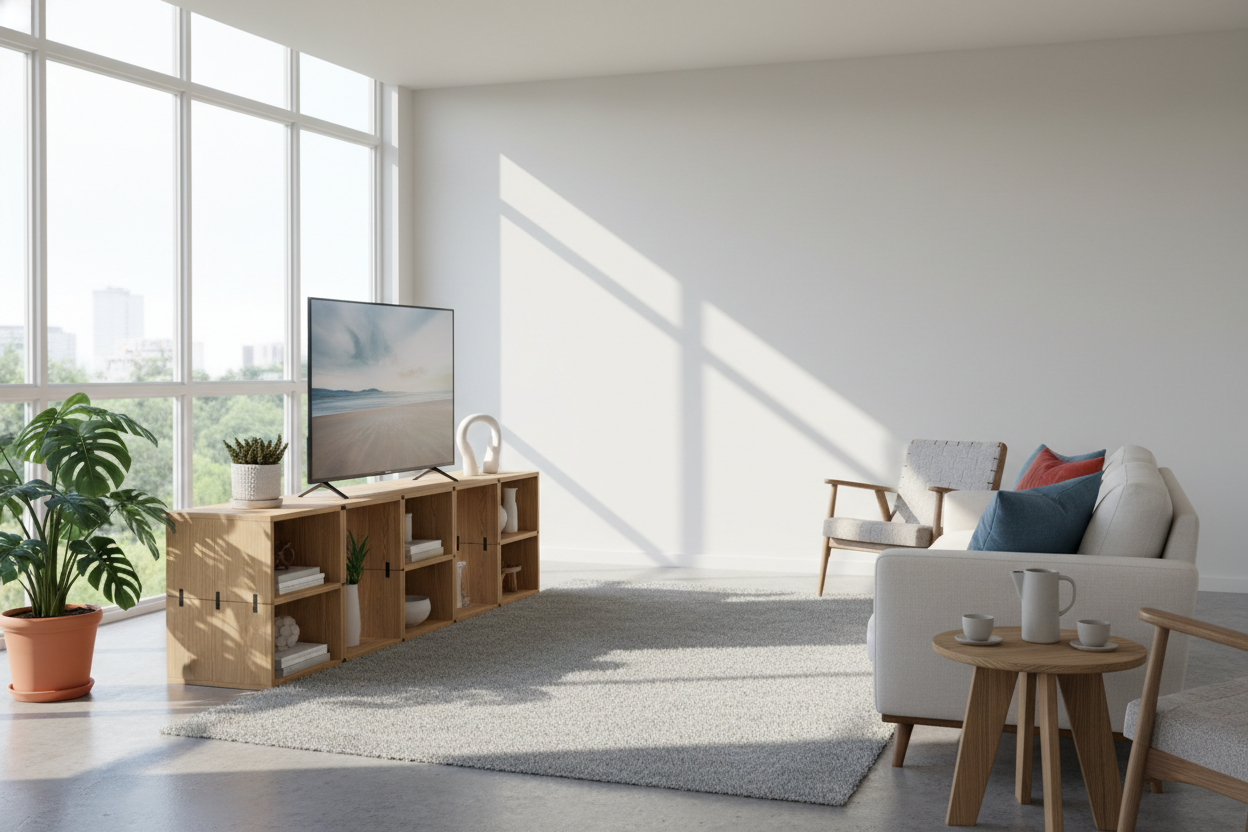
I was three hours deep into a 'simple' media console assembly when I realized Part H was upside down. The cam locks were already stripped, my thumb was bruised from a manual screwdriver, and I was genuinely considering just stacking my TV on a pile of pizza boxes. That was the night I swore off complex flat-packs forever and bought a no tools tv stand 55 inch.
Quick Takeaways
- Assembly takes 10 minutes—no screwdrivers or hammers required.
- Modern 55-inch TVs are light enough that high-tech plastic and particle board are surprisingly stable.
- It is a renter's dream because it disassembles without ruining the structural integrity.
- Cable management is the secret to making budget furniture look high-end.
My Breaking Point With Flat-Pack Furniture
We have all been there. You buy a piece of furniture that looks stunning in the professional photos, only to receive a 70-pound box filled with 400 tiny silver bits and a manual written in riddles. In my last apartment, I spent an entire Saturday trying to assemble what I thought was the oak tv stand 55 inch screens actually need. It was solid wood, heavy as a dead lift, and required a degree in structural engineering to put together.
By hour four, the doors were crooked and I had a literal blister from the Allen wrench. When I moved six months later, that 'sturdy' stand basically disintegrated the moment we tried to take it down the stairs. I decided then and there: if I cannot build it with my bare hands in the time it takes to boil pasta, I do not want it in my living room.
How Twist-and-Turn Assembly Actually Works
The magic of the tool-free design is usually a 'twist-and-turn' system. Instead of screws, you have threaded support tubes. You place a shelf, screw a tube into the pre-drilled hole using just your hand, and repeat until you have a tower. It is essentially adult Legos. There are no hidden cam locks to break and no 'Part G' that looks exactly like 'Part F' until it is too late.
I was skeptical that plastic or composite tubes could hold my tech, but the physics are solid. Because the weight is distributed vertically through the pillars, the tension keeps everything locked in place. You are not relying on a tiny screw thread biting into cheap MDF; you are relying on the entire surface area of the support tube.
The 60-Pound Question: Is It Safe for a Big Screen?
I will be honest: putting a $500 television on something that feels like a toy during assembly is nerve-wracking. I remember the anxiety I felt when I tested the thinnest tv stand I could find a few years back. You worry about the 'wobble factor.' But here is the reality: a modern 55-inch LED TV usually weighs between 30 and 45 pounds. Most tool-free stands are rated for 50 to 60 pounds on the top shelf.
The key is the center of gravity. These stands are typically lower to the ground and wider than they are tall, which makes them incredibly difficult to tip. I gave mine a good 'earthquake shake' once it was fully loaded with my TV and a heavy soundbar. It did not budge. If you have carpet, just make sure the feet are leveled, but on my hardwood floors, it is as steady as any $400 boutique piece.
Styling It So It Doesn't Look Like a College Dorm
The knock on no-tool furniture is that it can look a bit... temporary. If you leave the shelves bare and let the cables hang like spaghetti, it will look like a freshman dorm room. To fix this, I treat the open shelving like a curated gallery. I use oversized coffee table books to hide the plastic support pillars and trailing ivy plants to soften the edges.
Cable management is non-negotiable here. Since these stands usually have open backs, buy a pack of adhesive cable clips and run your power strips along the underside of the shelves. If you find the minimalist look too sparse, you can always browse a larger collection of tv stands to find something with baskets or bins that fit the openings perfectly. It is all about the layers.
The Ultimate Moving Day Test
The real victory came when my lease was up. Normally, moving a TV stand involves two people, a lot of swearing, and a high probability of the legs snapping off in the truck. With this no tools tv stand 55 inch, I just twisted the tubes off in reverse. In five minutes, the entire unit was a flat stack of boards that fit in the backseat of my car.
When I got to the new place, I put it back together in the same amount of time. No screws were stripped, and no structural integrity was lost. For anyone who moves every year or two, this is the only way to live. It is cheap, it is sturdy, and it respects your time.
FAQ
Will this stand hold an older, heavier TV?
If you have an older plasma screen that weighs 80+ pounds, skip the tool-free stuff. These are designed for modern, lightweight LED and OLED screens. Always check the specific weight capacity on the box before buying.
Are the support tubes made of metal or plastic?
It depends on the brand, but most use a high-density PVC or a light aluminum. Both are surprisingly strong under vertical pressure, but metal will obviously feel a bit more premium to the touch.
Can I add wheels to a no-tools stand?
Generally, no. These stands rely on a flat, stable base to keep the tension system secure. Adding casters would likely make the unit unstable and could cause the bottom shelf to warp over time.



Leave a comment
This site is protected by hCaptcha and the hCaptcha Privacy Policy and Terms of Service apply.