

















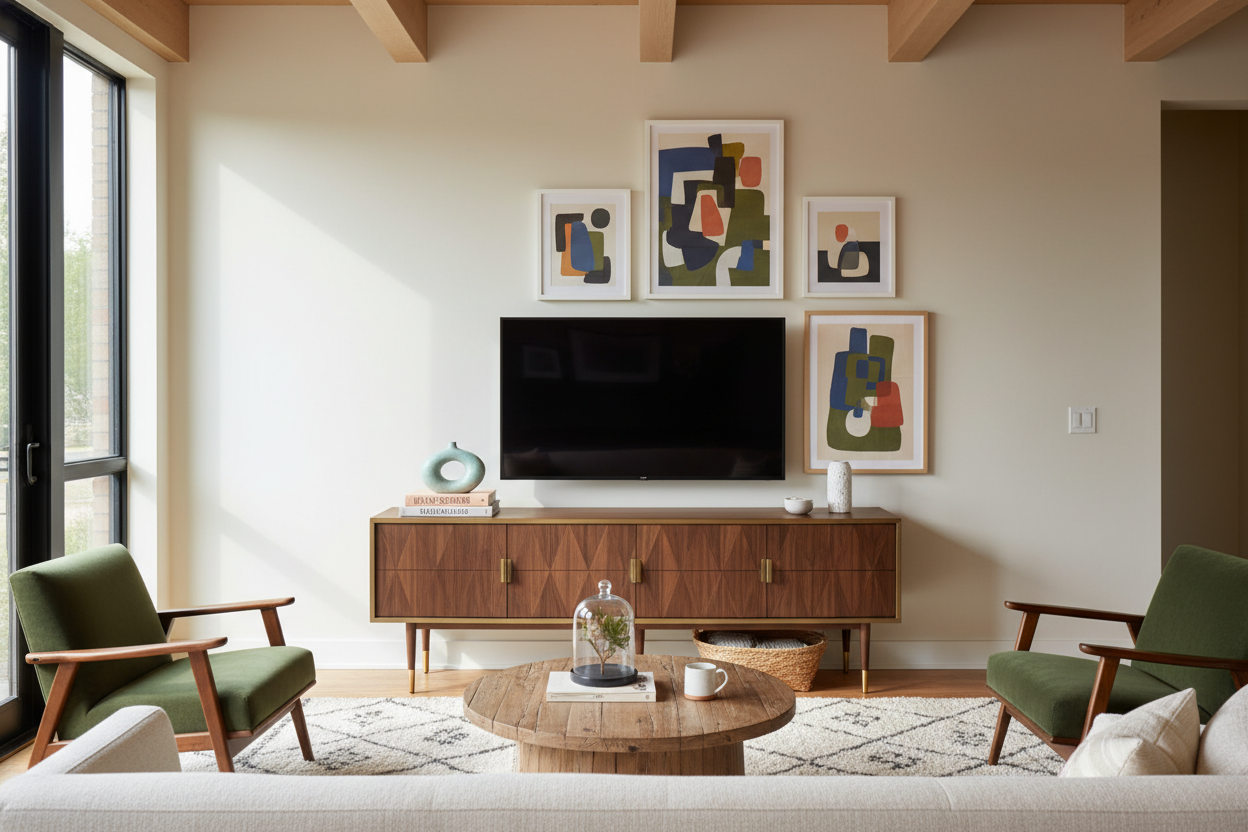
I’ve spent way too many hours staring at 47 open browser tabs, trying to find a piece of furniture that doesn't look like it came out of a cardboard box. We’ve all been there—you want eclectic tv stands that say 'I have taste,' but you’re terrified of your living room looking like a chaotic flea market booth where everything smells like mothballs.
The goal is a media wall that feels collected, not cluttered. It’s about finding that sweet spot where a 1970s brutalist cabinet can live happily next to a modern OLED screen without looking like a total accident. It takes a bit of strategy to keep the 'weird' looking intentional.
- Choose a base with heavy visual weight to anchor the screen.
- Keep the TV height at eye level, even when repurposing vintage finds.
- Aggressively hide every single plastic cable and black box.
- Repeat one key material or color across the room to tie it all together.
The Fine Line Between 'Curated' and 'Chaos'
Styling an eclectic tv stand is a high-wire act. On one side, you have the 'everything matches and it’s boring' vibe. On the other, you have 'I found this on the curb and just threw a TV on it.' To pull off the curated look, you need a grounding element.
The focal point of your living room shouldn't be a mess of competing textures. When you mix a mid-century silhouette with a boho rug and industrial lighting, the media unit has to act as the diplomat. It needs to be interesting enough to hold its own against the 'big black rectangle' of the TV, but solid enough to keep the room from feeling like it’s vibrating with too much energy.
Rule 1: Let the Console Do the Heavy Lifting
An eclectic media console shouldn't be a wallflower. If you pick something thin and spindly, the TV will overwhelm it. I look for pieces with bold materials—think fluted wood, heavy mixed metals, or thick cane detailing. These textures provide enough visual interest to compete with whatever is happening on the screen.
If you’re starting from scratch, I suggest browsing a solid collection of Tv Stands to find a piece with strong architectural bones. You want something that doesn't disappear. A chunky, hand-carved mango wood cabinet or a metal-framed unit with reclaimed wood inserts provides that 'heavy' look that anchors the entire wall. It makes the tech feel like an accessory to the furniture, rather than the other way around.
Rule 2: Don't Be Afraid to Repurpose Vintage Storage
I’m a huge fan of using non-traditional furniture as an eclectic tv console. I’ve seen people use old library card catalogs, low-slung industrial workbenches, and even vintage trunks. But there is a massive catch: the height. Most dining sideboards are 34 to 36 inches tall, which is great for serving food but terrible for watching a movie from a sofa.
There is an ongoing debate about Media Console vs. Credenza: What Does TV Stand For Anymore? and the answer usually comes down to your neck health. If you find a stunning vintage apothecary cabinet, measure it. If it puts the middle of the TV screen above your seated eye level, keep looking. A true media unit is usually 20 to 24 inches tall for a reason. If you go vintage, look for 'lowboy' dressers or long, lean credenzas that keep the screen at a comfortable height.
Rule 3: Hide the Tech, Display the Weird Stuff
Nothing kills the vibe of eclectic entertainment centers faster than a tangled nest of white power strips and black HDMI cables. It’s the ultimate buzzkill. To keep it looking chic, you have to be ruthless about cable management. I use adhesive clips along the back of the legs and tuck routers into woven baskets that still allow for airflow.
Once the 'ugly' stuff is gone, use that reclaimed surface space for the things you actually like. This is where the personality comes in. I like to layer a few brass objects, a stack of oversized art books, or a trailing Pothos plant. The key is to leave some negative space. If you cover every square inch of the console with 'quirky' finds, it stops looking like a design choice and starts looking like a shelf at a thrift store that hasn't been dusted since 1994.
The One 'Matching' Rule You Can't Break
The secret to making a mismatched room feel professional is repetition. You don't want your eclectic tv stand to be an island. If the stand is a dark, moody walnut, make sure there’s a walnut picture frame or a walnut leg on a chair somewhere else in the room. This 'echo' tells the eye that the piece belongs there.
It’s about intentionality. When you repeat a wood tone or a specific metal finish, it proves the mismatching was a choice, not an accident. It anchors the piece and gives the whole room a sense of cohesion that allows you to be as weird as you want with the rest of your decor.
My Biggest Styling Mistake
I once fell in love with a vintage 1920s steamer trunk and decided it would be my new eclectic tv stand. It looked incredible—full of character and history. But it was narrow. Every time I walked past it, the TV wobbled. Eventually, the lack of storage for my gaming console meant I had wires draped over the side like a tech-themed waterfall. I ended up selling it and buying a proper media unit with a similar weathered finish. Character is great, but stability and wire holes are better.
FAQ
How high should my TV stand be?
Ideally, the center of your TV should be at eye level when you’re sitting on your sofa. For most people, that means a stand between 18 and 24 inches tall. Anything higher and you’re asking for a neck ache.
Can I mix different wood tones?
Yes, absolutely. In fact, that’s the heart of the eclectic look. Just try to keep the undertones similar—don't mix a 'cool' grey-toned wood with a 'warm' orange-toned oak unless you really know what you're doing.
How do I stop my eclectic stand from looking messy?
The 'Rule of Three' is your friend. Group your decor in odd numbers and varying heights. And for the love of design, hide your remote controls in a decorative box or a drawer.

Leave a comment
This site is protected by hCaptcha and the hCaptcha Privacy Policy and Terms of Service apply.