

















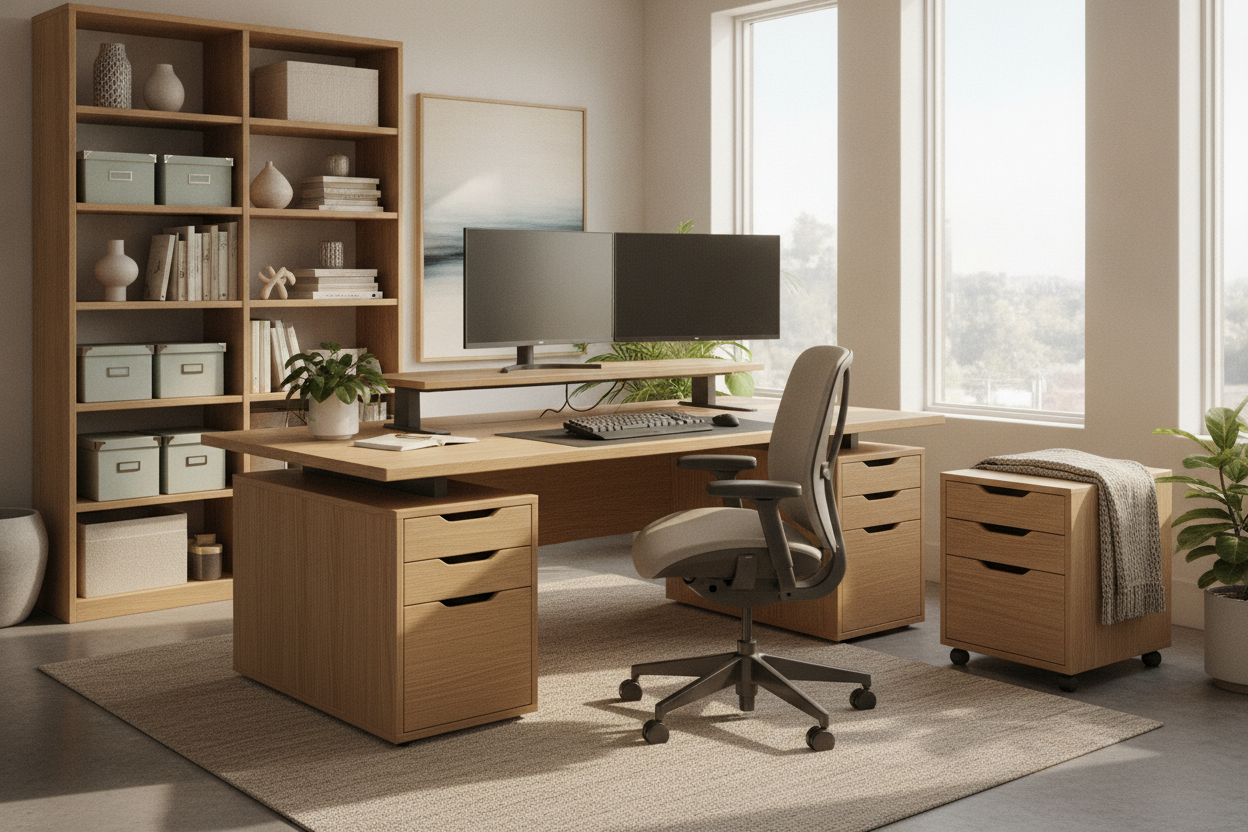
I spent $1,200 on a high-end mesh chair and another $300 on a gas-spring monitor arm, yet I was still ending my workdays with a burning sensation between my shoulder blades. I thought I had the ultimate setup. I was wrong. The culprit wasn't my seat; it was the 'minimalist' slab of wood I was using as a table. My ergonomic desk with drawers epiphany didn't happen until I realized my desk surface had become a graveyard for sticky notes, charging cables, and half-read books.
- Clutter forces you to lean forward, negating the support of expensive chairs.
- Integrated storage keeps the 'reach zone' clear for your mouse and keyboard.
- Modern drawer designs prioritize knee clearance to avoid the 'cubicle squeeze.'
- A clean surface allows for a neutral wrist angle and proper forearm support.
The Minimalist Desk Trap That Ruined My Back
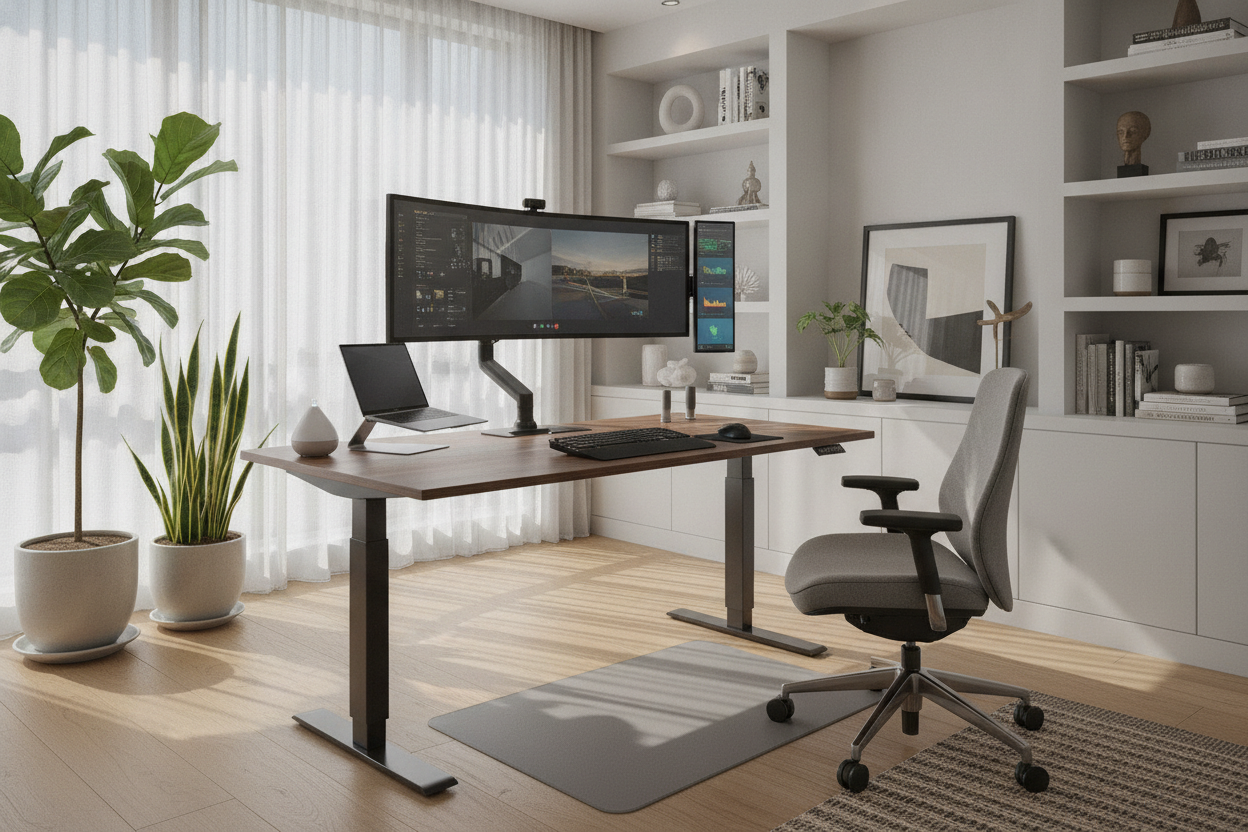
I fell hard for the 'aesthetic' workstation trend. You know the one: a massive, flat piece of walnut on thin metal legs. No drawers, no cabinets, just 'vibes.' For the first week, it looked like a Pinterest board. By week three, it was a disaster zone. Because I had nowhere to put my daily essentials, they lived on the desk. My notebook sat right where my mouse should be. My iPad was propped up against the monitor stand. To compensate, I started pushing my keyboard further away and hunching my shoulders to reach it.
I was basically playing a high-stakes game of Tetris just to find a spot for my coffee mug. This physical clutter created a mental fog, but more importantly, it wrecked my ergonomics. I couldn't rest my forearms on the desk because there was a stapler in the way. I was sitting at the edge of my seat, literally, because the 'stuff' on my desk was pushing me out of my ergonomic chair's support zone. Minimalist desks are great if you don't actually work at them, but for the rest of us, they are a recipe for a chiropractor visit.
Why an Ergonomic Desk With Storage is the Missing Link
The secret to good posture isn't just a straight spine; it's the ability to keep your tools within a comfortable range of motion. When you switch to an ergonomic desk with storage, you reclaim the 'neutral reach zone.' This is the semi-circle area your arms can reach without moving your torso. By tucking my hard drives and pens into a drawer, I finally had space to pull my keyboard close enough to keep my elbows at a 90-degree angle. No more reaching. No more leaning.
I eventually upgraded to an electric height adjustable desk with dual storage, and it was a total shift in how I move throughout the day. When the desk goes into standing mode, having those drawers attached means my essentials move with me. I'm not reaching down to a floor cabinet while standing, which is a fantastic way to pull a muscle. Clearing the deck allows you to position your monitor at the perfect distance—usually about an arm's length—without a pile of mail forcing the screen too far back or too close to your face.
The Legroom Dilemma (And How to Beat It)
The biggest pushback I hear about drawers is the 'knee-banger' factor. We all remember those heavy 1990s oak desks that felt like sitting in a cockpit with zero room to move your legs. Thankfully, furniture design has evolved past those chunky pedestals. When finding a contemporary desk with drawers, look for slim-profile center drawers or offset modules that sit to the side of your primary seating area.
I've tested desks where the drawer is only two inches deep—just enough for a laptop and a charging cable—which leaves plenty of space for your thighs. If you're tall, this is a non-negotiable. I personally look for at least 25 inches of vertical clearance from the floor to the bottom of the drawer. If a desk doesn't list that dimension, I move on. You want storage that hides your mess, not storage that bruises your kneecaps every time you cross your legs.
Yes, Apartment Dwellers Can Have Drawers Too
If you're working out of a bedroom corner or a hallway nook, you might think you have to choose between a desk that fits and a desk that stores. I've been there. In my old 500-square-foot apartment, I tried to make a tiny console table work as a desk. It was a nightmare. My back was constantly tight because I was trying to balance a laptop on a surface no bigger than a placemat.
The solution isn't a smaller table; it's a smarter one. A compact 28 inch wide desk with drawers can actually feel more spacious than a 40-inch table without storage. Why? Because the drawers act as a 'staging area.' You only have the one thing you're working on in front of you. When you're done, it goes in the drawer, and the 'office' disappears. It’s about psychological boundaries as much as physical ones.
My 3 Non-Negotiables for Buying a Workstation Now
After assembling and returning more desks than I care to admit, I've narrowed my criteria down to three essentials. First, the drawer slides must be full-extension. There is nothing more frustrating than a drawer that only opens halfway, leaving your pens trapped in the dark back corner. Second, check the weight capacity. If you're putting a heavy monitor or an iMac on a desk with a thin drawer frame, you'll see sagging within six months.
Finally, look at the surface material. I prefer a matte finish that doesn't reflect my monitor light back into my eyes. If you are looking for a reliable writing computer desk, prioritize stability over everything else. A desk that wobbles when you type will make you tense up your shoulders instinctively. Find something with a solid frame and integrated storage, and your back will thank you by Friday afternoon.
FAQ
Do drawers make a desk harder to assemble?
Usually, yes. Drawer slides are the most common point of failure for DIY furniture. Look for desks that use pre-installed tracks or high-quality ball-bearing slides rather than the cheap plastic rollers that pop out of the groove.
How deep should desk drawers be?
For ergonomics, shallow is actually better. A 2-to-3-inch deep drawer is perfect for stationery and electronics without eating into your legroom. If you need to store hanging files, look for a side-mounted pedestal drawer instead of a center one.
Can I add a keyboard tray to a desk with drawers?
It's tricky. Most center drawers occupy the space where a keyboard tray would mount. If you want a tray, you'll likely need a desk with side drawers only, or a very wide desk where the tray can sit between two storage modules.


Leave a comment
This site is protected by hCaptcha and the hCaptcha Privacy Policy and Terms of Service apply.