

















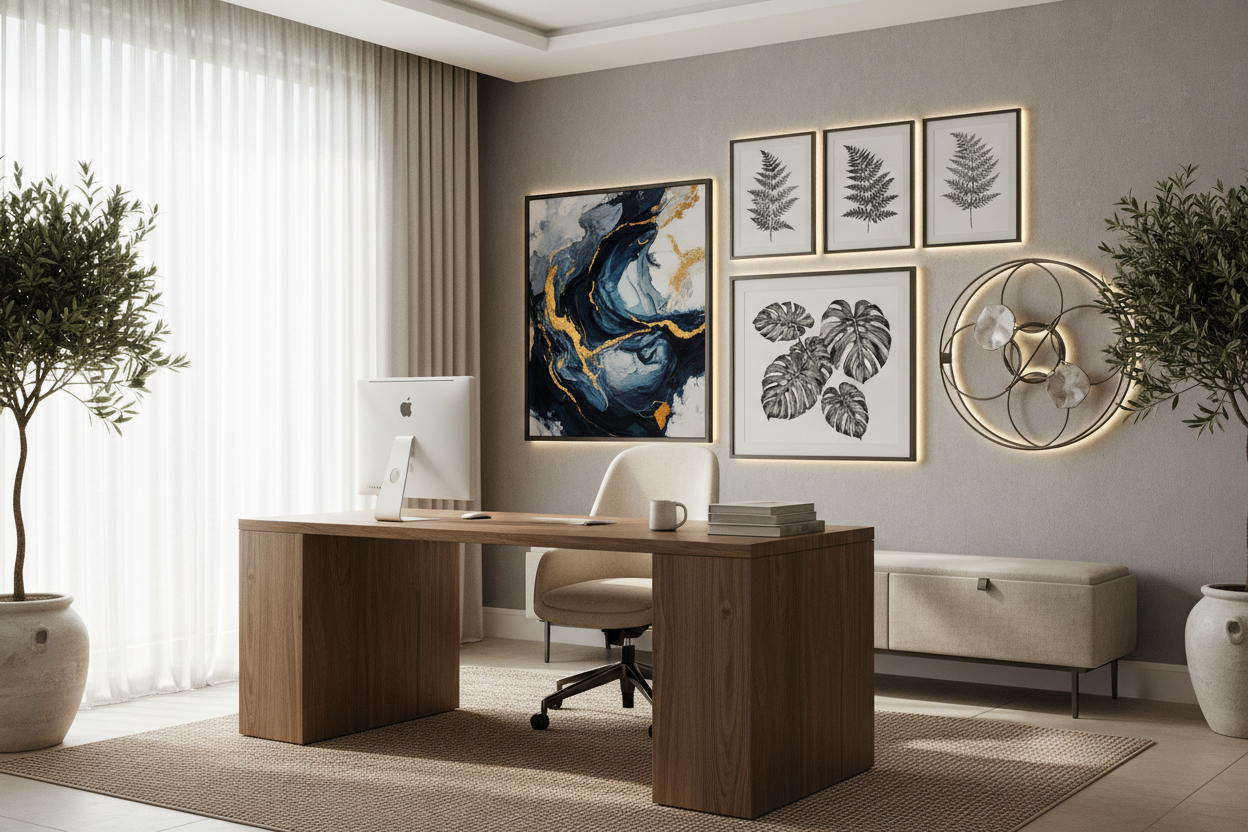
Staring at a sterile, blank wall while trying to meet a deadline isn't just boring; it is visually fatiguing. Your environment directly dictates your cognitive output, yet many professionals treat their workspace aesthetics as an afterthought. A well-curated view can reduce eye strain and provide a necessary mental break during intense focus blocks. In this guide, we explore sophisticated home office wall art ideas that balance professional polish with personal inspiration, ensuring your backdrop works as hard as you do.
Key Principles for Office Art Selection
- Visual Ergonomics: Choose art with resting points (negative space) to prevent visual clutter and cognitive overload.
- Acoustic Properties: Opt for canvas art for home office spaces with echo issues; the fabric absorbs sound better than glass-framed prints.
- Color Psychology: Select cool tones (blues, greens) for deep focus or warm accents (terracotta, ochre) for creative stimulation.
- Glare Management: Avoid standard glass glazing if the art sits opposite a window or ring light; use matte finishes or museum glass.
Curating the Best Wall Art for Home Office Focus
When selecting the best wall art for home office environments, we must move beyond mere decoration and consider "visual ergonomics." The artwork should anchor the room without screaming for attention. Large-scale abstract pieces often work best here. They provide texture and color without forcing the brain to decipher a complex narrative or literal scene every time you glance up from your monitor.
Materiality: Canvas vs. Framed Prints
The medium matters as much as the image. Home office art prints encased in heavy frames add a sense of structure and authority, ideal for traditional or transitional spaces. However, if your office feels small or "boxy," a gallery-wrapped canvas can feel lighter and less constricting because it lacks a hard boundary.
Furthermore, consider the texture. Home office decor wall art featuring heavy impasto brushstrokes or mixed media adds depth. This tactile element contrasts beautifully with the sleek, flat surfaces of monitors and laminate desks, restoring a sense of organic balance to a tech-heavy room.
Strategic Placement and Scale
A common error is undersizing the artwork. Wall pictures for home office setups should generally occupy 60% to 75% of the available wall space above a piece of furniture, such as a credenza or the desk itself. If the art is too small, it looks like a floating postage stamp, making the room feel disjointed.
The "Zoom Background" Strategy
If the wall is visible during video calls, the best art for home office backdrops conveys professionalism. Avoid chaotic gallery walls directly behind your head, as they can be distracting to others on the call. Instead, opt for a singular, substantial piece of art for home office walls that aligns with your personal brand. Symmetry is your friend here; a pair of vertical prints flanking your seating position creates a balanced, architectural look on camera.
Lessons from My Own Projects
I learned a hard lesson about home office wall pictures during a project for a tech executive in Seattle. We installed a stunning, high-gloss photography print directly behind his desk. It looked incredible in person. However, the first time he turned on his ring light for a board meeting, the artwork turned into a giant mirror. The glare completely obscured the image and created a blinding reflection for the camera.
I had to rush replace the glazing with non-reflective museum acrylic. Now, whenever I specify canvas art for home office or framed pieces, I physically sit in the client's chair and test the lighting angles before hammering in a single nail. It’s a small detail, but functional visibility is paramount in a workspace.
Conclusion
Transforming your workspace requires intention. The right art doesn't just fill a void; it defines the energy of the room. Whether you choose acoustic-friendly canvas or sleek, framed photography, ensure the piece supports your workflow rather than distracting from it. Treat your walls as part of your productivity toolkit.
Frequently Asked Questions
How high should I hang art in my home office?
The center of the artwork should be at eye level, which is typically 57 to 60 inches from the floor. However, if you are hanging art above a desk where you will mostly view it while seated, you can lower it slightly (6–8 inches above the desktop) to keep it within your seated line of sight.
What is the best subject matter for productivity?
Nature scenes and landscapes are proven to lower cortisol levels and reduce stress. Abstract minimalism is also excellent for maintaining focus, as it adds aesthetic value without narrative distraction.
How do I choose art for a small office?
In a compact space, one large statement piece often makes the room feel bigger than several small pieces, which can create visual clutter. Look for art with a horizon line or depth to visually "push" the wall back.


Leave a comment
This site is protected by hCaptcha and the hCaptcha Privacy Policy and Terms of Service apply.