
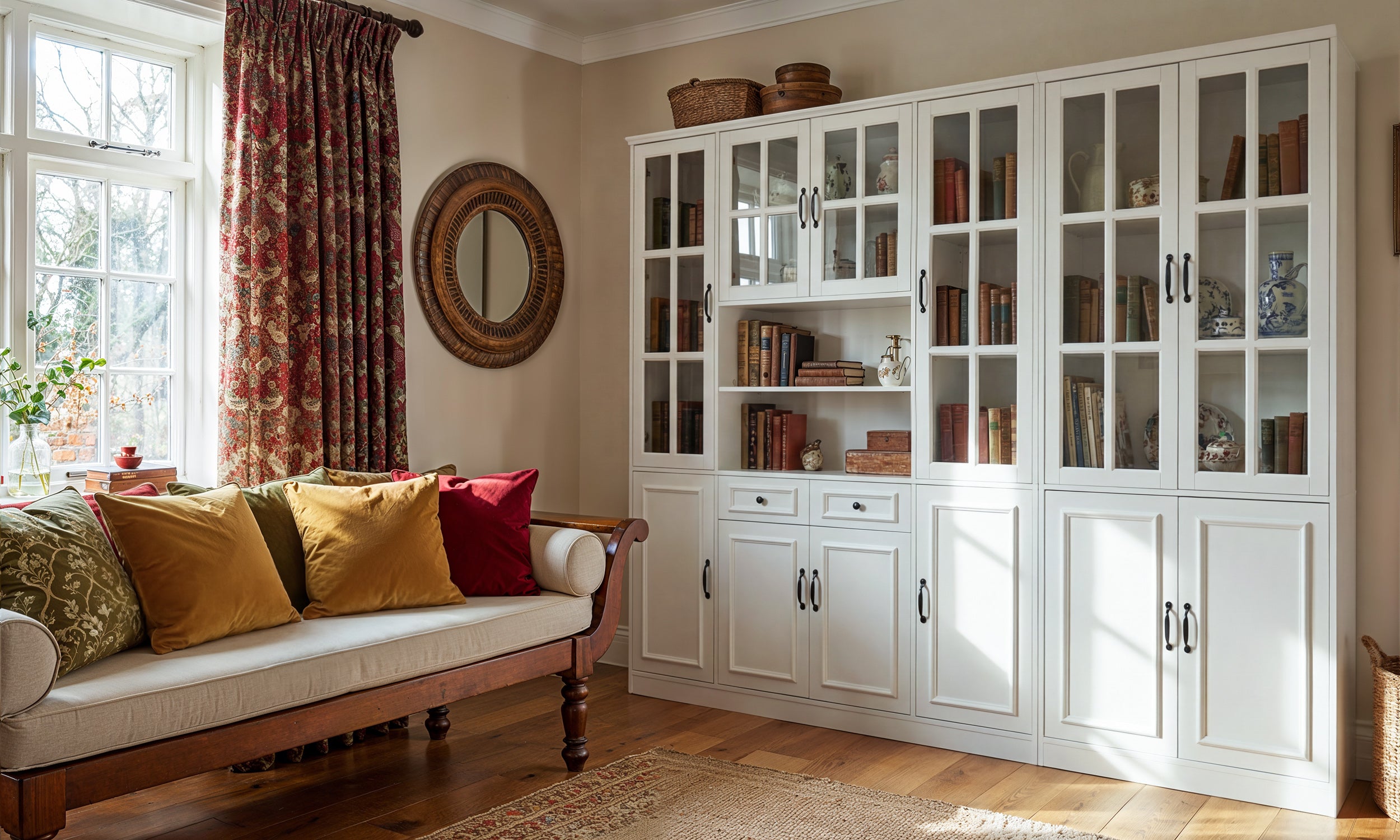
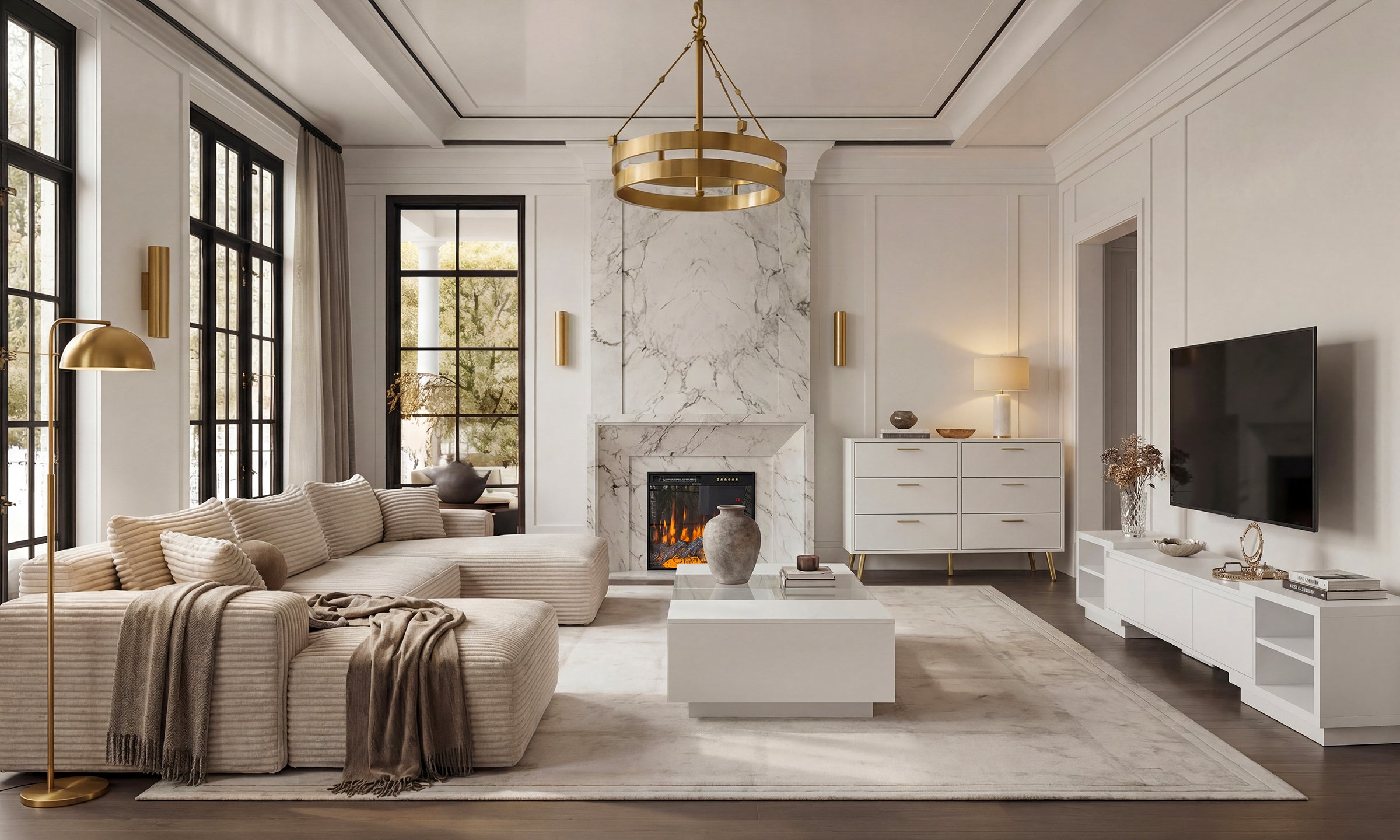
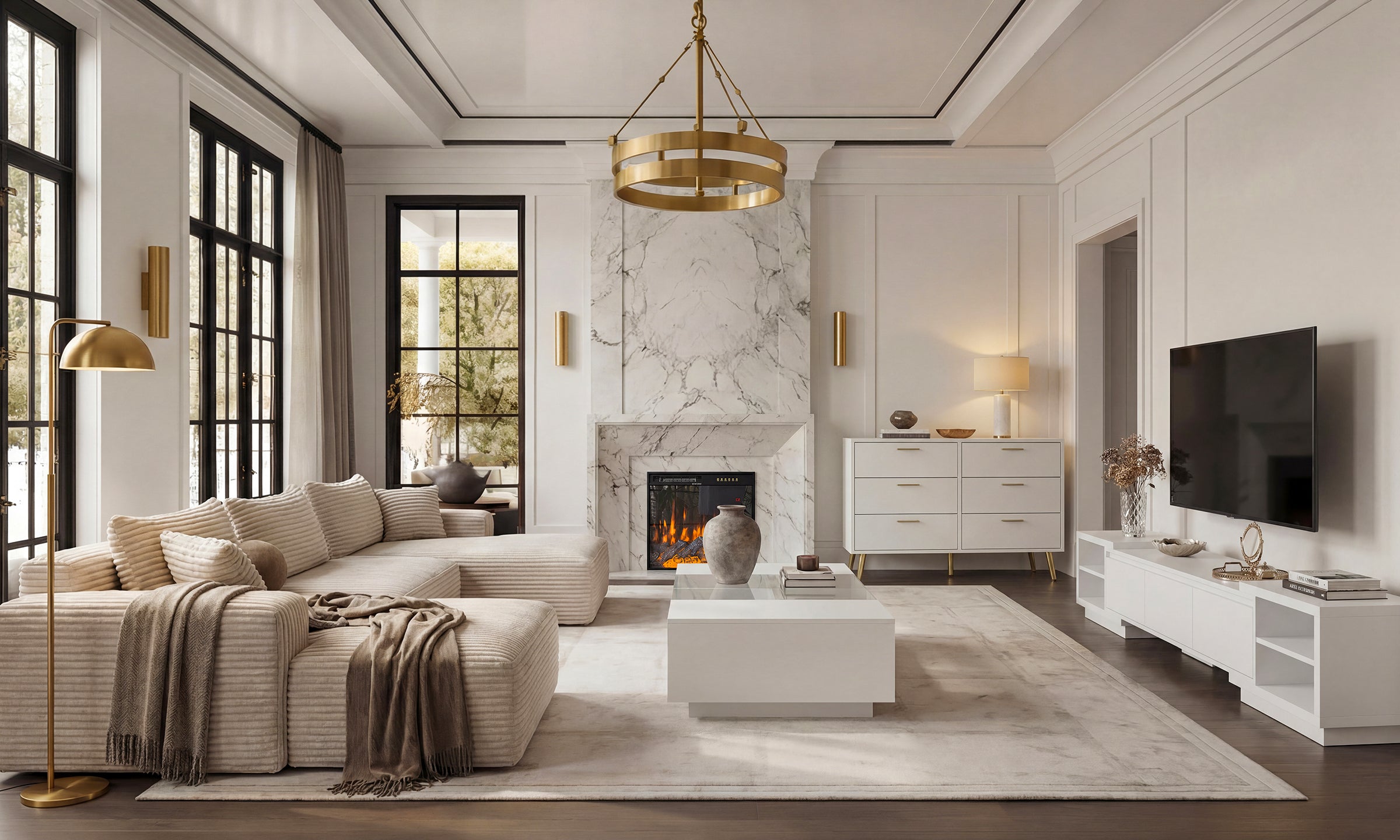
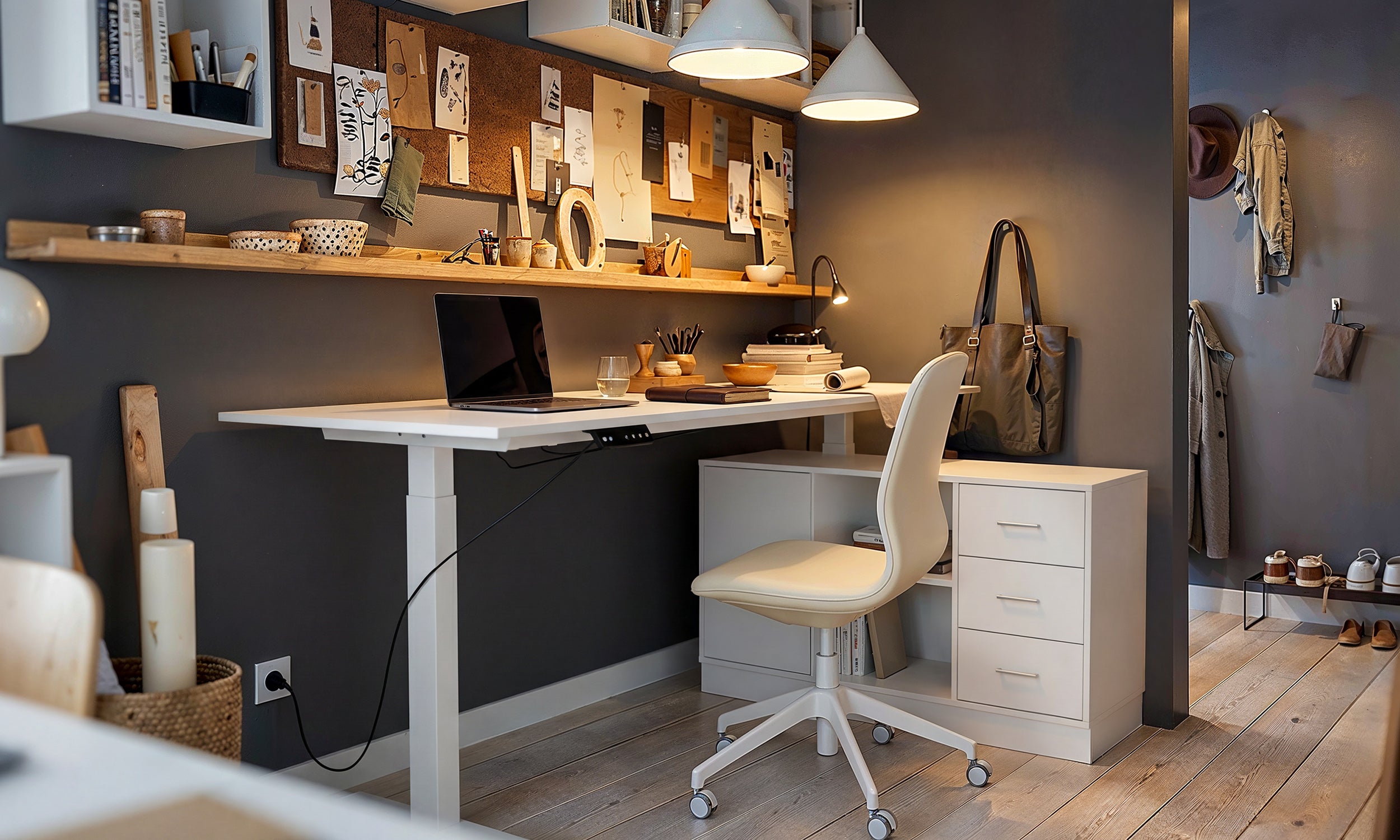
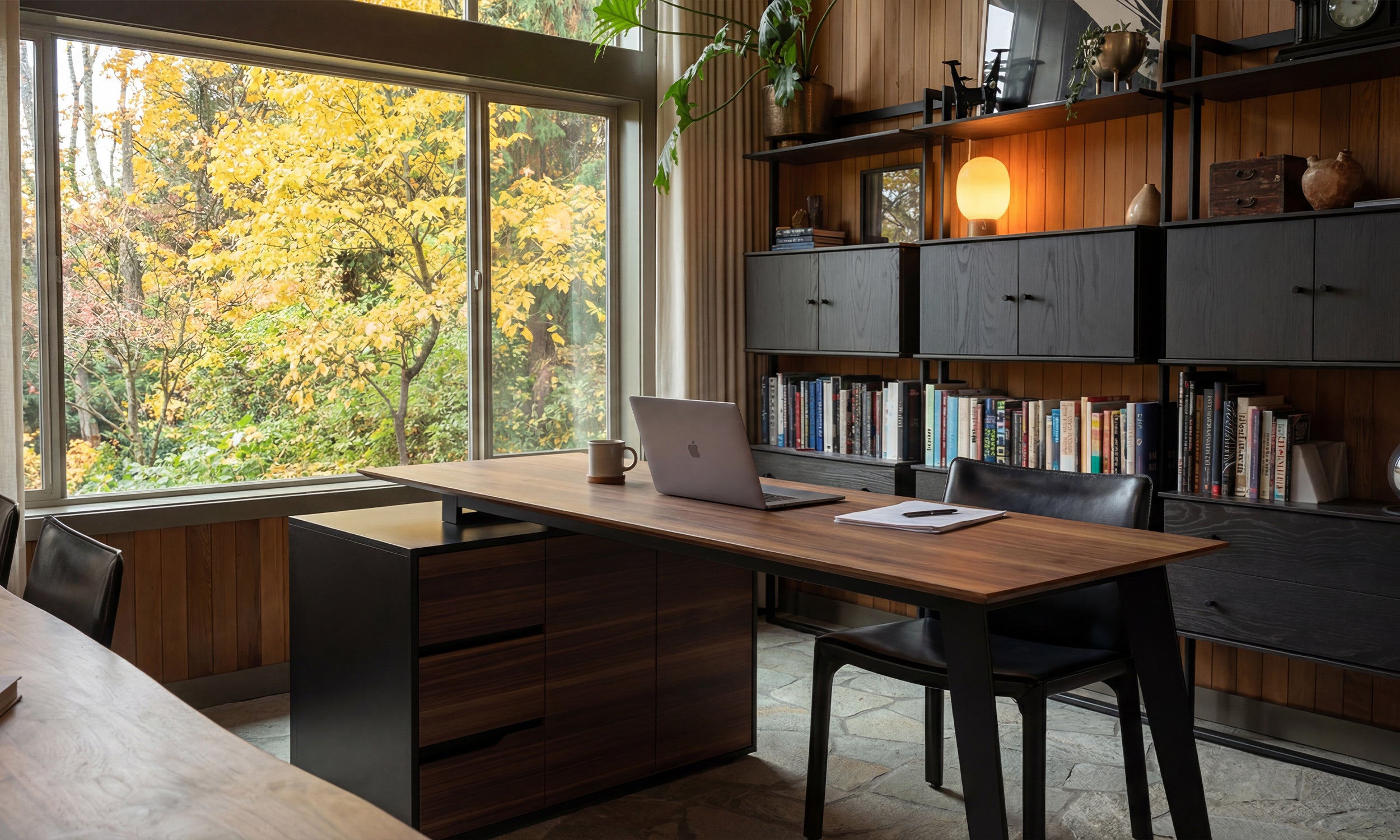



An alcove desk is a desk set into a recess: beside a chimney breast, under the stairs, inside a closet or between two walls. It is either a built-in top fixed wall to wall, or a freestanding desk a little narrower than the recess. For a freestanding desk, the recess should be at least 2 inches wider than the desk at its narrowest point, because baseboards can take up to 1 inch on each side.
Below: how to measure, depth, knee room, shelves and lighting, then six alcove desk ideas and six freestanding desks from the FUFU&GAGA writing and computer desk collection, narrowest first.
Quick answer
- Width: desk width plus 2 inches. A 39.4-inch desk needs a 41.4-inch alcove; a 47.2-inch desk needs 49.2 inches.
- Depth: the desk may stick out of a shallow recess. Add 36 inches behind it for the chair.
- Height: a surface 28 to 30 inches high, with 20 to 28 inches clear for your legs.
- Shelves: first shelf at least 16.1 to 17.7 inches above the desktop, so a 24-inch or 27-inch monitor fits under it.
What is an alcove desk?
An alcove is "a small recessed section of a room or an arched opening (as in a wall)" (Wikipedia, Alcove). An alcove desk puts the work surface inside that recess, so it takes little floor from the rest of the room. The same setup is also called an alcove office, alcove workspace, alcove workstation or desk nook. There are two ways to do it:
| Point | Built-in alcove desk | Freestanding desk in an alcove |
|---|---|---|
| Fit | Cut wall to wall, no gaps | Desk width plus about 2 inches |
| Depth | Cut to suit the recess | Fixed; 21.1 to 31.5 inches in the picks below |
| Fixing | Supports screwed into three walls | None; a tall hutch should be anchored |
| Best for | Odd widths, very shallow recesses | Renters, common sizes, a quick setup |
How is a built-in alcove desk made?
A built-in alcove desk is usually one board resting on wood strips fixed to the back and side walls, with no legs. The Real Homes project uses a 19 mm medium-density fiberboard top on one back strip and two side strips screwed to the walls, and says to check for hidden pipes and cables before drilling (Real Homes, How to create an alcove office). The shelves above are made the same way.
Walls in a recess are rarely straight or square. Fine Woodworking's method for fitted furniture starts narrower than the space, leaves the face-frame edges 3/8 inch too wide for trimming to the wall, and checks how flat the walls are first (Fine Woodworking, Built-ins that fit like a glove). For a desk top, trace a cardboard template of the recess onto the board, and cut the cable hole before the top goes in.
How to measure an alcove for a desk
Measure the alcove in several places and plan around the smallest number. Layoutr's room-measuring guide warns against assuming opposite walls are equal, because older buildings often differ by 2 inches or more (Layoutr, How to measure a room).
- Width at three heights: baseboard to baseboard at the floor, wall to wall at desk height (about 29 inches), and at shelf or hutch height.
- Width at the back and the front, since side walls often splay or close in.
- Depth on both sides, from the back wall to the front edge of each side wall.
- Baseboards (skirting boards): Layoutr notes they project 0.6 to 1 inch per side, and furniture stops against the baseboard, not the wall.
- Limits: a window sill, sloped ceiling or stair soffit, plus outlets, radiators and pipes.
The arithmetic: desk width plus 1 inch of baseboard on each side. If the narrowest wall-to-wall width is at least the desk width plus 2 inches, the desk slides in: 49.2 inches for a 47.2-inch desk. The comparison table below gives the figure for each pick.

How deep should an alcove desk be, and how much chair space does it need?
An alcove desk should be deep enough for your screen and keyboard; it does not have to match the depth of the recess. Plan7Architect's home office guide gives 24 to 30 inches for a standard desk (Plan7Architect). Compact writing desks run 21.7 to 23.6 inches in the picks below.
One 24-inch monitor has a base 7.2 inches deep (BenQ GW2490 specifications), so a 21.7-inch desk leaves 21.7 - 7.2 = 14.5 inches in front for a keyboard. OSHA says to place the monitor at least 20 inches from your eyes (OSHA, Monitors).
A desk deeper than the recess projects into the room: a 21.7-inch desk in a 14-inch-deep alcove stands 21.7 - 14 = 7.7 inches proud. For the chair, Plan7Architect recommends at least 36 inches behind the desk edge, and Dimensions.com gives 36 to 42 inches for a chair that moves (Dimensions.com, office workstation clearances). From the back wall that is 21.7 + 36 = 57.7 inches. Our small home office dimensions guide applies the same clearances room by room.
Alcove desk height and knee space
The work surface of an alcove desk should sit 28 to 30 inches from the floor, the desk height range Dimensions.com gives. The same range answers the built-in desk height question; choose carefully, because a fixed top cannot be changed later.
Under the top, OSHA calls for leg clearance at least 20 inches wide, 17 inches deep at knee level and 24 inches deep at foot level (OSHA, Work space). It says the space should generally be 20 to 28 inches high and free of files, CPUs, books and storage (OSHA, Desks). A narrow alcove has no room beside the desk for a drawer unit or computer tower, so plan where those go.
Alcove desk and shelves: how high should the first shelf go?
The first shelf above an alcove desk should clear your monitor on its stand. From the maker's spec pages, a 24-inch monitor stands 16.1 inches high and a 27-inch monitor 17.7 inches (BenQ GW2790 specifications). Add room to tilt the screen, and check your own model.
- Shelf depth: keep shelves shallower than the desk. Plan7Architect gives 12 to 16 inches for a bookcase; a 12-inch shelf over a 21.7-inch desk leaves 21.7 - 12 = 9.7 inches of open desk in front.
- Eye level: OSHA says the top of the screen should be at or slightly below eye level, so set the shelf around the screen, not the reverse.
A desk with a hutch gives you desk and shelves in one piece. For storage behind doors, see our armoire desk guide.
How do you light a dark alcove desk?
Light an alcove desk from a lamp on or just above the work surface, because the side walls and any shelf block the ceiling light. OSHA says to provide supplemental task or desk lighting for reading and writing, to use light, matte colors on walls and ceilings to reflect indirect light, and to use blinds or drapes on bright windows (OSHA, Workstation environment). A light strip under the lowest shelf works too.
Outlets and cords in an alcove
Find the nearest outlet before choosing the desk. Layoutr points out that socket positions decide where a desk can go without extension cords across a walkway. The CPSC says extension cords should only be used temporarily and should not run under carpets, through doorways or under furniture (CPSC, Household Extension Cords Can Cause Fires). For a permanent alcove office, have a licensed electrician add an outlet in the recess.
Can a standing desk go in an alcove?
Yes, if nothing sits in its lift path. The top moves, so the width must be clear at every height it passes, with no shelf, sill or sloped ceiling above it. The 63-inch standing desk below rises to 44.9 inches; with a 27-inch monitor the highest point is 44.9 + 17.7 = 62.6 inches from the floor. Measure the alcove width at 30 and at 45 inches, not only at the floor.
Six alcove desk ideas, with the numbers
1. Closet office
Plan7Architect says a converted closet works if it is at least 24 inches deep and around 5 feet wide; the chair sits out in the room. In a 60-inch closet a 47.2-inch desk leaves 60 - 47.2 = 12.8 inches, or 6.4 each side. Measure the door opening too; it is often narrower than the inside.
2. Under the stairs
Height is the limit. Where the monitor stands you need desk height plus monitor height: 29.5 + 16.1 = 45.6 inches for a 24-inch screen. Put the screen and chair at the tall end.
3. Chimney-breast alcove
These recesses are often shallow. A built-in top only 14 inches deep leaves 14 - 7.2 = 6.8 inches in front of a monitor base, which suits a laptop. A freestanding desk that projects past the breast gives more depth.
4. Window alcove or bay
Compare the sill height with the desk height, 28.7 to 29.5 inches for the fixed desks below. A bay 65 inches wide takes a 63-inch desk, and blinds keep glare off the screen.

5. Bedroom nook
A 41.4-inch nook takes a 39.4-inch desk, and the chair needs 57.7 inches from the back wall before the bed gets in its way. Our desk in a small bedroom guide covers the rest of the room.
6. Hallway niche
Plan7Architect gives 30 to 36 inches for a walkway past a desk. A 21.7-inch desk in a 12-inch-deep niche projects 9.7 inches, so a 48-inch hallway keeps 48 - 9.7 = 38.3 inches clear with the chair tucked under.
Our picks: freestanding desks by alcove width
Sizes and features are as listed for each product. "Alcove width" is the desk width plus 2 inches.
39.4" or 47.2" Mid-Century Modern Wooden Study Desk
The narrowest writing desk here comes in two sizes: 39.4" W x 21.7" D x 29.5" H and 47.2" W x 21.7" D x 29.5" H. It has an MDF top with rounded corners on four solid wood legs, two small drawers on wooden slides and a listed capacity of 220 lb.
Alcove width: 41.4 inches for the small size, 49.2 inches for the large.
Best for: a small alcove desk in a closet, bedroom nook or chimney-breast recess.
Skip it if: you need drawers for files (each is rated for 3 lb), or a deep top for a large monitor.
47.2" Modern Black Writing Desk with Drawer
A black writing desk on turned legs, listed at 47.2" W x 23.6" D x 29.4" H overall, with one pull-out drawer (19.1" x 12.5"). The listing describes it as rubberwood with MDF, rated for 50 lb on top and 15 lb in the drawer.
Alcove width: 49.2 inches.
Best for: a laptop and writing desk beside a chimney breast or in a hallway niche.
Skip it if: your gear weighs more than 50 lb, or you need an exact surface height: the listing gives 29.4" overall and also a 28" desk height.
51.2" Minimalist Solid Wood Writing Desk
Solid rubberwood top and base, 51.2" W x 27.6" D x 28.7" H, with rounded corners and a listed capacity of 80 lb. It is the deepest fixed desk here, leaving 27.6 - 7.2 = 20.4 inches in front of a monitor base.
Alcove width: 53.2 inches.
Best for: a 5-foot closet office, or a wide recess where the desk can project into the room.
Skip it if: you need drawers (the listing shows none), or floor space is tight: the chair needs 27.6 + 36 = 63.6 inches from the back wall.
54.3" Mid-Century Modern L-Shaped Corner Desk with Drawers
An L-shaped desk for a wide recess: 54.3" W x 40.9" D x 29.1" H overall, with a 54.3" W x 23.6" D desktop on steel legs. Three drawers (35 lb each) and a press-to-open cabinet sit under the return, on the left or right as you choose during assembly. The desk holds 180 lb.
Alcove width: 56.3 inches, with 40.9 inches of wall on the cabinet side. If your writing hand decides the side, see our left handed desk guide.
Best for: an alcove office that needs closed storage without a separate cabinet.
Skip it if: the recess is shallow on both sides, so the cabinet would stand out in the room, or you keep hanging files (the drawer interior is 4.2" high).
62.2" Traditional Writing Desk with Bookcase, 9 Drawers and LED Lighting
The desk-and-shelves pick: 62.2" W x 21.1" D x 82.7" H, with a 59.1" wide desktop, a bookcase hutch with adjustable shelves and cabinets, nine drawers and plug-in LED lighting in warm, natural or cool white. Listed capacity is 200 lb. The listing's dimension diagram shows 19.5 inches between the desktop and the hutch, enough for a 16.1-inch or 17.7-inch monitor.

Alcove width: 64.2 inches, under a ceiling higher than 82.7 inches. The listing says wall anchoring hardware is included. Use it: the CPSC's Anchor It! campaign says to anchor all furniture with drawers, doors and shelves, and our guide to anchoring a bookcase to the wall shows how.
Best for: a wide, full-height alcove where desk, shelves and lighting should be one piece.
Skip it if: the recess has a window, sloped ceiling or stair above it, you cannot fix into the wall, or you need a stated desk height (the listing gives none).
63" Modern Walnut Standing Desk with Electric Height Adjustment
An electric sit-stand desk with a 63" W x 31.5" D walnut-look top that lifts from 29.6" to 44.9", with a four-preset memory controller and built-in cable management. Listed capacity is 110 lb.
Alcove width: 65 inches, clear from the floor to above the raised top.
Best for: a bay or window alcove with nothing above the desk.
Skip it if: a shelf or sill sits lower than about 62.6 inches over the desk, floor space is tight (31.5 + 36 = 67.5 inches from the back wall), or your gear weighs more than 110 lb. It has no drawers.
Compare the picks
| Desk | W x D x H as listed | Alcove width | Storage | Best for |
|---|---|---|---|---|
| Wooden study desk, small | 39.4 x 21.7 x 29.5 in | 41.4 in | 2 small drawers | Narrow nooks |
| Wooden study desk, large | 47.2 x 21.7 x 29.5 in | 49.2 in | 2 small drawers | Closets, bedrooms |
| Black writing desk | 47.2 x 23.6 x 29.4 in | 49.2 in | 1 drawer | Laptop and writing |
| Solid wood desk | 51.2 x 27.6 x 28.7 in | 53.2 in | None | Deeper top |
| L-shaped corner desk | 54.3 x 40.9 x 29.1 in | 56.3 in | 3 drawers, cabinet | Closed storage |
| Desk with bookcase hutch | 62.2 x 21.1 x 82.7 in | 64.2 in | Hutch, 9 drawers | Desk and shelves |
| Walnut standing desk | 63 x 31.5 in, 29.6 to 44.9 in high | 65 in | None | Sit-stand in a bay |
Alcove desk checklist
- Width at the floor, desk height and shelf height, back and front; use the smallest.
- Freestanding: desk width plus 2 inches.
- Depth: desk depth plus 36 inches for the chair.
- Height: 28 to 30 inches, with 20 to 28 inches clear for legs.
- First shelf above the monitor: 16.1 to 17.7 inches for the two models here.
- A task lamp, and an outlet in reach.
- Anchor a tall hutch to the wall.
FAQ
What is the ideal height for a built-in alcove desk?
Set a built-in alcove desk 28 to 30 inches high, the range Dimensions.com gives for desks, and keep 20 to 28 inches clear under the top for your legs.
How much narrower than the alcove should a desk be?
About 2 inches narrower than the narrowest wall-to-wall width. Baseboards project 0.6 to 1 inch per side and furniture stops against them, so a 47.2-inch desk needs about 49.2 inches.
Can I have an alcove desk in a rental?
Yes. Use a freestanding desk about 2 inches narrower than the recess, with a lamp for light. Nothing is drilled and the desk leaves with you. Ask the landlord before anchoring a tall hutch.
What is the best desk for a tiny alcove or box room?
The narrowest desk that still holds your screen. Among our desks that is the 39.4-inch wooden study desk, which needs a recess about 41.4 inches wide. For anything narrower, a built-in top cut to the recess is the usual answer.
Ready to measure? Compare widths and depths against your alcove in the FUFU&GAGA writing and computer desk collection.

Leave a comment
This site is protected by hCaptcha and the hCaptcha Privacy Policy and Terms of Service apply.