


















I remember trying to close a five-figure contract while my laptop sat on a wobbly vintage vanity I’d repurposed. Every time I typed, my external monitor shook like a minor tremor. It is remarkably hard to feel like a CEO when your office business desk is a piece of residential furniture that is literally bowing under the weight of a printer.
If you are running a real company from your spare bedroom, you have to stop shopping in the 'accent table' aisle. You need hardware that matches your overhead. Switching to a commercial-grade surface was the moment I stopped feeling like a freelancer and started acting like an owner.
- Commercial desks handle 200+ lbs, while home desks often buckle at 50.
- Look for 30-inch depth to avoid eye strain from monitors being too close.
- Built-in cable management is the difference between a pro setup and a disaster.
- High-pressure laminate (HPL) is your best friend for scratch resistance.
The Kitchen Table Hustle Is Cute, Until It Isn't
We’ve all been there. You start with a laptop and a dream at the dining table. But then you add a second monitor, a docking station, a mechanical keyboard, and a massive external hard drive. Suddenly, you are playing a high-stakes game of Tetris every time you want to set down a cup of coffee.
The biggest mistake I made early on was buying a standard writing computer desk. It looked great on Instagram with its spindly gold legs and white lacquer top. But the second I tried to clamp a dual-monitor arm to it, the wood started to crack. Those desks are designed for writing a thank-you note, not for a 10-hour workday involving three peripherals and a stack of client contracts.
Real corporate office desks offer the surface area you actually need. You want enough room to have a notebook open next to your keyboard without overlapping. If you are constantly moving things around just to find space for your mouse, your desk is too small for a professional workflow.
What Actually Makes It a True Desk for Business?
The difference between residential and commercial furniture is mostly about what is happening under the hood. Most 'home' desks are made of low-density fiberboard that feels like cardboard if you ever have to move it. A real desk for business is a tank. It is built to survive a decade of 40-hour weeks without the drawers sagging or the legs wobbling.
Structural integrity is everything. I once bought a cheap 'business' desk from a big-box store that used cam-locks for everything. Six months in, the whole thing leaned three degrees to the left. Now, I look for heavy-duty steel frames and tops that are at least an inch thick. You want something that does not vibrate when your phone rings on silent.
Then there is the finish. You want high-pressure laminate. It is not as 'romantic' as solid wood, but it is practically bulletproof. I’ve dropped heavy staplers and spilled boiling tea on my current setup, and it still looks brand new. Corporate desks are built for utility first, and that is exactly what a growing business needs.
Commercial Furniture Doesn't Have to Scream 'Cubicle'
I used to be terrified that buying a 'business' desk meant my home office would look like a 1990s accounting firm. We’ve all seen those depressing gray rectangles. But the market has changed. You can get the durability of a commercial piece with the aesthetic of a high-end boutique hotel.
The trick is in the silhouette. Skip the chunky, floor-length pedestals and look for 'floating' tops or U-shaped legs. When you style a desk in home office environments, the accessories do the heavy lifting. A heavy-duty commercial desk looks incredibly executive when paired with a high-end brass lamp and a leather desk mat.
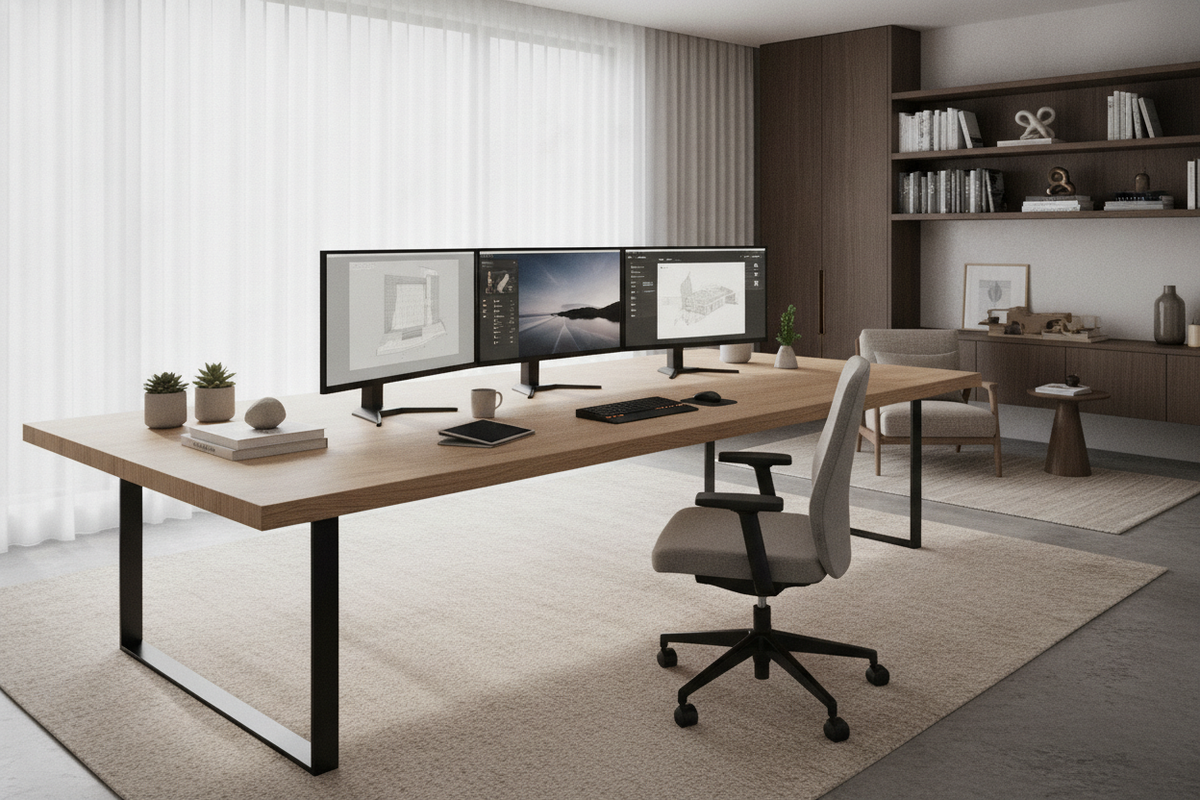
I went with a dark walnut finish and black steel legs. It feels substantial and serious, but it still fits the vibe of my house. It is about finding that balance where a client walks in and thinks 'This person is successful,' not 'This person bought their furniture at a liquidation sale.'
The 3 Non-Negotiable Features for Client-Facing Spaces
If you ever host people in your office, your desk is your first impression. First, you need a modesty panel. If your desk is in the center of the room, no one wants to see your knees or the tangled mess of power strips underneath. It creates a visual barrier that feels much more professional.
Second, integrated power is a must. Fumbling around on the floor to find an outlet for a client’s laptop is embarrassing. My current office desk for business has a recessed power hub built right into the top. It is a small detail that makes a massive impact during a presentation.
Third, think about the L-shape. Even if you do not think you need the extra space, that return is where you put the 'mess'—the printer, the scanner, the stacks of paper—leaving the main desk clean for the client to look at. For more on these specs, check out this business office desk buying guide to get your measurements right before you pull the trigger.
My Top Pick for Hosting Clients in Your Workspace
If I were starting a boutique agency today, I would go straight for a setup that commands the room. You want something that acts as a focal point. My personal recommendation for anyone doing serious in-person consulting is this L shaped executive counter for office.
It is a power move. The height and the scale of it create a natural 'zone' for work. I’ve found that having a desk with a slightly raised counter side is great for signing documents or reviewing plans while standing. It feels less like a bedroom and more like a headquarters.
Just make sure you measure your doorway before it arrives. I once had to take a door off its hinges because I forgot that commercial desks are often deeper than standard residential ones. It was a headache, but having a rock-solid workspace that does not wobble when I type was worth the effort.
How deep should a business desk be?
At least 30 inches. Anything less and your monitors will feel like they are in your face, and you will not have room for a keyboard and a notepad in front of you simultaneously.
Is a sit-stand desk professional enough for clients?
Absolutely, provided the wires are managed. If you have wires dangling like vines while the desk is raised, it looks messy. Use a cable snake or a management tray to keep it clean.
What is the best material for a desk that won't scratch?
High-pressure laminate (HPL) is the gold standard for durability. It is much tougher than the standard melamine found on cheap flat-pack furniture and resists heat and scratches.

Leave a comment
This site is protected by hCaptcha and the hCaptcha Privacy Policy and Terms of Service apply.