

















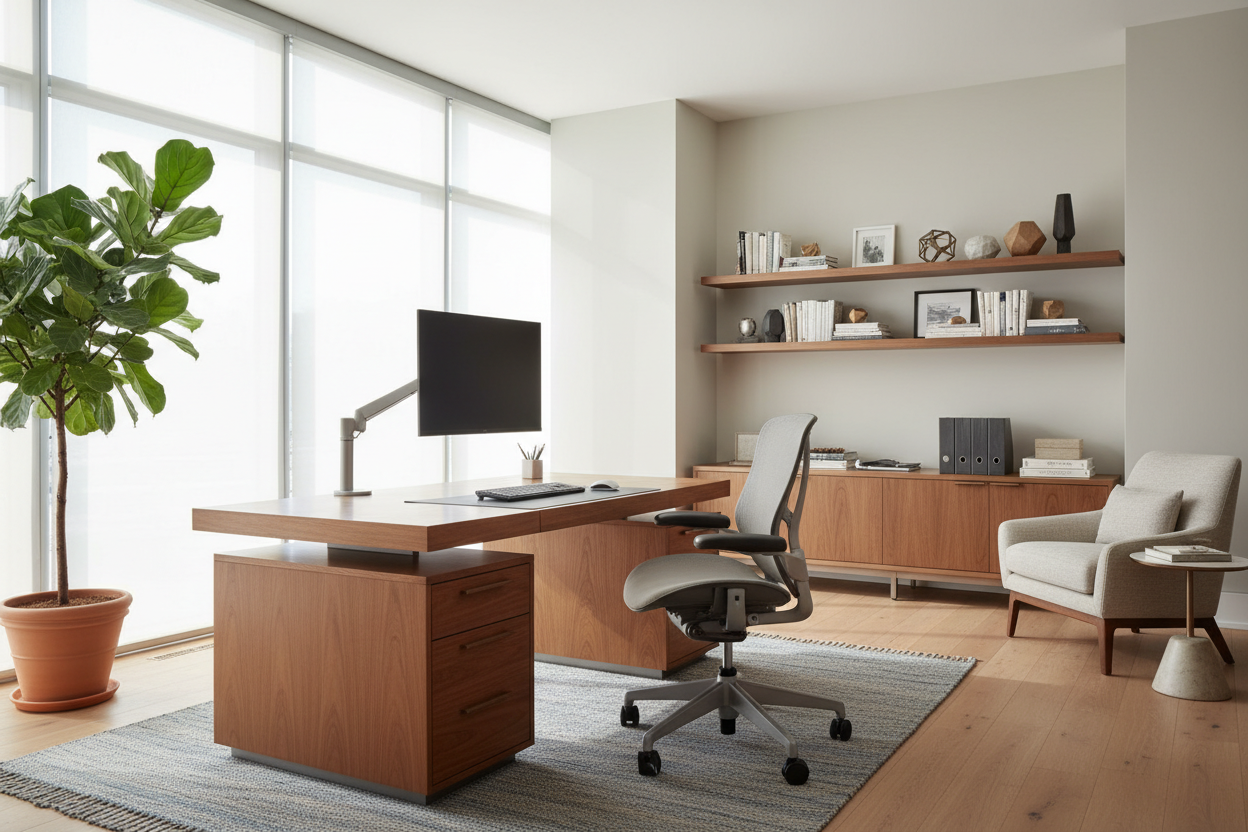
One of the most frequent hesitations I encounter when presenting a design scheme to a client isn't about the silhouette of a desk or the textile on a lounge chair—it is about the budget. However, the conversation shifts dramatically when we stop viewing these pieces as mere decoration and start viewing them as business assets. The question can i write off office furniture is the pivot point that often allows professionals to upgrade from generic, uncomfortable setups to ergonomic, high-performance workspaces.
Quick Decision Guide: Tax & Design Factors
- Exclusive Use: To claim deductions, the furniture must be used strictly for business. A dining chair used occasionally for emails usually doesn't qualify.
- Ordinary and Necessary: The IRS requires the expense to be common for your industry and helpful for your business.
- Section 179 vs. Depreciation: You may be able to deduct the full cost immediately (Section 179) or depreciate the value over several years.
- Quality Documentation: Keep receipts not just for the price, but to prove the item fits the "office" description (e.g., "ergonomic task chair" vs. "decorative accent chair").
Is Office Furniture a Business Expense?
From a design perspective, the workspace is a tool for productivity. From a financial perspective, the answer is generally yes. Is office furniture a business expense? Absolutely, provided it meets the criteria of being essential to your operations. Whether you are outfitting a corporate headquarters or a dedicated room in your house, the tax code typically recognizes that you need a surface to work on and a chair to sit in.
When you understand that can you deduct furniture for home office setups is a valid inquiry, it frees you to select pieces that offer longevity. Instead of buying a disposable particle-board desk, you can justify investing in solid hardwoods or commercial-grade laminates because the net cost, after tax savings, is significantly lower.
Elevating the "Ordinary and Necessary"
The IRS uses the phrase "ordinary and necessary," but as a designer, I interpret this as "functional and durable." When you ask, can i deduct office furniture from my taxes, you are essentially asking if you can invest in the infrastructure of your career.
Material Quality and Longevity
If you are going to claim furniture on your taxes, ensure the build quality withstands the scrutiny of daily use. I always advise clients to look for commercial-grade abrasion ratings (Double Rubs) on upholstery. A chair with 100,000 double rubs isn't just a luxury; it's a long-term asset that won't need replacing in two years. This durability reinforces the validity of your furniture expenses as a business necessity rather than a personal indulgence.
The Ergonomic Argument
Clients often ask, "Is an office chair tax deductible even if it looks like a luxury item?" If that chair provides lumbar support, adjustable armrests, and a synchro-tilt mechanism that prevents back strain, it is a health necessity for your work. A high-end ergonomic chair supports your body for 8+ hours a day. This functional requirement is what separates a tax-deductible task chair from a living room recliner.
Space Planning and the "Exclusive Use" Rule
For those wondering can you write off home office furniture, the layout is critical. The IRS stipulates that the space (and the furniture within it) must be used exclusively for business.
In my design practice, I create distinct zones to help clients adhere to this. We might position the desk and storage credenza in a way that visually separates the "work zone" from the rest of the room. This not only aids in mental focus but also helps clarify that these pieces are strictly for business operations. If you place a sleeper sofa in your office for "client meetings," it becomes a grey area. Stick to pieces like filing cabinets, bookcases, and task lighting that clearly signal professional intent.
My Personal Take on Office Furniture Write-Offs
I learned the importance of this early in my career during a studio renovation. I initially hesitated to buy a high-end, architectural drafting table because of the upfront cost. It felt like a splurge. However, my accountant explained how can you write off furniture for home office applied to my situation.
I bought the table—a heavy, steel-base piece with a maple top. Here is the unpolished truth: The tax deduction was helpful, but the real value was in the daily interaction. Cheap laminate desks I’ve owned in the past would chip at the edges where my wrists rested, scratching my skin and ruining sweaters. This solid maple top has developed a patina but remains smooth after seven years. The drawer mechanisms still glide silently, unlike the jarring "clunk" of budget metal cabinets. When you write off quality furniture, you aren't just saving on taxes; you are buying silence, texture, and a lack of friction in your workday.
Conclusion
Designing a workspace is about creating an environment that fosters success. Knowing that you can legitimately deduct these costs allows you to make smarter, longer-lasting design choices. Don't settle for temporary solutions; invest in a space that reflects the quality of your work.
Frequently Asked Questions
Can you deduct furniture for home office use if you are a W-2 employee?
Generally, no. Under current tax laws, W-2 employees typically cannot deduct unreimbursed business expenses, including home office furniture. This deduction is primarily for self-employed individuals and business owners.
Is an office chair tax deductible if I also use it for gaming?
Strictly speaking, no. The "exclusive use" test is rigorous. If the IRS determines the chair is used for personal leisure (like gaming) alongside work, it may disqualify the deduction. It is best to have a dedicated setup for work.
How do I depreciate expensive furniture?
You can often choose to deduct the full cost in the year of purchase (Section 179) or depreciate it over a set period (usually 7 years for office furniture). Consult a tax professional to see which method benefits your cash flow and tax liability most.



Leave a comment
This site is protected by hCaptcha and the hCaptcha Privacy Policy and Terms of Service apply.