

















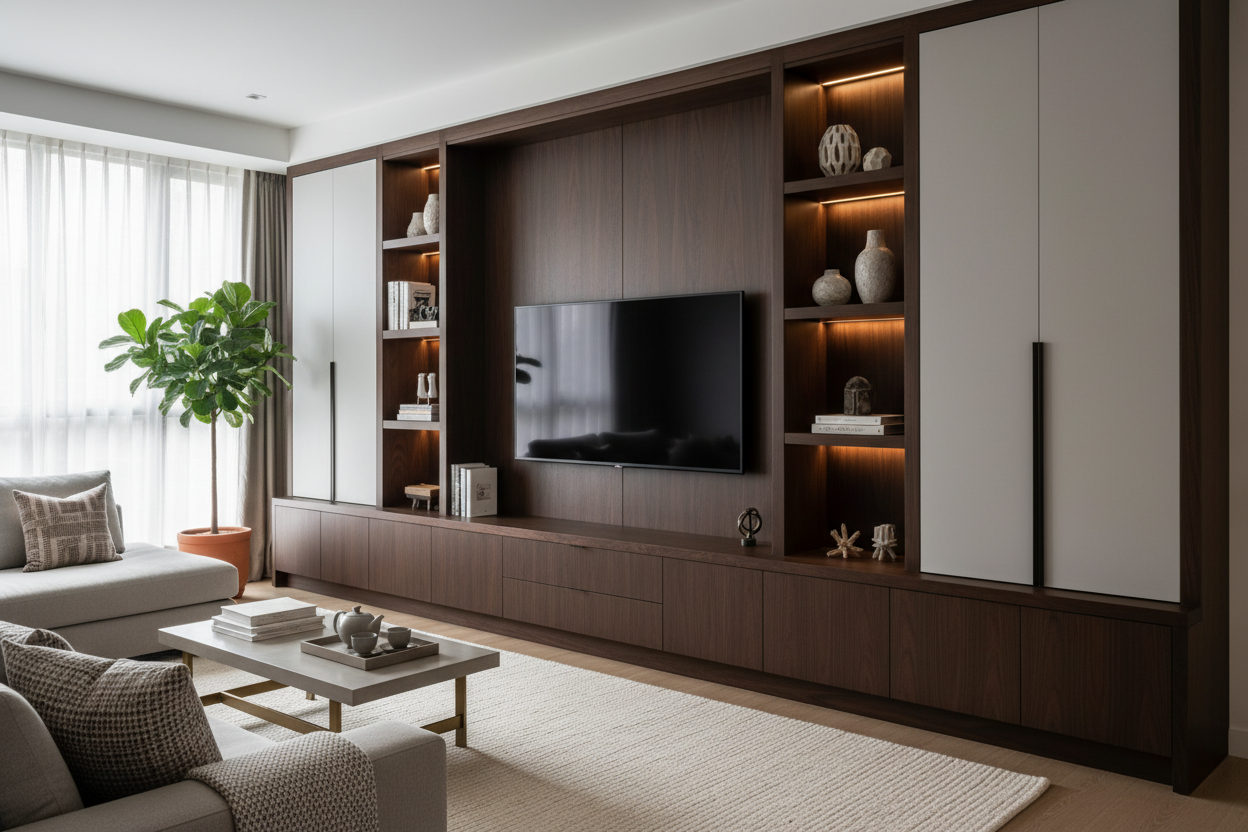
I spent three years staring at a 65-inch black rectangle that looked like it was colonizing my living room. I tried the minimalist approach with a low-slung stand from a Swedish retailer, but the result was just a mess of dust bunnies and a spaghetti-tangle of black power cords that mocked my attempts at 'decorating.' Every time I sat down to watch a movie, I wasn't looking at the screen; I was looking at the gap between the wall and the console where my router lived.
That was the breaking point. I realized that unless I wanted my home to feel like a temporary dorm room forever, I had to stop buying 'placeholder' furniture. I started researching built in cabinets for tv, and while the price quotes initially made my eyes water, the transformation of the room was undeniable. Here is the reality of going custom versus staying modular.
Quick Takeaways
- Expect to pay between $3,000 and $8,000 for a professional install, depending on materials and size.
- Built-ins solve the 'black hole' effect by framing the TV as a design choice, not an afterthought.
- The mess is real—expect drywall dust in your coffee for at least a week.
- If you are a renter or move every two years, a high-end standalone console is a much smarter investment.
The 'Best Buy Showroom' Problem
We’ve all been there. You buy a beautiful, thin OLED TV, and then you realize you have nowhere to put the soundbar, the gaming console, and the three different remotes. My living room felt less like a sanctuary and more like a Best Buy showroom floor. The scale was all wrong; a massive screen on a small, flimsy stand makes the ceiling feel lower and the walls feel cluttered.
I spent hours on Pinterest looking at the modern built-in tv cabinet trend, trying to figure out why I ditched my TV stand in my head before I even called a pro. The issue isn't just the TV; it's the lack of architectural weight. A standalone piece of furniture often looks like it’s just 'floating' against the wall. A built-in, however, becomes the wall. It adds a sense of permanence that a $400 MDF console simply cannot replicate.
When I finally committed, I realized I wanted more than just a place for the screen. I needed a built in tv unit that could hide the clutter of daily life—the board games, the extra blankets, and the unsightly mess of wires that had been driving me crazy for years. It was about reclaiming the room's aesthetic from the electronics.
Sticker Shock: Getting Real Quotes for the Project
Let's talk about the elephant in the room: the cost. When I started calling local carpenters for built in wall cabinets for tv, I expected a figure around $1,500. I was hilariously wrong. A quality contractor who uses actual birch plywood or solid wood—not that crumbly particle board—is going to charge for their expertise, their tools, and the sheer amount of labor involved in scribing cabinets to your likely-crooked walls.
My first quote was $6,500. I nearly choked. But when you break it down, it makes sense. You’re paying for custom-built boxes, soft-close hinges, integrated LED lighting, and a finish that won't peel in two years. I considered the DIY 'IKEA hack' route, but after measuring my baseboards and realizing my floor had a half-inch slope, I knew I’d end up with a lopsided mess. Custom work ensures that the unit looks like it was built with the house in 1920, not slapped on in 2024.
If you're quoted less than $2,000 for a full-wall unit, be suspicious. They are likely using thin materials that will sag under the weight of books or a heavy TV. I decided to save for an extra six months to afford the contractor who understood cable management—someone who knew that I needed access panels for my HDMI ports so I wouldn't have to rip the whole thing out just to plug in a new Apple TV.
How to Avoid the 90s Entertainment Center Look
The biggest fear I had was ending up with one of those chunky, honey-oak monstrosities from my childhood. To keep a built in wall tv cabinet looking current, you have to play with proportions. The 90s look was all about deep, cavernous holes for boxy TVs. Today, we want the TV to sit almost flush with the shelving or be recessed just enough to disappear when it’s off.
I opted for a monochromatic look. By painting the entire built in tv unit the exact same color as my walls—a deep, moody charcoal—the unit felt like an architectural feature rather than a piece of furniture. We also skipped the traditional 'open shelving everywhere' look. Instead, we used a 70/30 ratio: 70% closed cabinetry at the bottom for the ugly stuff, and 30% open shelving at the top for the pretty stuff. If you're not ready for a full-wall commitment, you might consider a modern wall cabinet for living room storage that offers a similar built-in feel without the permanent construction.
Another tip: skip the ornate crown molding if your house is modern. Clean lines and 'slab' door fronts keep the tv built in cabinet from feeling dated. I also insisted on 'push-to-open' hardware. No handles meant a smoother, more integrated appearance that doesn't scream 'kitchen cabinets in the living room.'
The Installation Chaos (And Why I'd Do It Again)
Nobody tells you about the dust. Even with the best 'dustless' sanding systems, my house felt like a construction site for four days. There were saws in the driveway, drop cloths over my sofa, and a constant hum of drills. My dog was convinced the world was ending. Living through a built in wall cabinets for tv installation is a test of patience, especially when your living room is the heart of your home.
But then, the final coat of paint dried. The contractor mounted the 85-inch screen into the custom-sized niche, and the cords disappeared into the hidden channels we’d planned. Suddenly, the room felt twice as big. By taking the cabinets all the way to the ceiling, we drew the eye upward, making our standard 8-foot ceilings feel like 10. The built in wall tv cabinet didn't just hold the TV; it anchored the entire house. I no longer felt like I was living in a room built around a screen; I was living in a designed space that happened to have a screen in it.
Do You Really Need Custom, or Just a Better Console?
Is custom right for everyone? Honestly, no. If you’re in a starter home or a rental, spending $5k on a permanent wall unit is a bad investment. You won't get that money back when you sell, and you can't take it with you. In those cases, you are much better off buying a high-quality, oversized modern tv console cabinet. A long, heavy-duty piece can give you a similar look of 'grounding' the room without the contractor headache.
However, if this is your 'forever' home, or at least your 'next ten years' home, the built in tv unit is the single best upgrade I’ve made. It eliminated the visual noise of my living room and gave me a place to hide the PS5 controllers, the stray chargers, and the mountain of DVDs I refuse to throw away. It turned a messy corner into a focal point. Just make sure you hire someone who knows their way around a level—and a vacuum.
FAQ
How deep should built-in cabinets for a TV be?
Typically, 12 to 16 inches is the sweet spot. Anything deeper than 18 inches starts to swallow the room and makes it hard to reach items at the back of the shelves. If you have a massive AV receiver, measure that first, as they often require at least 15 inches of clearance plus room for cables.
Can I change my TV size later if I have built-ins?
This is the biggest risk. When designing your tv built in cabinet, always leave a 'buffer' zone. If you have a 65-inch TV now, design the opening for a 75-inch. You can always use a black backplate or trim to hide the gap, but you can't easily stretch a wooden cabinet later.
Does a built-in TV unit add home value?
Yes, but with a caveat. It adds value if it’s done professionally and matches the style of the home. A poorly built DIY unit can actually hurt your resale value because the new buyers will see it as a demolition project they have to fund.


Leave a comment
This site is protected by hCaptcha and the hCaptcha Privacy Policy and Terms of Service apply.