

















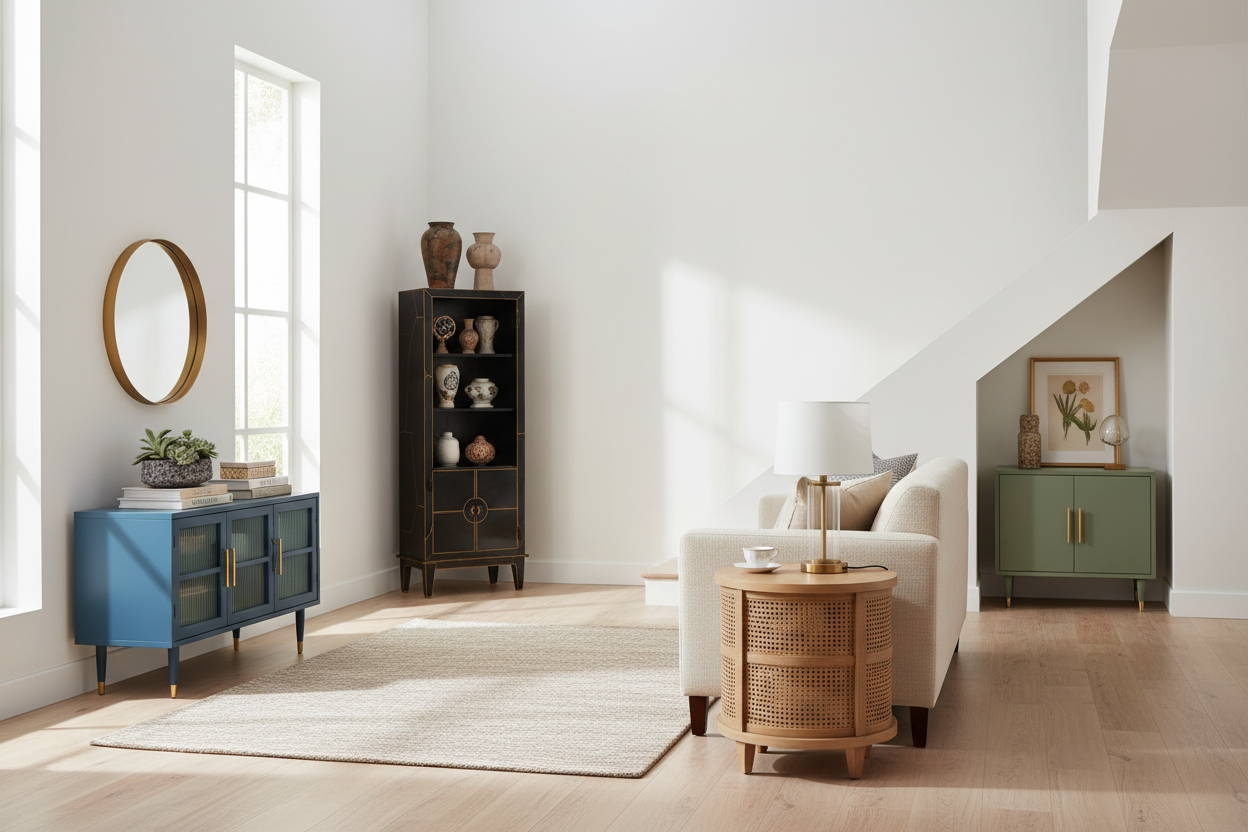
I once spent three hours trying to Marie Kondo a coat closet that didn't actually exist. My renter's reality is a 600-square-foot walk-up where 'storage' is just a polite word for 'the floor under my bed.' For years, I fell for the trap of the open console table—you know the one, with the thin legs and the single shelf that looks great in a catalog but looks like a dumpster fire once you actually put your mail and spare change on it.
The day I finally ditched my 'curated' open shelving for closed **accent cabinets** was the day my apartment stopped looking like a staging area for a yard sale. There is a specific kind of peace that comes from knowing your clutter is exactly three inches behind a solid door. If you are struggling with a lack of built-in closets, you don't need a bigger apartment; you just need better furniture placement.
- Stop the visual noise: Open shelving is for people with no hobbies and perfect handwriting. Closed cabinets hide the chaos.
- Check the weight: If an accent cabinet for sale online weighs less than 40 pounds, it’s probably made of paper and hope. Aim for heavier units.
- Depth matters: For hallways, stick to 12-15 inches deep. For dining rooms, you need 16-18 inches for those oversized platters.
- Leveling feet are a must: Especially in old buildings with floors that slant like a skate park.
The Day I Realized Open Consoles Were Ruining My Vibe
I used to think that 'airy' furniture was the secret to making a small room feel bigger. I bought a glass-topped console for my entryway and an open-shelf bookcase for my living room. Big mistake. Within a week, that 'airy' console was buried under dog leashes, half-empty bags of treats, and a stack of New Yorkers I was never going to read. It didn't make the room feel bigger; it just made the mess more visible from the sofa.
The pivot to closed storage changed everything. When you switch to a solid piece, you aren't just gaining storage; you're gaining a visual anchor. A well-chosen occasional cabinet provides a clean surface for a lamp and a tray, while the interior does the heavy lifting of holding your unsightly essentials. I realized that my home felt cluttered not because I had too much stuff, but because I had nowhere to put the 'ugly' stuff that I actually use every day. If you can see your router, your spare lightbulbs, or your junk mail, your furniture is failing you.
The Hallway: Faking a Mudroom Drop Zone
Most apartments have that weird, useless stretch of wall right behind the front door. It’s usually too narrow for a bench but too long to leave empty. This is the prime spot for a 3-drawer entryway storage cabinet. I installed one that was only 14 inches deep, and it transformed my morning routine. The drawers hold the things I always lose—keys, sunglasses, and my transit card—while the cabinet doors hide the bulky winter boots that usually trip me up in the dark.
The key here is compartmentalization. Don't just get a big empty box; you want a mix of drawers for small items and shelves for the bigger stuff. It creates a 'drop zone' that keeps the rest of your living space from becoming a dumping ground. I’ve seen plenty of accent cabinets for sale that are marketed for bedrooms, but they actually work best in high-traffic hallways where every square inch of floor space has to earn its keep. My hallway went from a bottleneck to the most organized part of my house just by adding one piece of furniture.
The Guest Room: Creating a Ghost Linen Closet
If you live in a house built before 1970, you probably don't have a linen closet. My 'linen closet' was originally a plastic bin shoved into the back of my own clothes closet, which meant I had to move three coats and a vacuum just to get a fresh towel. I finally solved this by putting a standalone occasional cabinet in the guest room. It’s a 'ghost' closet—it holds all the things that don't have a home elsewhere, like extra duvet covers, beach towels, and those bulky wool blankets that only come out in January.
I chose a piece with a slightly deeper profile for this spot. Since the guest room isn't as cramped as the hallway, I could afford a cabinet that was 18 inches deep. This allows you to stack towels two-deep without having to cram them in. It also gives your guests a surface to put their bags on, making the room feel like a hotel suite rather than a storage unit with a twin bed. It’s an honest solution for a house that lacks the architectural bones to handle modern life.
The Dining Area: The Modern Anti-Buffet
I have a visceral reaction to those massive, honey-oak china hutches from the 90s. They take up half the room and look like they belong in a museum of bad decisions. However, I still needed a place for my 'good' glassware and the three bottles of gin I bought for a party three years ago. The solution is a sleek, dark piece that feels more like a bar than a pantry. A black cabinet with glass doors is the perfect middle ground—it lets you see the silhouettes of your nice wine glasses without exposing the chaos of your napkin collection.
I prefer black or charcoal for the dining area because it feels more intentional and 'moody.' It acts as a sophisticated backdrop for dinner parties. I once made the mistake of buying a cheap, wobbly buffet that shook every time I cut a steak on the table next to it. Now, I look for pieces with a solid base and tempered glass. It’s about finding a balance between utility and aesthetics; you want something that can hold 40 pounds of liquor bottles without the shelves bowing like a pool noodle. This is where you really want to pay attention to the material specs when looking at accent cabinets for sale.
How to Actually Shop for One Online
Shopping for furniture online is a minefield of photoshopped images and misleading descriptions. I’ve been burned by 'solid wood' that turned out to be thin veneer over compressed sawdust. When you're looking at **accent cabinets**, the first thing you check is the ship weight. If a 36-inch wide cabinet weighs 35 pounds, it’s made of air. You want something with some heft—look for a ship weight of at least 60-70 pounds for a medium-sized unit. That usually indicates higher-density materials and better hardware.
Secondly, look at the back panel. Low-end cabinets use a piece of folded cardboard that you nail into the frame. Higher-quality pieces use a recessed wood panel. It might seem minor, but that back panel is what keeps the cabinet from leaning to the left after six months. Always follow the rules for buying an accent cabinet: measure your baseboards before you buy, check the internal shelf height (will your tallest vase fit?), and always, always read the assembly reviews to see if the holes actually line up. I’ve spent too many Friday nights drilling new holes into misaligned MDF to ever skip that step again.
Styling It So It Doesn't Look Like a Filing Cabinet
Once the cabinet is built and the clutter is hidden, you have to make it look like a piece of decor. The biggest mistake people make is treating the top of the cabinet like a shelf. It’s not a shelf; it’s a stage. If you have a taller piece, you need to be careful with the proportions. I usually suggest styling a tall accent cabinet with a large, leaning piece of art or a tall lamp to draw the eye upward. If you put a tiny little candle on a 4-foot-tall cabinet, it looks like an afterthought.
Use the 'Rule of Three'—a tall item (a lamp), a wide item (a tray or a stack of books), and a textured item (a small plant or a bowl). This creates a visual triangle that feels balanced. I also love using a decorative tray to corral 'functional' items like a carafe of water or a bowl for keys. It makes the items look intentional rather than messy. And whatever you do, don't center everything perfectly. Off-center styling feels more modern and less like a showroom display. I learned this after my living room started looking like a doctor’s waiting room—asymmetry is your friend.
FAQ
What is the difference between an accent cabinet and a sideboard?
It’s mostly about scale and intent. Sideboards are usually long, low, and designed for dining rooms to hold plates. Accent cabinets are more versatile, often taller or narrower, and meant to fit into 'extra' spaces like hallways, entryways, or bedroom corners.
Can I put a TV on an accent cabinet?
Only if the weight capacity allows it and the height makes sense. Most accent cabinets are 30-36 inches tall, which is actually a bit high for a TV (unless you like neck strain). Check the top-surface weight limit—some are only rated for 25-50 lbs, which isn't enough for a large modern TV and its stand.
How do I know if the cabinet is high quality?
Check the hardware and the weight. Real metal hinges and drawer slides are a good sign. If the description mentions 'cam-locks,' it’s flat-pack, which is fine as long as the material is high-density MDF or solid wood, not low-grade particleboard that crumbles when it gets damp.


Leave a comment
This site is protected by hCaptcha and the hCaptcha Privacy Policy and Terms of Service apply.