

















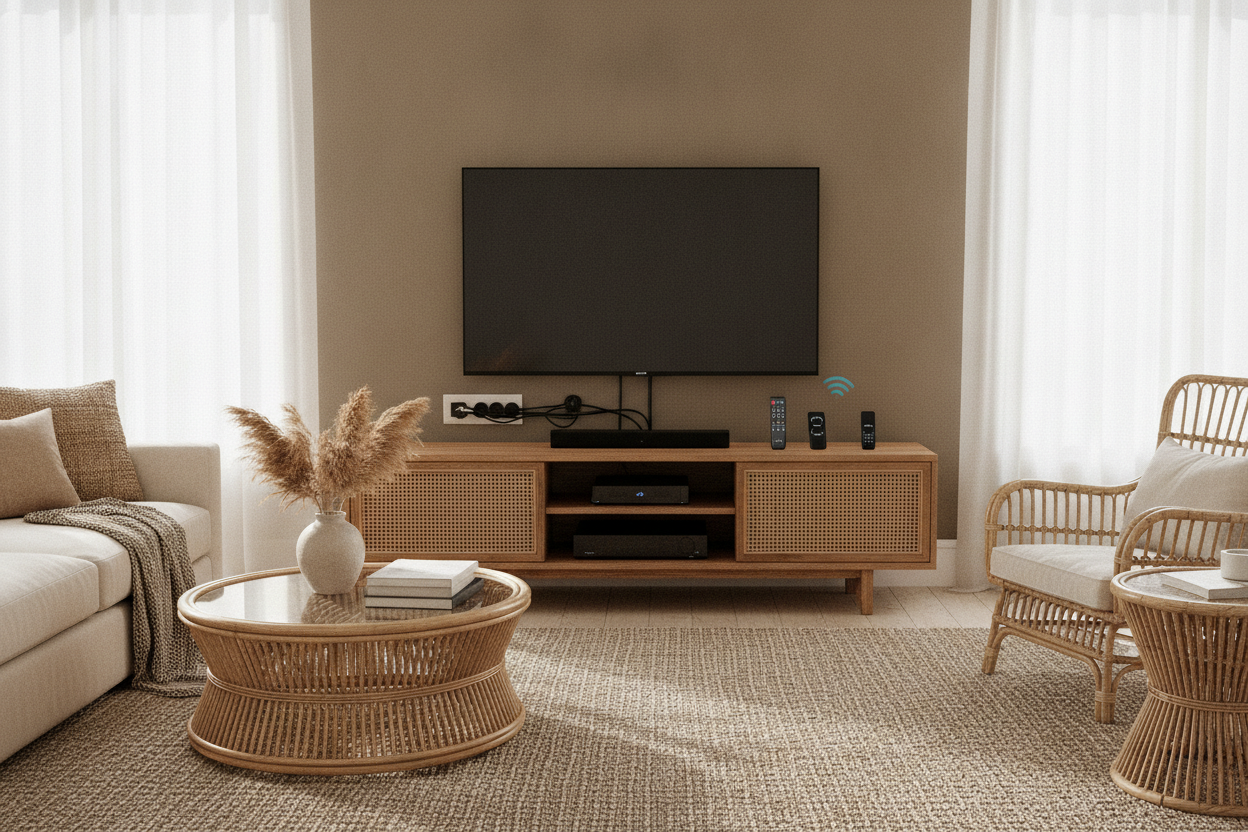
I spent three weeks staring at a tangle of HDMI cables and a router that looked like a plastic spider on my floor. I finally bought a gorgeous solid walnut cabinet, only to realize I had to keep the doors wide open every time I wanted to watch Netflix. If the door was shut, my Apple TV remote was useless. That is when I realized the rattan television stand isn't just a boho trend—it is a functional masterpiece for the tech-fatigued homeowner.
- Infrared signals pass through the weave, so you can keep doors closed while using your remote.
- Natural airflow prevents your Xbox, PlayStation, or router from overheating.
- The texture hides messy cables and blinking lights while looking lighter than solid wood.
- Choosing a wood frame with rattan inserts provides the best durability for heavy TVs.
The 'Open Door' Media Cabinet Curse
There is nothing that kills a living room's vibe faster than a beautiful piece of furniture that doesn't actually work. I learned this the hard way after dropping $800 on a mid-century sideboard with thick, solid doors. It looked like a million bucks until I realized my soundbar and streaming box were effectively trapped in a lead-lined bunker. To change the volume or pick a show, I had to get up and physically swing the doors open. My living room looked like a kitchen mid-meal prep half the time.
It is a classic design fail. We want to hide the ugly tech—the blinking blue lights, the dusty routers, the spaghetti-pile of power strips—but most furniture designers forget that infrared (IR) remotes need a line of sight. If your remote cannot see the sensor on your device, it is not happening. You end up sitting on the floor, holding your remote at a 45-degree angle toward a tiny gap in the door, wondering why you didn't just buy a wire rack from a hardware store instead. It is an exhausting way to live in a space that is supposed to be for relaxing.
I have seen people resort to those clunky IR repeater kits that just add more wires to the mess, or worse, they just take the doors off entirely. Neither is a good look. You want your tech to be invisible, but you also want it to respond when you press 'play' on your third episode of the night.
Why Woven Doors Are the Ultimate Tech Hack
This is where rattan tv consoles save the day. The magic is in the weave. Whether it is a tight hex-weave or a looser radio-weave cane, there are thousands of tiny holes in that door front. These holes are small enough to hide the visual clutter of your messy cables, but large enough for those invisible infrared signals to pass through completely uninterrupted. You can finally shut the doors on the chaos and still have a remote that actually works from the comfort of your sofa.
When you are shopping for tv stands, the signal test is the one functional feature people almost always forget to check. They look at the wood grain, they check the height, they measure the width—but they don't think about the remote. A woven tv console solves this without forcing you to compromise on your aesthetic. It is the simplest solution to a problem that has plagued living rooms since the invention of the VCR. I have tested this with everything from old-school cable boxes to the latest 4K streaming sticks, and the signal pass-through is flawless.
Beyond the tech benefits, there is an organic warmth to rattan that solid wood or metal just cannot replicate. It softens the hard edges of a large television screen. If you have a room full of flat surfaces, adding that bit of woven texture makes the space feel lived-in rather than staged. It is the secret superpower of the design world: a piece of furniture that works harder than it looks.
Airflow Matters for Your Router, Too
Electronics hate heat. If you have ever touched your Wi-Fi router or a gaming console after it has been running for three hours inside a closed MDF box, you know it gets hot enough to fry an egg. Heat is the silent killer of tech; it slows down your internet speeds and kills the lifespan of your hardware. Most standard cabinets are basically ovens for your electronics, trapping hot air with nowhere to go.
The mesh-like structure of a rattan media console table provides constant, passive ventilation. It is like having a screen door for your tech. I recently realized the importance of this when upgrading to real wood furniture. Solid wood is great for weight, but it is a heavy insulator. By choosing a unit with rattan door fronts, you get the structural integrity of a heavy wood frame without suffocating your expensive Xbox or high-end router. Your fans won't have to work nearly as hard, which means a quieter living room for you.
Grounding the Look (So It Doesn't Feel Flimsy)
One mistake people make is going full tropical and buying a piece that is 100% wicker. Unless you live in a beach hut, that can look a bit flimsy and dated. For a modern living room, you want a rattan and wood tv stand. Look for a piece where the chassis—the top, sides, and legs—is made of solid oak, walnut, or high-quality ash. You want that weight and grounding to support a 65-inch or 75-inch screen without the top bowing over time.
The rattan should be an accent on the door panels only. This gives you that breezy, textural contrast against the smooth wood grain. I prefer a caning style weave because it feels a bit more structured and intentional. It is also worth checking the back panel. A good unit will have pre-drilled cable management holes that align with the shelves, so you aren't forced to take a hole-saw to your brand-new furniture the second it arrives. I always look for legs that are at least 5 inches high—it makes the room feel larger and lets my Robot vacuum get underneath.
The Glass Alternative (If You Hate Dusting)
I will be honest: rattan has one downside, and it is dust. Those tiny holes that let the signal through also let a bit of dust in over time. If you live in an old apartment with a radiator that spits out soot, or if you just genuinely loathe the idea of dusting inside your cabinet once a month, there is another way. A media console with glass doors offers the same signal-passing benefits as rattan but keeps the interior airtight.
Glass is sleek and definitely feels more high-end modern than boho-chic. However, glass shows fingerprints and does not hide the cable mess nearly as well as a textured weave does. If you go the glass route, your cable management game needs to be 10/10 because everyone will see that tangled mess behind the panes. Personally, I will take a little dusting over seeing my power strips any day. The rattan weave provides a visual 'blur' that keeps your electronics hidden while keeping them accessible.
Personal Experience: My MDF Disaster
A few years ago, I bought a cheap rattan-look stand where the weave was actually just a printed pattern on a piece of plastic. Not only did it look terrible, but the frame was made of thin MDF that started sagging under the weight of my TV within six months. The doors didn't even line up anymore. Now, I only buy units with solid wood frames and real natural cane. It costs more upfront, but it does not end up in a landfill after one season of TV binges. Trust me, your tech and your floor deserve the real thing.
FAQ
Does rattan break easily?
Natural cane is surprisingly tough, but it is not invincible. If you have a cat that likes to use furniture as a scratching post, rattan might not be for you. For everyone else, it holds up just fine to normal daily use and weight.
Can people see my messy wires through the rattan?
From a distance, no. The texture of the weave creates a visual barrier that hides the clutter. You would have to put your face right up against the door to see the specific wires inside.
How do I clean the weave?
Do not use heavy chemical sprays. A vacuum with a brush attachment is the best way to get dust out of the crevices. For sticky spots, a slightly damp microfiber cloth does the trick without warping the fibers.

Leave a comment
This site is protected by hCaptcha and the hCaptcha Privacy Policy and Terms of Service apply.