

















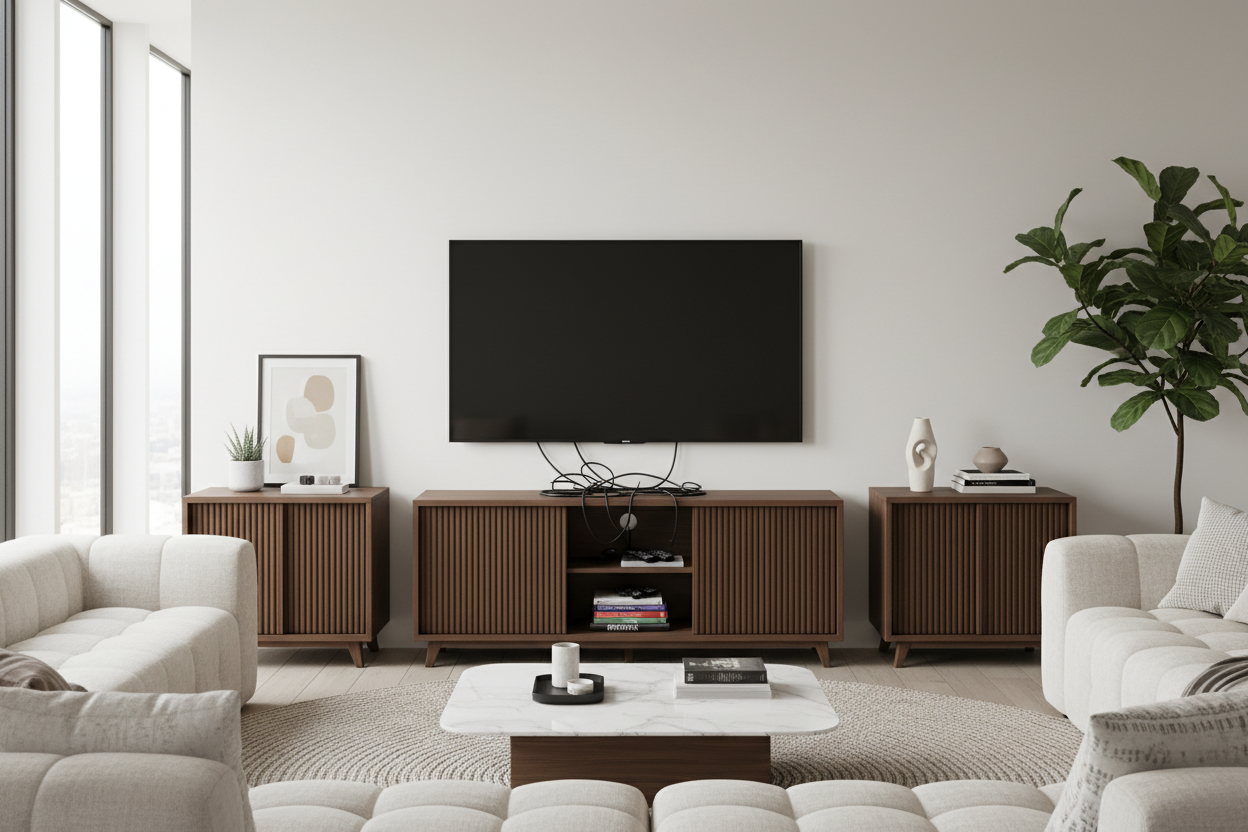
I spent three hours last Tuesday staring at a dust-caked router and a tangled nest of HDMI cables that looked like a plate of black spaghetti. My living room was supposed to be a sanctuary, but my trendy, fully open media console was betraying me. It put every piece of ugly plastic tech on a pedestal for the world to see.
If you are tired of your electronics doubling as unwanted decor, it is time to look at side tv stands. These units offer a smart compromise: they hide the junk while letting your actual style breathe in the center.
Quick Takeaways
- Open consoles are a trap for anyone with more than one gaming console or a cable box.
- Side TV stands use enclosed cabinets to hide visual clutter like controllers and routers.
- The open center section ensures your soundbar or receiver does not overheat.
- Opaque doors mean you do not have to be a master of cable management to have a clean room.
The Trendy Open Console Trap (And Why I Hated It)
I fell for the 'airy' aesthetic hard. I bought this beautiful, three-tier industrial shelf because it looked great in a staged photo with exactly one ceramic vase and a vintage record player. The reality? I have a PS5, a Nintendo Switch, a mesh router, and a soundbar. Within a week, the 'airy' look was replaced by a chaotic display of glowing black boxes and grey wires.
The problem with open shelving is that it demands perfection. There is no place to shove the extra controller or the instruction manual for the TV you bought three years ago. I realized I was failing at choosing the perfect TV stand because I prioritized how it looked empty rather than how it worked with my actual life.
Every time a guest sat on my sofa, I felt like they were judging my cable management. Or lack thereof. It was not just messy; it was distracting. You want to watch a movie, but your eyes keep drifting to the blinking orange light on the modem.
Enter the Side TV Stand: The Best of Both Worlds
After a month of trying to hide my router behind a stack of books (which, by the way, kills your Wi-Fi signal), I started hunting for a side tv stand. The layout is simple: two enclosed cabinets on the ends, flanking an open shelf in the middle. It creates a visual anchor that feels solid without being a heavy, monolithic block of wood.
When I started browsing the collection of TV stands available, I looked for units with at least 15 inches of depth. You need that clearance for the cables sticking out the back of your devices. If the unit is too shallow, your doors won't close, and you are right back where you started.
This 'sandwich' design—closed, open, closed—tricks the eye. The symmetry makes the room feel organized, even if the inside of those cabinets looks like a junk drawer exploded. It is the ultimate 'fake it till you make it' furniture hack.
How I Hid My Gaming Chaos Behind Closed Doors
The real magic happens behind the doors. I finally found a stand with dual side cabinets that changed the way my living room feels. On the left side, I have my gaming hub. I drilled a small hole in the back panel for the power strip. Now, the controllers, the charging docks, and the physical discs are completely invisible.
On the right side, I keep the 'boring' stuff. The router, the external hard drive, and a basket of miscellaneous cords I am too afraid to throw away. Having an opaque door on each side lowered my living room anxiety by about 40%. I no longer feel the need to straighten every cable before people come over.
One mistake I made in the past was buying a unit with glass doors. Do not do that. Smoked glass or clear glass still shows the mess. You want solid wood, MDF, or even metal mesh if it is tight enough. You want a barrier between your eyes and the tech-spaghetti.
Keeping the Center Shelf Styled and Breathing
With the mess hidden on the sides, the center shelf actually gets to be pretty. This is where I put my soundbar. Tech generates heat, and shoving a receiver into a closed cabinet is a recipe for a short-circuited expensive toy. The open middle allows for crucial airflow.
I opted for a mid century modern TV stand because the clean lines keep the center feeling intentional. I keep one or two heavy coffee table books under the soundbar to give it some height, and maybe a small brass tray for the remotes. Because the sides are 'heavy' and closed, the open middle feels like a curated gallery rather than a storage shelf.
It is about balance. You get the storage of a dresser with the functionality of a media hub. My living room finally feels like an adult lives here, rather than a college student who just discovered the electronics aisle.
FAQ
Will my remote work if the box is behind a solid door?
Most modern boxes use Bluetooth or RF, so they work through doors. If you have an older IR-only box, you might need an inexpensive IR repeater, or just keep that one device in the open center section.
How do I prevent my electronics from overheating?
Make sure there is at least two inches of clearance around your console. If you are worried, you can leave the cabinet door cracked during heavy gaming sessions or install a small, silent USB fan in the back panel.
Can I use a side TV stand for a 75-inch TV?
Yes, but check the weight limit. A 75-inch TV usually needs a stand that is at least 70 inches wide to avoid looking top-heavy. Ensure the side cabinets are wide enough to provide a stable base for the screen's feet.

Leave a comment
This site is protected by hCaptcha and the hCaptcha Privacy Policy and Terms of Service apply.