

















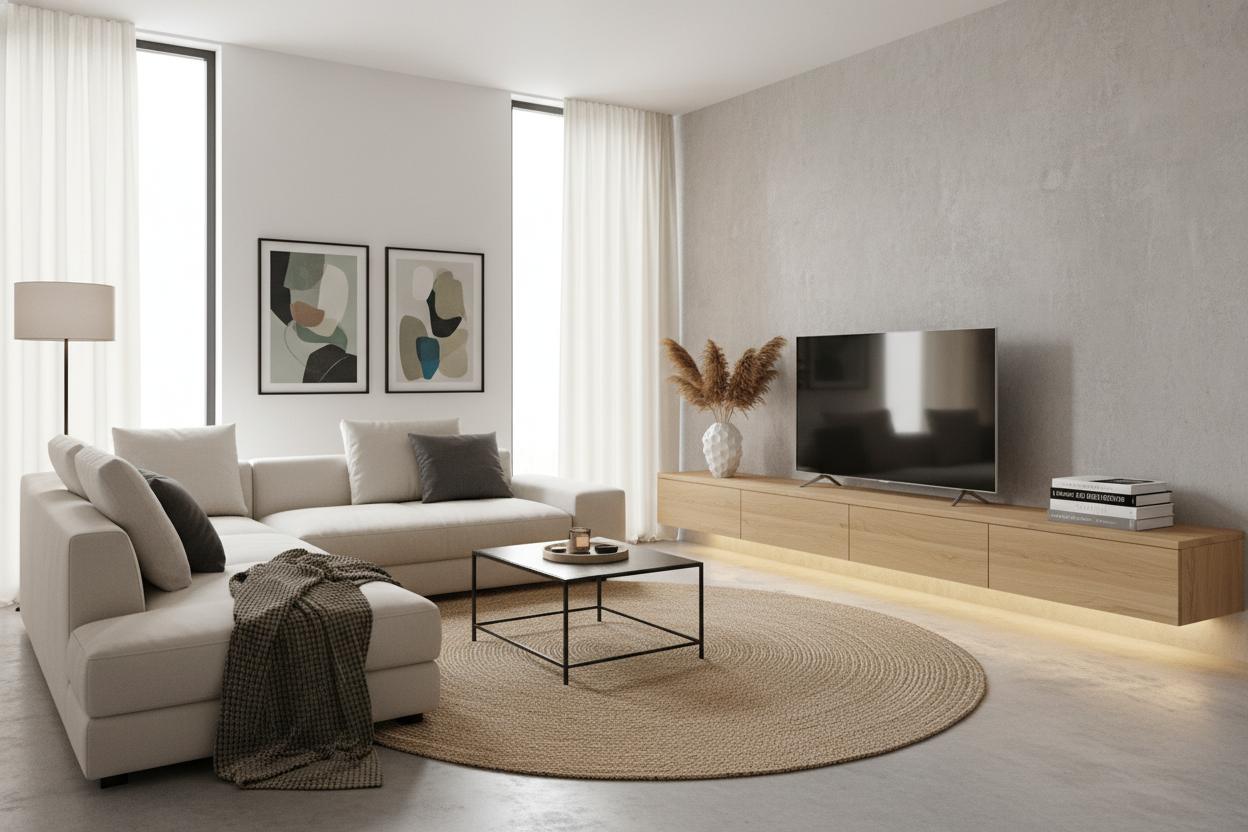
I remember sitting on my floor three years ago, surrounded by hex keys and half-empty boxes, looking at a media tower that stood nearly six feet tall. I thought I was being 'organized.' In reality, I was building a shrine to my PlayStation and a 65-inch screen. The room felt cramped, top-heavy, and honestly, a bit like a dorm room for someone with a 401k. It wasn't until I swapped that behemoth for a contemporary low tv stand that the room finally breathed.
Suddenly, the ceiling felt higher, the walls felt wider, and I didn't feel like I was living inside a tech retail store. If your living room feels like it's being swallowed by electronics, the height of your furniture is likely the culprit. Ditching the vertical bulk for something closer to the ground is the easiest way to make a small room feel massive.
- Proportions: Low stands ground the room and make ceilings feel taller.
- Art Space: You gain 2-3 feet of vertical wall space for gallery walls or large canvases.
- Materials: Avoid flimsy 1/2-inch MDF; look for solid wood or high-quality 3/4-inch veneers.
- Cable Management: Low units require more discipline with cord organization to keep the 'clean' look.
The 'Electronics Showroom' Epidemic
We’ve all seen it. A gorgeous, high-resolution 4K TV mounted five feet up the wall or sitting on a console that looks like it belongs in a corporate boardroom. This is the 'electronics showroom' vibe, and it’s a design killer. When your media setup is the tallest thing in the room, it commands all the attention. You aren’t looking at your beautiful rug or your curated bookshelf; you’re looking at a giant black rectangle and the massive box holding it up.
Most modern televisions are huge. A 75-inch screen has enough visual weight to sink a ship. If you pair that with a tall, bulky media center, you’re creating a wall of 'tech' that suffocates the rest of your decor. I’ve found that by keeping the furniture low, you strip away that retail-floor energy. It makes the TV feel like a part of the room rather than the reason for the room's existence.
How Dropping the Height Fixes Your Proportions
There is a specific kind of visual magic that happens when you bring your furniture closer to the floor. It’s about the horizon line. When you are browsing tv stands, you’ll notice that 'low' usually means anywhere from 12 to 18 inches off the ground. By lowering the TV, you open up the entire top half of your wall. This makes the room feel airy and less cluttered.
It also fixes the 'neck strain' issue. Most people mount their TVs way too high—the infamous 'TV over the fireplace' mistake. A low console puts the center of the screen at eye level when you’re actually sitting on your sofa. It’s more ergonomic, and it grounds the seating area. Instead of a floating screen, you have a solid, low-profile anchor that defines the 'living' part of the living room.
You Actually Get to Hang Art Now
One of the biggest perks of low modern tv stands is the vertical real estate they return to you. In my old setup, the media tower took up so much space I couldn't hang a single picture without it looking crowded. Now? I have a full gallery wall surrounding the screen. Because the stand is low, the TV doesn't feel like it's competing with the art; it just feels like one more frame in the collection. It’s the difference between living in a theater and living in a home.
The Fine Line Between 'Design Studio' and 'Dorm Room'
There is a risk here. If you buy a unit that is too thin or made of cheap, hollow-core particle board, a low stand can look like a temporary solution you bought for your first apartment. To get that 'design studio' look, you need weight and texture. A stylish black tv stand with a matte finish or a textured wood grain provides a mature, sophisticated anchor that doesn't feel flimsy.
I once made the mistake of buying a $120 'minimalist' unit that arrived with the structural integrity of a wet cracker. Within two months, the middle was sagging under my TV's weight. I learned the hard way that you need a solid frame—either steel or kiln-dried wood—to prevent that dreaded 'U' shape. Color choice matters too. While a modern white tv stand can look incredibly chic and disappear against a white wall, if it’s made of thin, high-gloss laminate, it can end up looking like a '90s hospital cart. Stick to satin or matte finishes to keep things looking expensive.
Hiding the Wires When You Lack Vertical Space
The only downside to a low-profile unit is that you have less 'cabinet' to hide your sins behind. When your stand is only 14 inches high, you can't just shove a tangled nest of HDMI cables and power strips behind it and hope for the best. You will see them from the side, and it will drive you crazy. I spent three hours last weekend with Velcro ties and a cable box just to hide four wires.
This is why I always tell people to look for units with built-in cable management. You want pre-drilled holes, internal channels, or slatted doors that allow infrared signals through while keeping the plastic boxes out of sight. If the unit doesn't have these, you're going to spend your Saturday drilling your own holes or staring at a waterfall of black rubber cords.
My Favorite Ways to Style Around a Low Console
Once you’ve dropped the height, you have to style the space so it doesn't look empty. I’m a big fan of the 'asymmetric lean.' Instead of centering everything, I put a large, leafy plant (like a Bird of Paradise or a tall Fiddle Leaf Fig) on one side of the stand. This adds a soft, organic shape to contrast the hard edges of the TV. On the other side, I might lean a large piece of art against the wall rather than hanging it.
Textured rugs also help. Since the furniture is low, your eyes are naturally drawn toward the floor. A high-pile wool rug or a vintage Persian-style runner can soften the whole look. I also love using a few oversized coffee table books stacked on one end of the console. It breaks up the flat surface and makes the 'tech' feel like it’s just another part of your library.
FAQ
How low is too low for a TV stand?
Usually, 12 to 18 inches is the sweet spot. If it’s lower than 10 inches, you’re basically putting your TV on a pallet. If it’s over 22 inches, it’s not really a low-profile stand anymore and you start losing those ceiling-height benefits.
Will a low stand work with a very large TV?
Actually, it's better. The larger the TV, the lower the stand should be. A 75-inch TV on a 24-inch stand puts the top of the screen way too high for comfortable viewing and makes the room feel incredibly top-heavy.
What materials should I look for?
Avoid anything that uses thin 'paper' veneers. Look for real wood veneers on high-quality plywood or solid wood legs. If you go for metal, make sure it's powder-coated steel rather than thin aluminum, which can rattle when your speakers' bass kicks in.


Leave a comment
This site is protected by hCaptcha and the hCaptcha Privacy Policy and Terms of Service apply.