

















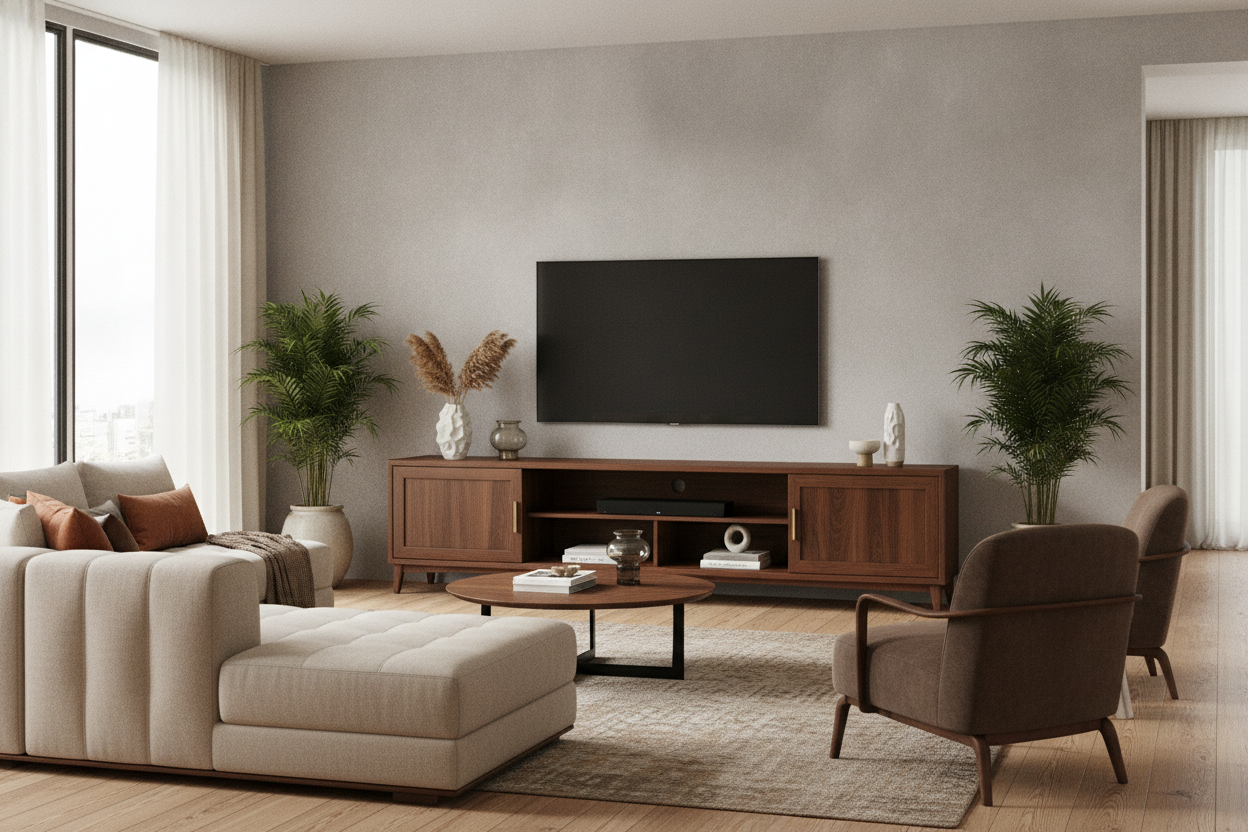
I remember staring at my first 'grown-up' TV—a 55-inch beast—sitting on a hand-me-down IKEA side table. It looked like a skyscraper balanced on a toothpick. I spent weeks trying to figure out why my living room felt 'off' until I realized my furniture was suffering from a massive scale problem. Buying a brown 60 inch tv stand wasn't just about storage; it was about stopping the visual vertigo every time I sat on the sofa.
- The 20% Rule: Your stand should be at least 20% wider than your TV screen.
- Visual Weight: Darker wood tones ground a room, preventing the TV from looking like a floating black void.
- Cable Management: A 60-inch unit usually offers enough depth for messy power strips and gaming consoles.
- Styling Space: Extra width allows for 'breathing room' where you can actually place a lamp or a plant.
The 'Overhang Anxiety' Epidemic
We’ve all seen it: a massive 65-inch flat screen perched precariously on a media unit that is exactly the same width—or worse, narrower—than the TV itself. This is what I call 'Overhang Anxiety.' When the edges of your screen dwarf the furniture beneath it, the entire room feels top-heavy. It creates a subconscious sense of instability, like the TV is just waiting for a reason to take a dive.
In a small apartment, you might think a smaller stand saves space. It doesn't. It just makes the TV look like an intruder. A 60-inch console provides the necessary visual foundation to support the screen's massive footprint. Without that extra length on the sides, your living room loses its focal point and starts looking like a cluttered tech graveyard. I've walked into dozens of homes where the owner wondered why their expensive decor felt cheap, and nine times out of ten, it was because their media console was three sizes too small.
The Golden Ratio of Media Furniture
Interior design isn't just about 'vibes'; it's about math. The golden ratio for a balanced media setup suggests your stand should be roughly 1.5 times the width of the TV. If you have a 50 or 55-inch screen, a 60-inch stand is the sweet spot. It provides about 3 to 5 inches of clearance on either side, which is the exact amount of space the eye needs to register 'balance.'
I learned this the hard way after trying to make a 40-inch cabinet work for years. My TV Looked Ridiculous Until I Got a 60 Inch Oak TV Stand. The moment I swapped the cramped unit for something wider, the room felt twice as large. A 60-inch unit acts as an anchor. It defines the 'entertainment zone' and gives you enough horizontal real estate to keep the screen from feeling like a giant black hole in the wall. If you’re rocking a 65-inch TV, 60 inches is the absolute minimum you can get away with before the proportions start looking goofy again.
Why Warm Wood Tones Actually Matter
There is a reason professional stagers almost always opt for wood over glass or metal. A rich brown finish—whether it’s walnut, acorn, or a deep espresso—brings a necessary organic element to a room filled with plastic and glass electronics. A brown 60 inch tv stand breaks up the 'sterile tech' look. It adds texture and warmth that makes the space feel lived-in rather than just 'assembled.'
When you browse tv stands, look for pieces with visible grain. Avoid that ultra-shiny, jet-black laminate that shows every speck of dust and fingerprint. Real wood or high-quality veneers in medium-to-dark brown hide the inevitable wear and tear of a busy household. Plus, brown is a neutral that actually plays well with others; it works with a navy blue rug, a forest green sofa, or even those trendy terracotta walls. It’s the safe bet that doesn't feel like a compromise.
Styling the 'Breathing Room'
The best part about a brown tv stand 60 inch is the surface area. When your stand is wider than your TV, you get these two magical zones on the left and right. This is where you inject personality. Instead of the TV being the only thing to look at, you can flank it with a low-profile table lamp for soft evening lighting or a ceramic bowl for your remotes. Keep objects low—you don't want to block the screen—but use the space to ground the electronics.
If you’re a minimalist who hates seeing the screen at all, you might even consider a hidden TV mechanism. But for most of us, the goal is just to make the TV look integrated. A trailing Pothos plant on one end and a stack of art books on the other can turn a piece of utility furniture into a curated vignette. Just remember to keep the cables tucked away; nothing ruins a 60-inch oak masterpiece like a 'spaghetti monster' of HDMI cords peeking out from the bottom.
Personal Experience: The MDF Meltdown
I once bought a 60-inch stand that looked incredible in photos but arrived weighing about as much as a pizza box. It was cheap MDF with a paper veneer that started peeling the second I set a cold drink on it. My advice? Check the weight capacity. A 60-inch TV isn't light, and you want a unit that won't bow in the middle after six months. Look for kiln-dried hardwoods or at least high-density furniture board with a real wood veneer. If the box says it weighs less than 50 pounds, send it back.
FAQ
Is a 60 inch stand too big for a small apartment?
Usually, no. A wider, lower stand actually makes a room feel more expansive than a tall, narrow one. It draws the eye horizontally, which tricks the brain into thinking the wall is wider than it is.
What shade of brown is most versatile?
Mid-century walnut is the 'Goldilocks' of wood tones. It’s dark enough to look expensive but light enough to show off the wood grain. It pairs well with both modern and traditional decor.
Can I put a 65 inch TV on a 60 inch stand?
Yes, but it's the limit. The TV will likely be about 56-58 inches wide, meaning you'll only have an inch or two of clearance on the sides. It works, but it won't give you that 'styled' look with room for decor.

Leave a comment
This site is protected by hCaptcha and the hCaptcha Privacy Policy and Terms of Service apply.