
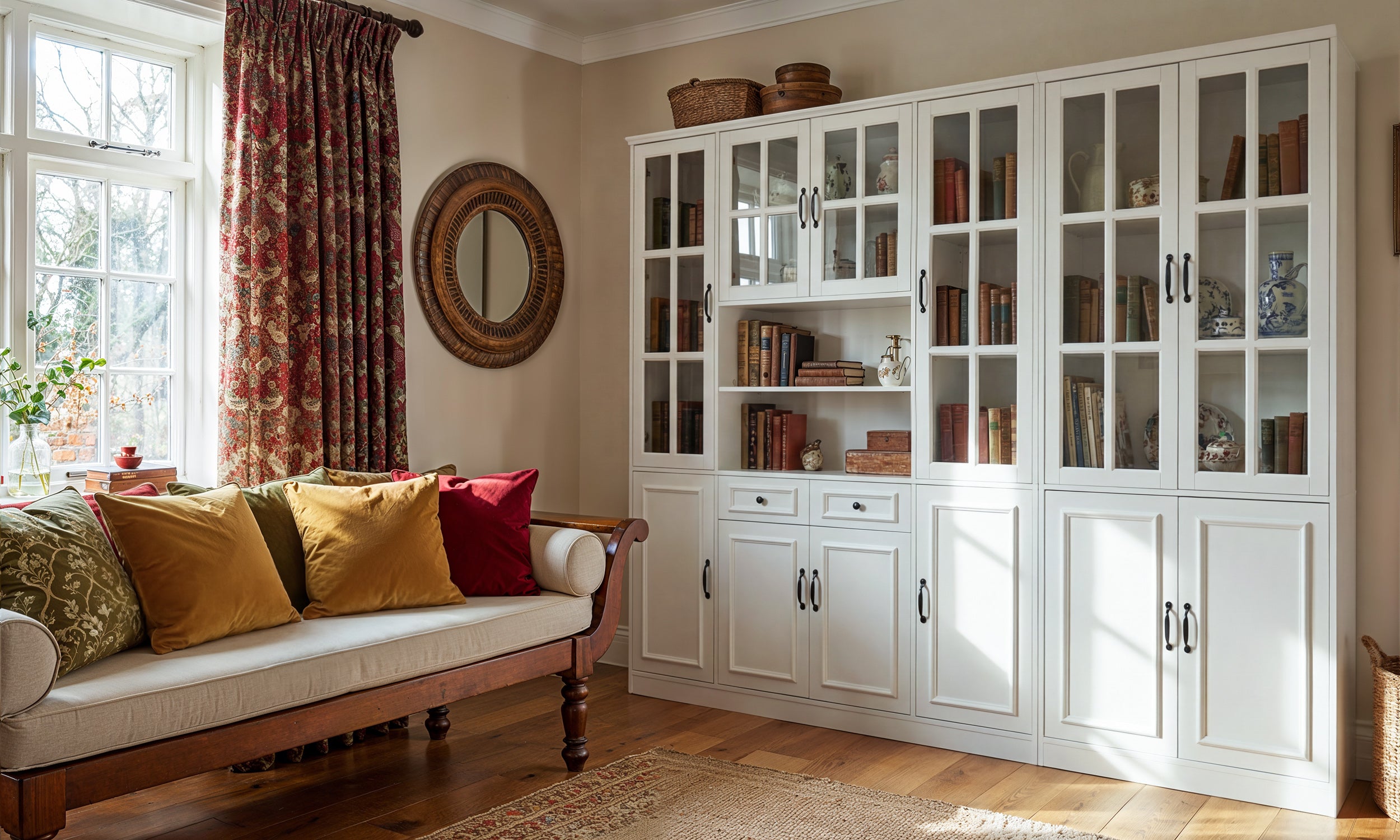

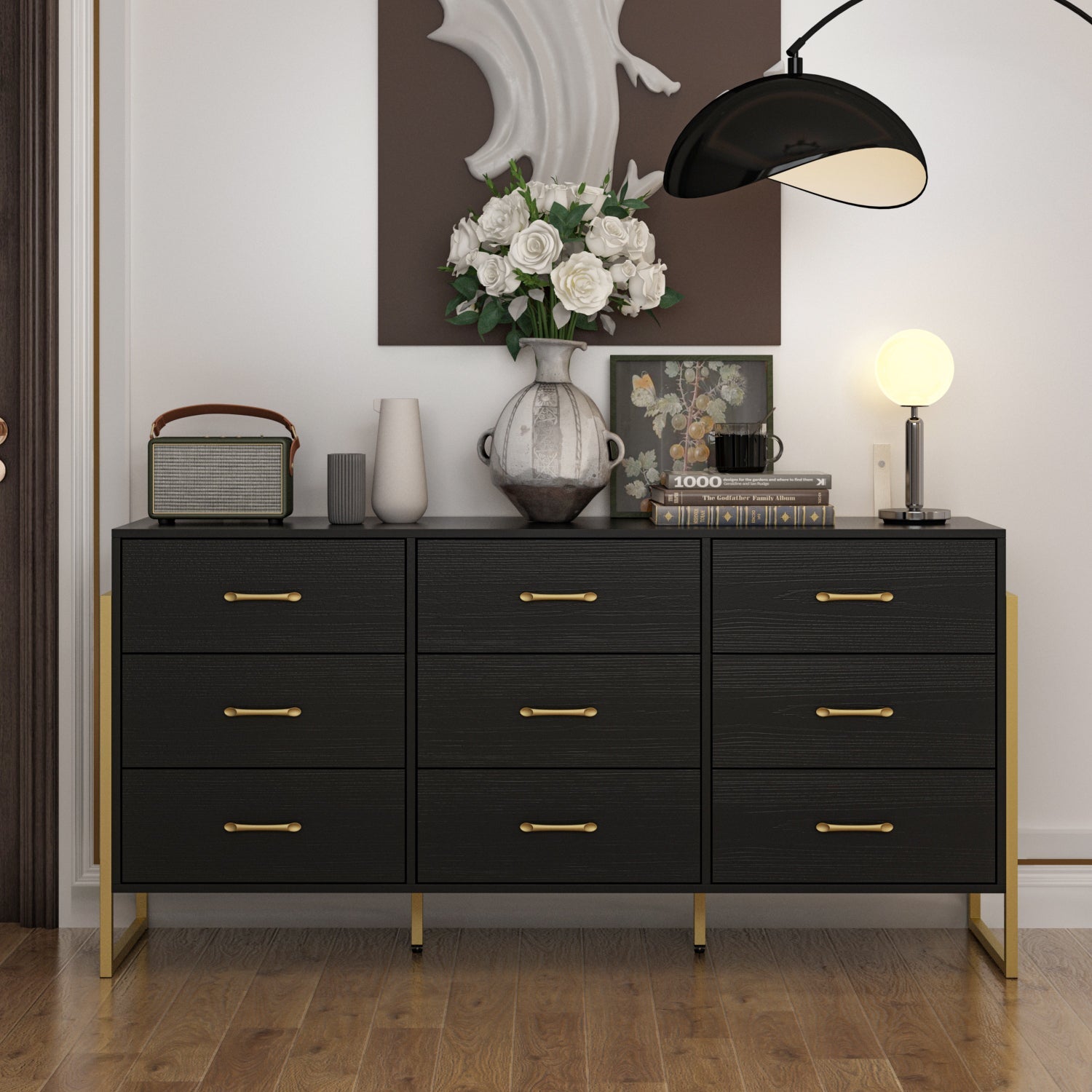

A narrow kitchen hutch is a tall freestanding cabinet with an upper section of shelves or glass doors over a closed base, sized for a small stretch of wall. Our working definition is a piece roughly under 32 inches wide. Shelf depth decides what it holds: an 11-inch shelf takes a 10-inch dinner plate lying flat, and a 13-inch shelf takes a 12-inch one.
It fits where a buffet can't: at the end of a counter run, beside the fridge, behind a door that stays open, or in a dining nook. Below are the walkway math, what fits on shallow shelves, glass vs solid doors, anchoring, and six picks from the FUFU&GAGA kitchen and pantry storage collection, from 15.7 to 31.5 inches wide plus one wider hutch.
Key takeaways
- Width: measure the gap at its narrowest point and leave room for door hinges and handles. Our narrow picks run 15.7 to 31.5 inches wide.
- Depth vs walkway: NKBA planning guidelines recommend at least 36 inches for a walkway and 42 inches for a one-cook work aisle. Add the hutch depth to that number to get the space you need in front of the wall.
- Dishes: dinner plates are 10 to 12 inches across, so look for a shelf at least 11 inches deep, or 13 inches for the larger plates.
- Doors: glass shows off dishes and glassware and keeps dust off; solid doors hide cereal boxes and mismatched containers.
- Safety: a tall, shallow cabinet should be anchored to the wall, whether or not a restraint comes in the box.
What is a narrow kitchen hutch?
Dictionary.com defines a hutch as one of "various chestlike cabinets, raised on legs and having doors or drawers in front, sometimes with open shelves above" (Dictionary.com). In kitchens and dining rooms the word usually means that two-part shape: a closed base cabinet for the bulky things, with shelves or glass doors above for dishes you use or want to see.
A narrow hutch keeps that stacked layout in a gap of two to three feet. Many slim pieces sold as pantry cabinets have the same structure, with an upper cabinet, a lower cabinet and sometimes a drawer in between, so it's worth looking at both categories. For how a hutch differs from a china cabinet, see our china cabinet vs hutch guide.
Where does a slim kitchen hutch fit?
- End of a counter run: the gap between the last base cabinet and a door frame or window is the classic spot. A tall narrow hutch extends your cabinetry without a renovation.
- Beside the fridge: leave the gap your refrigerator's manual asks for, and check that the fridge door and the hutch doors can both open fully. The NKBA guideline on door interference says no entry door should interfere with appliances, and appliance doors shouldn't interfere with one another.
- Dining nook: a slim hutch beside a small table keeps napkins, glasses and serving pieces within reach without crowding the chairs.
- Behind a door that stays open: measure from the wall to the back of the open door. If the gap is deeper than the hutch and the door still opens fully, it fits.
Narrow isn't always the answer. One slim tower in the middle of a long, empty wall can look lost, and a wide stand mixer or toaster oven may not fit on a shallow shelf. If you have the wall and the walkway, a wider hutch or buffet gives you more counter space.
How wide and deep should a narrow hutch be?
Width is set by the gap: measure it at the narrowest point (door casings, baseboard heaters, the fridge hinge) and leave a little room so the doors clear the walls. Count handles in the depth.
Depth is set by the walkway. The National Kitchen & Bath Association's Kitchen Planning Guidelines recommend a walkway of at least 36 inches, a work aisle of at least 42 inches for one cook and 48 inches for several cooks, measured between counter fronts, tall cabinets and appliances. The NKBA calls these recommendations, and notes that state or local codes may apply.
The arithmetic is simple: hutch depth plus the clearance you want equals the space you need between the wall and the opposite counter, island or table edge.
| Hutch depth | Walkway (36 in) | One-cook aisle (42 in) | Two-cook aisle (48 in) |
|---|---|---|---|
| 11.8 in | 47.8 in | 53.8 in | 59.8 in |
| 13.8 in | 49.8 in | 55.8 in | 61.8 in |
| 15.7 in | 51.7 in | 57.7 in | 63.7 in |
For example, if your counter front is 54 inches from the opposite wall, an 11.8-inch-deep hutch keeps a 42.2-inch work aisle (54 - 11.8), while a 15.7-inch-deep one leaves 38.3 inches: fine as a walkway, but under the one-cook aisle guideline.
In a dining nook, the NKBA seating guideline is 32 inches from the table edge to a wall or obstruction where nobody passes, 36 inches if people need to edge past a seated diner, and 44 inches to walk past. So a 13.8-inch-deep hutch behind the chairs needs the table edge 57.8 inches from the wall (44 + 13.8) if people walk behind.
Doors also swing into the room. On a two-door cabinet each door is roughly half the cabinet's width, so the doors on a 27.6-inch cabinet reach about 14 inches into the aisle when open.

What fits on shallow kitchen hutch shelves?
Go by the shelf depth inside the cabinet, not the outside depth: the back panel and doors take up part of it. Plate sizes come from Lenox's dinner plate size guide.
| Item | Size (Lenox) | Shelf depth it needs lying flat |
|---|---|---|
| Dinner plates | 10 to 12 in across | 11 in fits 10-in plates; 13 in fits 12-in plates |
| Salad and dessert plates | 8 to 9 in | 9 in or more |
| Bread and butter plates | 5 to 7 in | Any shelf, two rows on deeper ones |
| Charger plates | 12 to 14 in | 13 to 15 in, or store upright in a rack |
Width matters as well. A 20-inch-wide shelf holds two stacks of 10-inch plates side by side, and a 25-inch shelf holds two stacks of 12-inch plates.
A simple layout works for most narrow hutches: everyday dishes and glasses at chest height, heavy items such as small appliances, stockpots and bulk bags in the base, and light, rarely used items on top. The NKBA access standard suggests storing frequently used items 15 to 48 inches above the floor, and the CPSC advises keeping heavier items on lower shelves.
Can a narrow hutch hold a microwave?
Only if the listing says it has a microwave shelf or an open appliance section, and the shelf is deeper and wider than your microwave plus the ventilation space in the microwave's manual. Of our picks, only the 63-inch hutch below lists an open middle section for a microwave; the narrow pantry cabinets are closed cabinets. The NKBA suggests placing the bottom of a microwave about 3 inches below the main user's shoulder and no more than 54 inches above the floor, with a 15-inch landing area next to, above or below it. Our microwave in a pantry cabinet guide covers clearance and cords.
Glass doors or solid doors?
Glass doors put glassware, serving bowls and good dishes on show while keeping dust off, and they make a tall cabinet look lighter in a small kitchen. Clear glass suits things you keep tidy; frosted glass hides a little more. Solid doors hide the cereal boxes, plastic containers and cleaning supplies that every kitchen has. A common compromise is the classic hutch split: glass above, solid below. Our kitchen display cabinet guide covers lighting and styling a glass-front cabinet.
Open shelves are easiest to reach but collect dust and kitchen grease, so keep them for things you use every day. Louvered doors add texture, but they take longer to dust than flat panels.
How much storage does a narrow hutch add?
The NKBA gives a way to compare: shelf and drawer frontage, which is cabinet width in inches times the number of shelves and drawers times cabinet depth in feet. It recommends 180 inches of pantry frontage in a small kitchen (under 150 square feet), within 1,400 inches of total storage. Here is the same arithmetic for our narrow picks, using their listed shelf and drawer counts:
| Cabinet | Width x shelves and drawers x depth in feet | Frontage |
|---|---|---|
| 15.7-in glass-top bookcase | 15.7 x 5 x 0.958 | about 75 in |
| 23.2-in cabinet | 23.2 x 6 x 0.983 | about 137 in |
| Stilla 27.6-in pantry | 27.6 x 5 x 1.15 | about 159 in |
| 31.5-in pantry (door racks not counted) | 31.5 x 6 x 1.308 | about 247 in |
| 30-in tall cabinet | 30 x 7 x 1.308 | about 275 in |
In other words, a single 27.6-inch pantry cabinet comes close to the NKBA's whole pantry allowance for a small kitchen, and a 30-inch one exceeds it. It's rough, since it uses outside dimensions.
Do you need to anchor a narrow kitchen hutch?
Yes. Our narrow picks stand 70.9 to 71.6 inches tall on bases only 11.5 to 15.7 inches deep, a small footprint for their height, and loaded upper shelves and open doors shift weight forward. The U.S. Consumer Product Safety Commission reports an average of 17,800 emergency-department-treated tip-over injuries a year from 2020 to 2022, 44% of them to people under 18, and 217 tip-over deaths reported from 2013 to mid-2023 (CPSC). The CPSC's Anchor It campaign says anchoring all furniture with drawers, doors and shelves to the wall prevents tip-over injuries and deaths.
Five of our six picks list a tipover restraint in the box; the 23.2-inch cabinet does not, so buy an anti-tip kit for it. Fasten into a stud or use anchors rated for your wall, load the bottom first, and keep tempting items off high shelves where a child might climb. Our guide on how to anchor a bookcase to the wall walks through the steps, and they apply to a hutch too.
Buying checklist
- Measure the gap at its narrowest point and subtract room for hinges and handles.
- Add the hutch depth to 36 inches (walkway) or 42 inches (one-cook aisle) and check the space in front.
- Check that cabinet doors, the fridge door and the oven door can all open at the same time.
- Look for an inside shelf depth of 11 inches or more for 10-inch dinner plates, 13 inches for 12-inch plates.
- Decide glass, solid or a mix based on what you'll store.
- Confirm whether a tipover restraint is included and plan where it will fasten.
Our picks: narrow kitchen hutches and slim pantry cabinets
Four tall cabinets 23.2 to 31.5 inches wide, a 15.7-inch glass-top piece and one wider true hutch. Dimensions and features come from each listing.
23.2" Slim White 6-Shelf Cabinet
This is the shallowest pantry-style pick, at 70.9" H x 23.2" W x 11.8" D. Two sets of double doors split it into upper and lower cabinets, with six adjustable shelves 20" wide and 11" deep, each rated 18 lb. That shelf depth suits 10-inch dinner plates and 8-to-9-inch salad plates.
Best for: a galley kitchen or narrow walkway where every inch of depth counts.
Skip it if: you want 12-inch plates lying flat or a restraint in the box; its spec lists no tipover restraint device, so buy a wall anchor kit with it.
Stilla 27.6" White Kitchen Pantry
The Stilla is 70.9" H x 27.6" W x 13.8" D, with two doors over four shelves (two adjustable, two fixed) and a large bottom drawer 6.5" H x 25.6" W x 11.8" D inside. The listing gives a 250 lb total capacity, black knobs on a white finish, and an anti-tip device fitted on the back.
Best for: the gap beside a fridge or at the end of a counter, where you want closed pantry storage plus a drawer for linens or snacks.
Skip it if: you need a microwave shelf (its spec says no) or glass doors to display dishes.
30" White Tall Cabinet with Shutter Doors
Louvered shutter doors and antique brass handles give this 71.6" H x 30" W x 15.7" D cabinet a retro look. Inside are six adjustable shelves 25" wide and 13" deep, enough for 12-inch dinner plates, and a middle drawer 24.9" W x 12.4" D on metal slides for cutlery or tablecloths. A tipover restraint is included.
Best for: a dining nook or kitchen wall where you want the most shelf space in a 30-inch width.
Skip it if: your walkway is tight: at 15.7 inches deep it needs 57.7 inches from the wall to keep a 42-inch work aisle. Louvers also take longer to dust than flat doors.
31.5" Natural Pantry Cabinet with Door Shelves
At 70.9" H x 31.5" W x 15.7" D, this wood-grain cabinet has grooved upper doors over four interior shelves 30.3" W x 15" D (the top one adjustable), three racks with safety bars on each door for spices and bottles, and two full-extension drawers below. The cabinet interior is 46" high, the total capacity is listed at 180 lb, and anti-tip hardware is included.
Best for: cooks who want spices and bottles at eye level on the doors, plus deep shelves for 12-inch plates and serving pieces.
Skip it if: you have a narrow aisle or want an open appliance shelf; the photos show closed doors over drawers.

15.7" White Slim Cabinet with Glass Upper Door
Sold as a bookcase, this 70.9" H x 15.7" W x 11.5" D piece has the hutch layout in miniature: a glass upper door over three shelves, and a closed lower door over two more. Shelves are 14" W x 11" D and rated 35 lb each; the top shelf and the lower partition adjust. A tipover restraint is included.
Best for: a dining nook or the gap beside a doorway, to show off glassware, mugs or salad plates in a very narrow space.
Skip it if: you need pantry capacity; a 14-inch shelf holds a single stack of plates, and it is the smallest pick here by far.
63" Kitchen Hutch with Glass Doors and Microwave Space
If your wall is long enough, this is a true buffet-and-hutch: 74.8" H x 63" W x 15.7" D, with glass doors and an adjustable shelf up top, an open middle section the listing describes for a microwave, toaster or coffee maker, and four drawers (6" H x 22" W x 12" D inside, 25 lb each) beside lower cabinets. Shelves are rated 33 lb each, and a tipover restraint is included. It comes in brown, white or wood.
Best for: a kitchen or dining wall with 63 inches plus a little side clearance to spare, where you want an appliance station and glass-front display in one piece.
Skip it if: you're shopping for a narrow hutch for a small gap; at 63 inches wide it is a full-size piece.

Compare the picks
| Pick | W x D x H (in) | Shelf depth | Doors | Restraint in box | Best for |
|---|---|---|---|---|---|
| 15.7" glass-top cabinet | 15.7 x 11.5 x 70.9 | 11 in | Glass over solid | Yes | Glassware in a tiny gap |
| 23.2" 6-shelf cabinet | 23.2 x 11.8 x 70.9 | 11 in | Solid, upper and lower | No | Tight galley walkways |
| Stilla 27.6" pantry | 27.6 x 13.8 x 70.9 | Not listed | Solid, plus drawer | Yes | Beside the fridge |
| 30" shutter cabinet | 30 x 15.7 x 71.6 | 13 in | Louvered, plus drawer | Yes | Most shelf space |
| 31.5" natural pantry | 31.5 x 15.7 x 70.9 | 15 in | Solid with door racks | Yes | Spices and big plates |
| 63" glass hutch | 63 x 15.7 x 74.8 | Not listed | Glass, open middle | Yes | Long wall, microwave |
Every pick here stands over 70 inches tall, so check your ceiling and leave room to tilt the cabinet upright after assembly; our flat-pack assembly guide has tips. You'll find more tall, slim and buffet options in the kitchen and pantry storage collection.
FAQ
How deep should a narrow kitchen hutch be?
For dishes, aim for an inside shelf depth of at least 11 inches, which takes 10-inch dinner plates, or 13 inches for 12-inch plates (Lenox lists dinner plates at 10 to 12 inches). Overall, 11.8 to 15.7 inches covers our narrow picks. Add that depth to 36 inches for a walkway or 42 inches for a one-cook work aisle to check the space in front.
What is a 12 inch deep hutch good for?
A hutch about 12 inches deep, such as our 11.8-inch cabinet with 11-inch shelves, holds 10-inch dinner plates, salad plates, glasses, mugs, spices and canned goods. It is a good choice for a galley kitchen or hallway, but 12-inch plates, chargers and wide appliances need a deeper shelf.
Should a tall narrow hutch have drawers or just shelves?
Drawers are handy for cutlery, linens and small items that get lost on a shelf, and a drawer in the middle splits a tall cabinet into upper and lower zones. Shelves are more flexible for plates and appliances. If space is tight, choose adjustable shelves and use bins or baskets for small things.

Leave a comment
This site is protected by hCaptcha and the hCaptcha Privacy Policy and Terms of Service apply.