

















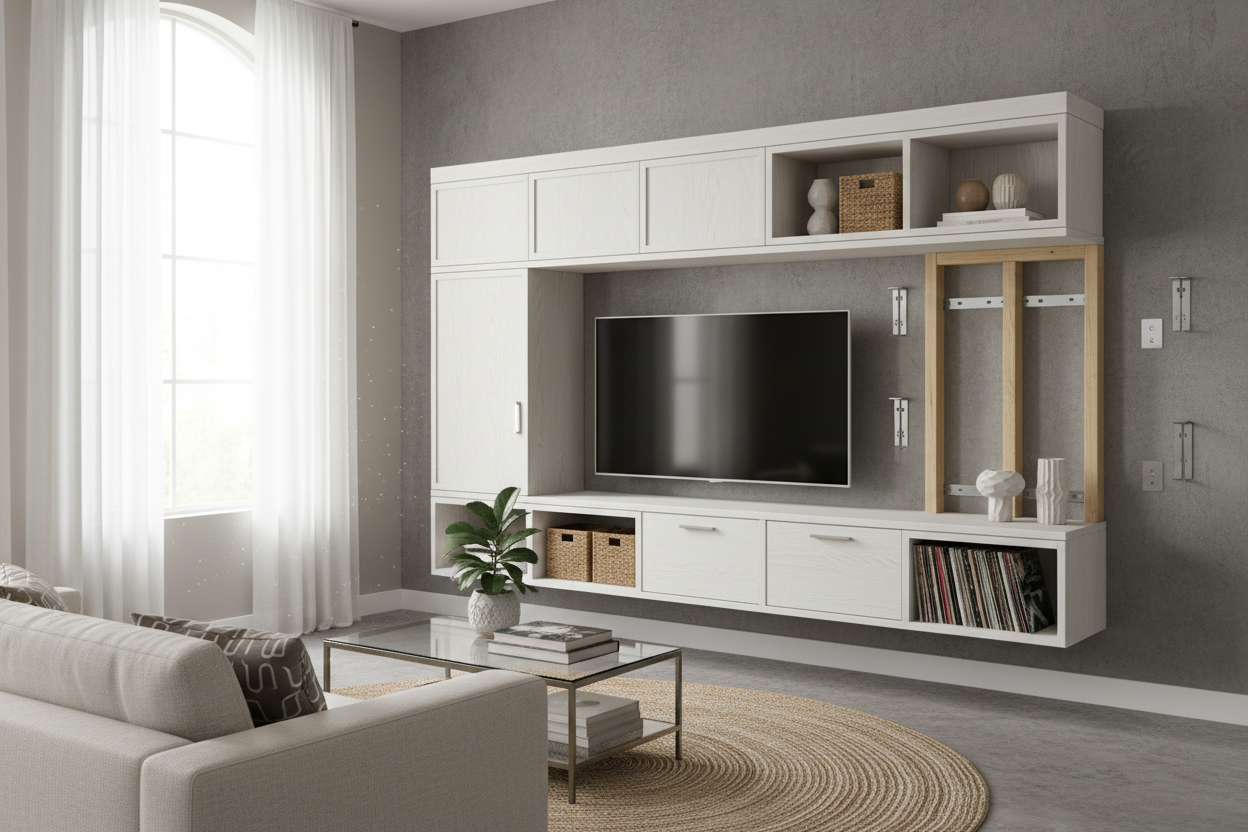
I spent three weeks staring at a blank wall, paralyzed by the thought of my 65-inch OLED and a heavy oak console ending up as a pile of expensive splinters. The dream of a wall hung tv cabinet is sleek and airy, but the reality involves a lot of tapping on drywall and sweating over a stud finder that keeps blinking 'error.'
We've all seen the Pinterest photos where the living room looks like a minimalist gallery. But nobody shows the frantic Google searches for 'how to patch a 4-inch hole in drywall' after a DIY disaster. If you're nervous, you should be—but it's a solvable problem with the right hardware.
- Drywall anchors are for picture frames, not furniture.
- Finding at least two studs is the bare minimum for safety.
- Cables will ruin the look if you don't plan for them.
- If your wall is plaster and lath, call a pro.
The Gravity of the Situation (Literally)
Most people underestimate the sheer leverage a wall hanging tv cabinet puts on a vertical surface. It's not just the 40 lbs of wood; it's the 50 lbs of tech and the accidental 10 lbs of pressure when you're leaning on it to plug in a new PlayStation. Residential drywall is basically just compressed chalk and paper—it has zero structural integrity on its own.
When you hang something that sticks out 15 inches from the wall, you aren't just pulling down; you're pulling out. That 'pulling out' force is what rips anchors through the wall. I've seen 1/2-inch drywall fail under the weight of a 'lightweight' unit because the owner thought four plastic toggles would be enough. Spoiler: They weren't.
Studs, Toggle Bolts, and Drywall Myths
I’ve seen people try to use those cheap plastic screw-in anchors for a tv cabinet hanging project. Don't do it. Unless you enjoy the sound of crumbling gypsum at 3 AM, you need to hit the studs. Metal or wood, it doesn't matter, but you need a solid bite into the skeleton of your house.
If the studs don't line up perfectly with your unit's mounting holes—which they never do—you have two choices. You can screw a 'ledger board' (a piece of 1x4 lumber) into the studs first and then mount the cabinet to that, or you can use heavy-duty 1/4-inch Snaptoggle bolts. These are the only anchors I trust for anything heavier than a mirror. They grip the back of the drywall like a steel claw, but even then, I still try to get at least two primary bolts into a stud.
Will My Cords Just Dangle Everywhere?
Nothing kills the 'floating' vibe faster than a black waterfall of power strips and HDMI cords. If you're going for a hanging tv cabinet, you have to commit to the wire hide. I prefer units like this Large Tv Cabinet Spacious Storage Cable Management 2 Doors 94 because it actually accounts for the mess with pre-drilled routing holes so you don't have to drill them yourself.
If you're feeling brave, you can install an 'in-wall' cable management kit. It's basically two plastic portholes that let you run wires behind the drywall. If you're a renter and can't cut holes, get some D-line paintable trunking. It’s not invisible, but it’s a lot better than a tangled mess of 'spaghetti' hanging under your expensive tech.
Real Talk: When to Just Hire a TaskRabbit
I once spent six hours trying to level a wall hung tv unit solo, only to realize I’d drilled into a vent pipe. That was a $400 mistake. There is no shame in admitting defeat. If your wall is made of crumbly 1920s plaster, or if you don’t own a drill with a masonry bit, pay someone else to take the risk.
The peace of mind is worth the $150 installation fee. Once it's up, though, the room feels twice as big. I wrote about Why I Replaced My Clunky Console With a TV Cabinet on the Wall because that floor space is precious. Being able to run a vacuum under your TV without moving a 100-lb sideboard is a minor life miracle.
The Verdict on Floating Your Tech
Making a tv cabinet hang on wall surfaces isn't magic; it's just physics and patience. If you own a level, a drill, and a decent stud finder, you can do this. I've done it in three different apartments now, and I've only had one 'incident' involving a poorly placed shelf.
Just don't rush the measurements. Use a piece of painter's tape to mark the wall before you drill a single hole. Triple-check the height—nothing is worse than a TV that sits too high, forcing you to crane your neck like you're in the front row of a movie theater. Get it right, and you'll never go back to floor-standing furniture again.
Can I mount this on a brick wall?
Yes, but you'll need a hammer drill and masonry anchors. Don't try to use standard wood screws; they'll just strip and fall out of the mortar.
What if my studs are metal?
You’ll need specialized metal-piercing screws or Snaptoggles. Standard wood screws won't grab onto thin metal studs effectively.
How high should the cabinet be?
Ideally, the bottom of the cabinet should be 12 to 18 inches off the floor. This keeps the TV at a comfortable eye level when you're sitting on the sofa.



Leave a comment
This site is protected by hCaptcha and the hCaptcha Privacy Policy and Terms of Service apply.