

















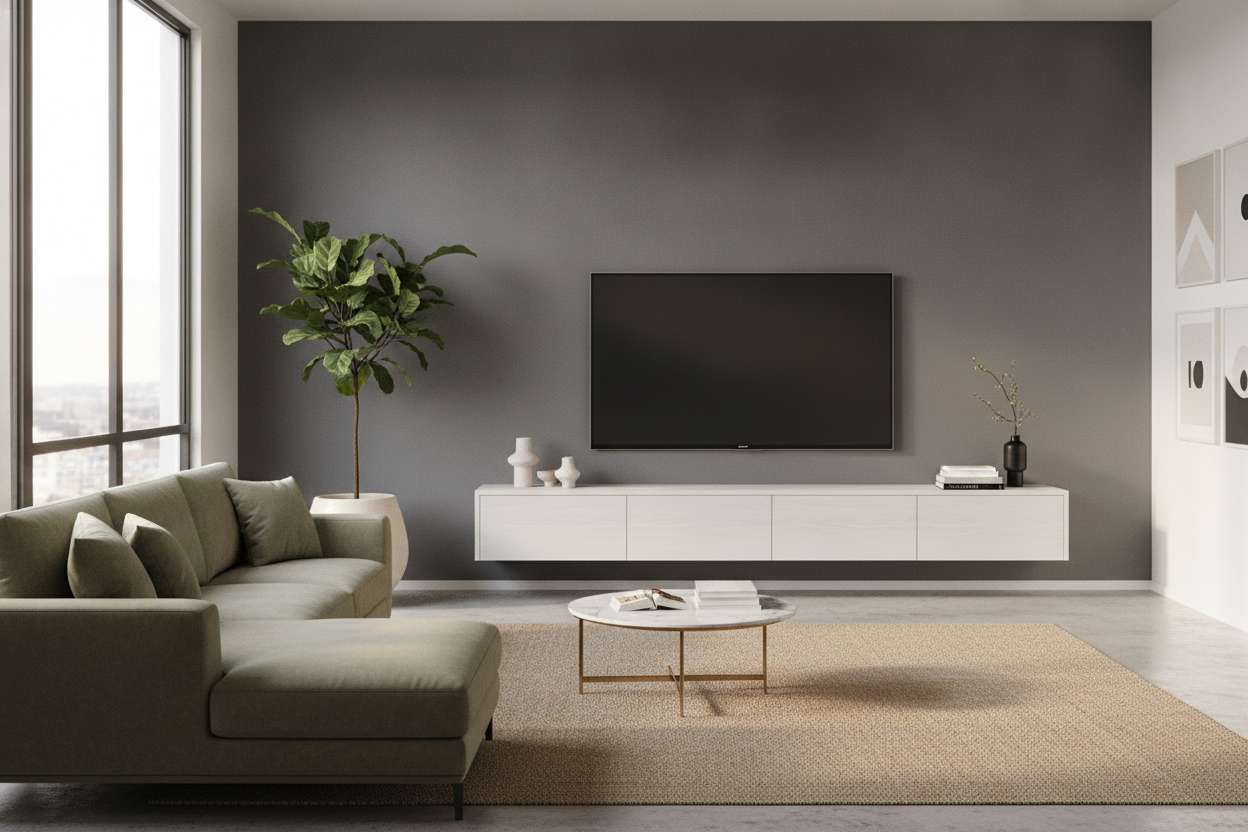
I have spent far too many nights sitting on a cardboard moving box, staring at a blank wall and wondering if my new media setup is going to look like a high-end lounge or a sad, disproportionate mess. There is a specific kind of panic that sets in when you realize your floating tv stand 60 inch unit might actually be narrower than the screen you just dropped a month's rent on. I’ve lived in four apartments in five years, and I’ve learned the hard way that the measuring tape is your only real friend.
- A 60-inch console is the visual 'sweet spot' for TVs between 50 and 55 inches.
- Wall-mounting clears floor space, which is a massive win for narrow city living rooms.
- Avoid the 'lollipop effect' by ensuring your console is at least 4-6 inches wider than your screen.
- Cable management is non-negotiable when the floor underneath is visible.
The 'Goldilocks' Width for Apartment Living Rooms
In my last place—a Brooklyn third-floor walk-up with windows that were never quite centered—I realized that massive 80-inch floor units are the enemy of flow. They block radiators and make it impossible to open the closet door all the way. That is why a floating tv stand 60 inch console is usually the winner. It is wide enough to feel like a deliberate piece of furniture, yet it leaves enough 'white space' on your wall so the room can actually breathe.
Switching from a bulky, dust-collecting floor cabinet to a sleek wall mounted media console entertainment center changed the entire vibe of my studio. Suddenly, I could see the floorboards again. It makes the room feel less like a storage unit and more like a home. At five feet wide, it anchors the wall without demanding the spotlight.
The Screen-to-Console Ratio You Cannot Ignore
Designers usually follow a simple rule: your console should be about 20% wider than your TV. If they are the same width, the whole setup looks top-heavy and precarious. When you are shopping for a 60 inch floating tv stand, you have to remember that TV sizes are measured diagonally, while consoles are measured horizontally. This trip-up has ruined many a living room aesthetic.
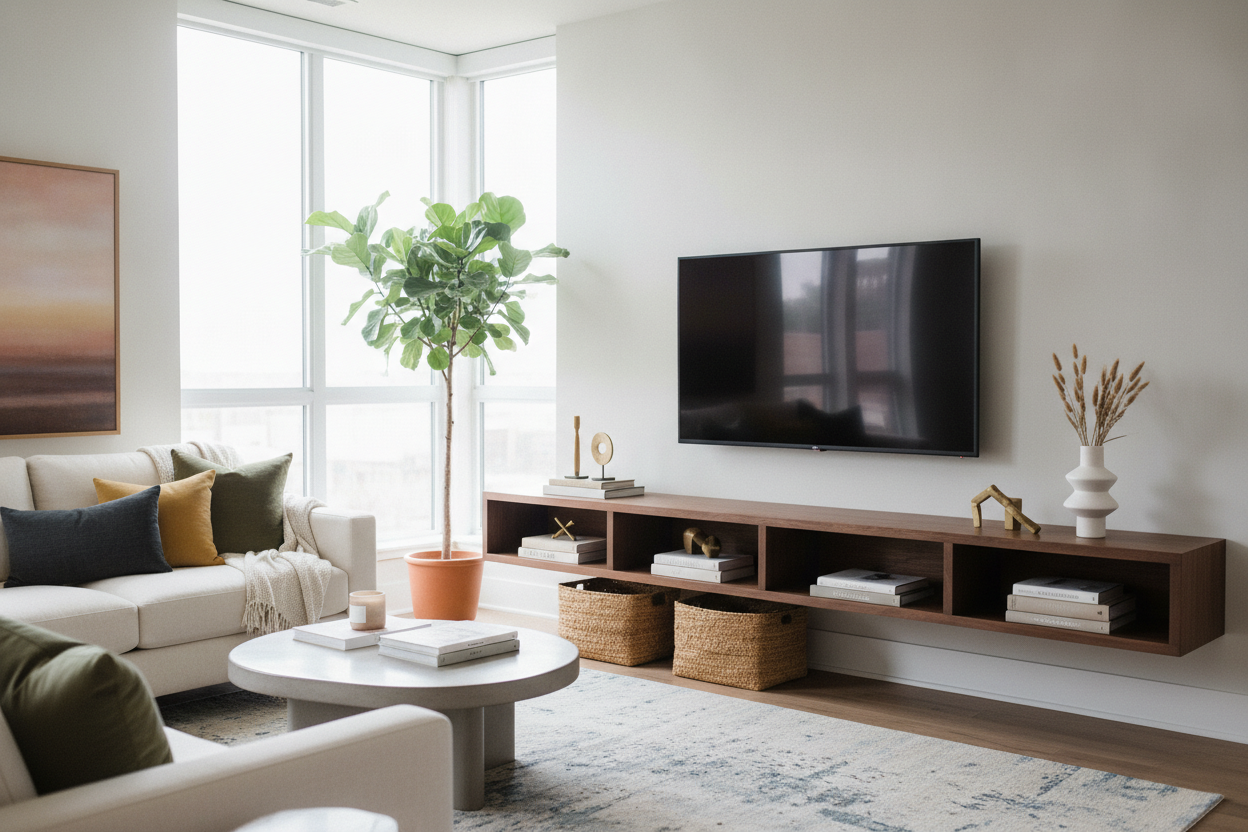
A 55-inch TV is actually about 48 inches wide. Pairing that with a 60-inch stand gives you about six inches of breathing room on either side. That is enough space for a small plant or a candle without it looking cluttered. If you go any smaller with the stand, the TV starts to look like a giant head on a tiny pair of shoulders.
So, Can You Put a 65-Inch TV Above It?
This is the question I get asked most often. A 65-inch TV has a physical width of roughly 57 inches. If you put that over a 60" floating tv stand, you only have 1.5 inches of ledge on each side. Visually, it is risky. It can work if the stand is chunky and deep, but if it is a slim profile, it will look like the TV is about to crush the furniture.
I once tried to cheat this look with a cheap particle board unit, and the lack of overhang made the TV look twice as big in a bad way. If you are curious about specific weight limits for this kind of setup, you might want to check out Does the Oglethorpe Floating TV Stand Actually Hold 60 Inches? before you start drilling holes in your drywall.
Hiding the Mess (Because 60 Inches Fills Up Fast)
Let’s talk about the 'floating' part. Because the floor is visible, any dangling wires will look like a tech-themed horror movie. A floating tv stand 60" wide usually gives you two or three compartments. In my experience, one of those is immediately sacrificed to the router and the power strip. That doesn't leave much room for a massive vinyl collection or three different gaming consoles.
I recommend prioritizing what actually needs to be plugged into the TV. My Apple TV and PS5 stay inside; the board games and extra blankets go in a separate basket. If you cram a floating unit too full, the weight can actually cause it to sag over time, especially if it is made of MDF rather than solid wood or high-grade plywood.
Styling Tricks to Make a Mid-Size Console Look Custom
If you feel like your 60-inch unit is looking a little lonely on a large wall, don't buy a bigger stand—style the perimeter. I love placing a tall, leafy plant like a Bird of Paradise on one side of the console. It draws the eye upward and 'extends' the visual footprint of the media area without taking up more wall space. You can also hang a pair of sconces about 10 inches above the ends of the stand to frame the whole setup.
If you've measured your wall and realized that 60 inches is either too much or not enough, it is worth the time to browse various TV stands in different widths. Sometimes an extra 10 inches makes the difference between 'that fits' and 'that belongs there.'
FAQ
Is a 60-inch stand big enough for a 75-inch TV?
Absolutely not. A 75-inch TV is about 65 inches wide. It will hang over the edges of the stand, which is a major interior design crime and looks incredibly unstable.
How high should I mount my floating stand?
The sweet spot is usually 10 to 12 inches off the floor. You want it high enough to clean under, but low enough that the TV remains at eye level when you are sitting on the sofa.
Can I mount a floating stand on drywall?
Yes, but you must hit the studs. If you rely on drywall anchors for a 60-inch unit plus the weight of your gear, you are asking for a disaster. Use a stud finder; it is worth the ten bucks.

Leave a comment
This site is protected by hCaptcha and the hCaptcha Privacy Policy and Terms of Service apply.