

















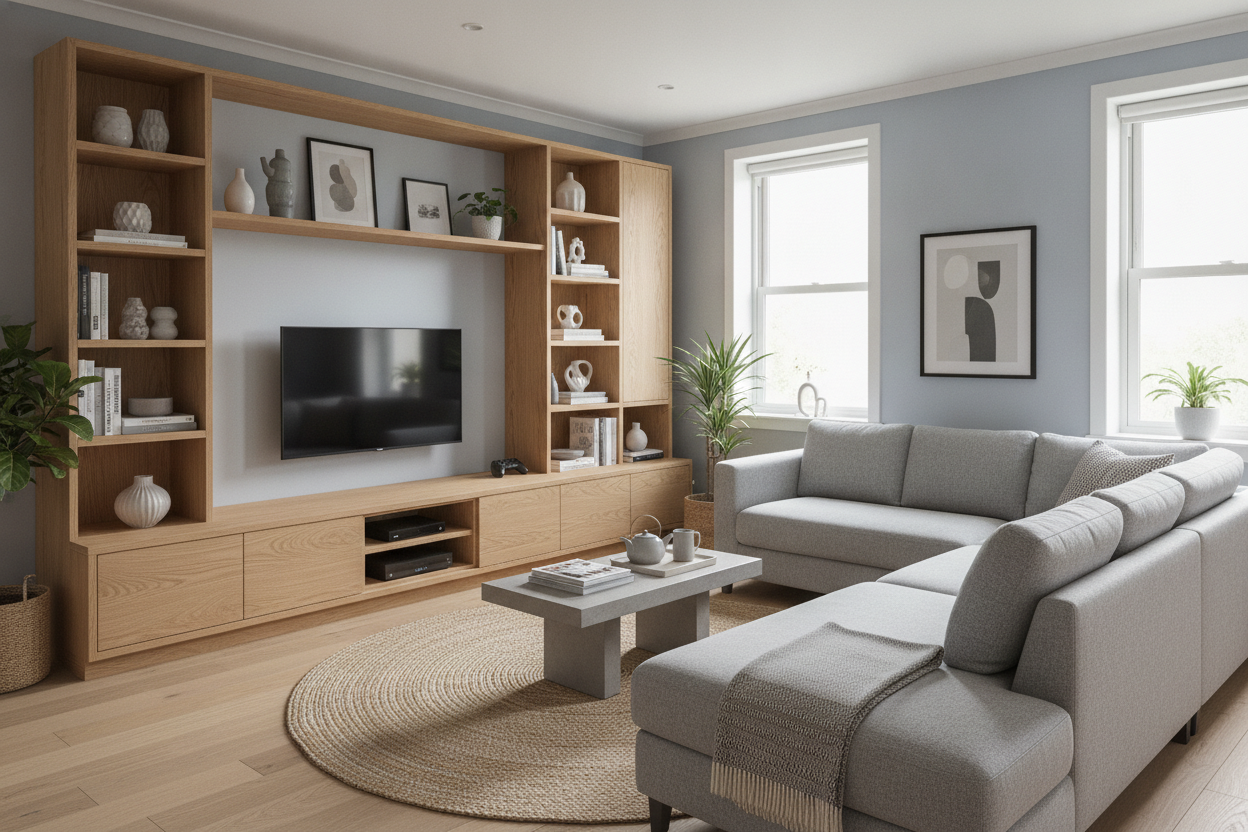
I once lived in a loft that was essentially a 40-foot-long concrete rectangle. I had a gorgeous sofa and a big TV, but no matter where I put them, the room felt like a high-end bowling alley. I spent weeks staring at 50 open tabs of furniture, trying to find a way to make the space feel like a home instead of a hallway. That is when I discovered that l shaped tv stands are the secret weapon for anyone dealing with a floor plan that makes zero sense.
- Defines zones in open-concept spaces without the bulk of a room divider.
- Uses the 'dead space' in corners that standard consoles leave empty.
- Provides double the surface area for decor, plants, or speakers.
- Hides messy cable clusters in the inner corner junction.
The 'Bowling Alley' Living Room Problem
The struggle with a long, narrow living room is that every piece of furniture feels like it is hugging the wall for dear life. When I first moved in, I would browse standard tv stands for hours, thinking a longer flat unit was the answer. It wasn't. A 70-inch straight console against a 20-foot wall just looks like a tiny island in a giant ocean of drywall.
Standard units don't create boundaries; they just sit there. If you are in a studio or an open-concept apartment, you need your furniture to do the heavy lifting of 'faking' a wall. An l-shaped entertainment center breaks that linear monotony by physically turning a corner, which tells your brain, 'Okay, the living room ends here and the dining area starts there.'
What Actually Qualifies as an L-Shaped Unit?
Not every l-shaped entertainment unit is built the same way. You generally have two camps: the modular 'expandable' consoles and the fixed corner units. The modular l-shaped tv console is my personal favorite for renters. These usually consist of two pieces—one that sits on top of the other—allowing you to slide them out or rotate them to fit the specific angle of your room.
Then you have the true l-shaped corner entertainment center. These are designed to hug two walls simultaneously. They are sturdier and offer a more built-in look, but they are less forgiving if you move to a new place with different dimensions. If you are looking for a permanent l-shaped tv stand design, go fixed; if you move every year, go modular.
How I Used a Corner Setup to Fake a Defined Space
In my last place, I had this annoying structural pillar that jutted out right where the TV needed to go. A flat unit would have left a weird 10-inch gap of wasted space. Instead, I used a symmetric l-shaped media console to wrap around that corner. It turned an architectural eyesore into a focal point.
By using an l tv stand, I was able to pull my sofa closer to the corner, creating a tight, cozy 'concorde' of furniture. Suddenly, the room didn't feel like a cavernous void. The 'L' shape acted as an anchor, making the TV area feel like a deliberate room within a room. It is a psychological trick—once you define the corner, the rest of the room feels manageable.
The Hidden Storage Bonus I Didn't See Coming
I used to think I needed a massive buffet or a wide storage cabinet with drawers to hide my board games and tech clutter. But an l-shaped tv unit with storage actually offers a surprising amount of real estate. Because you have two 'wings,' you effectively double your shelf space without the piece feeling twice as big.
My l-shaped media cabinet holds my PS5, a soundbar, and about a dozen books on one side, while the other side stays clear for a table lamp and a plant. It functions like a media center and a low bookshelf had a baby. It keeps the visual height low—which keeps the room feeling airy—while still swallowing up all the junk that usually ends up on the floor.
3 Things to Measure Before You Commit
Before you buy an l-shaped media console, do not trust your eyes. Measure the 'return'—that is the part of the 'L' that sticks out. If it is too deep, it will encroach on your walkway and you will be stubbing your toe every morning. Make sure the depth of the unit allows at least 30 inches of walking space between it and your coffee table.
Second, check your outlet placement. L-shaped units often cover up more wall space, and there is nothing worse than realizing your power strip is trapped behind the heaviest part of the l-shaped tv cabinet. Lastly, check the weight limit on the 'floating' section if you are buying a modular unit. Some are only rated for 20-30 lbs on the extended wing, which is fine for a plant, but bad for a heavy vintage receiver.
FAQ
Will an L-shaped stand work in a small room?
Yes, actually. It often works better than a flat stand because it utilizes the corner space that usually goes to waste. Just stick to a modular l-shaped tv unit so you can adjust the width.
Can I put a 65-inch TV on a corner L-stand?
Check the specs, but usually yes. The key is making sure the TV's legs or pedestal fit on the main section of the l-shaped unit. The 'L' part is usually for storage and decor, not the screen itself.
Are they hard to assemble?
Modular ones are easy because they are often two separate pieces. Fixed l-shaped corner entertainment centers can be a beast because of the mitered joints. Budget an extra hour and have a friend help you flip it over.

Leave a comment
This site is protected by hCaptcha and the hCaptcha Privacy Policy and Terms of Service apply.