

















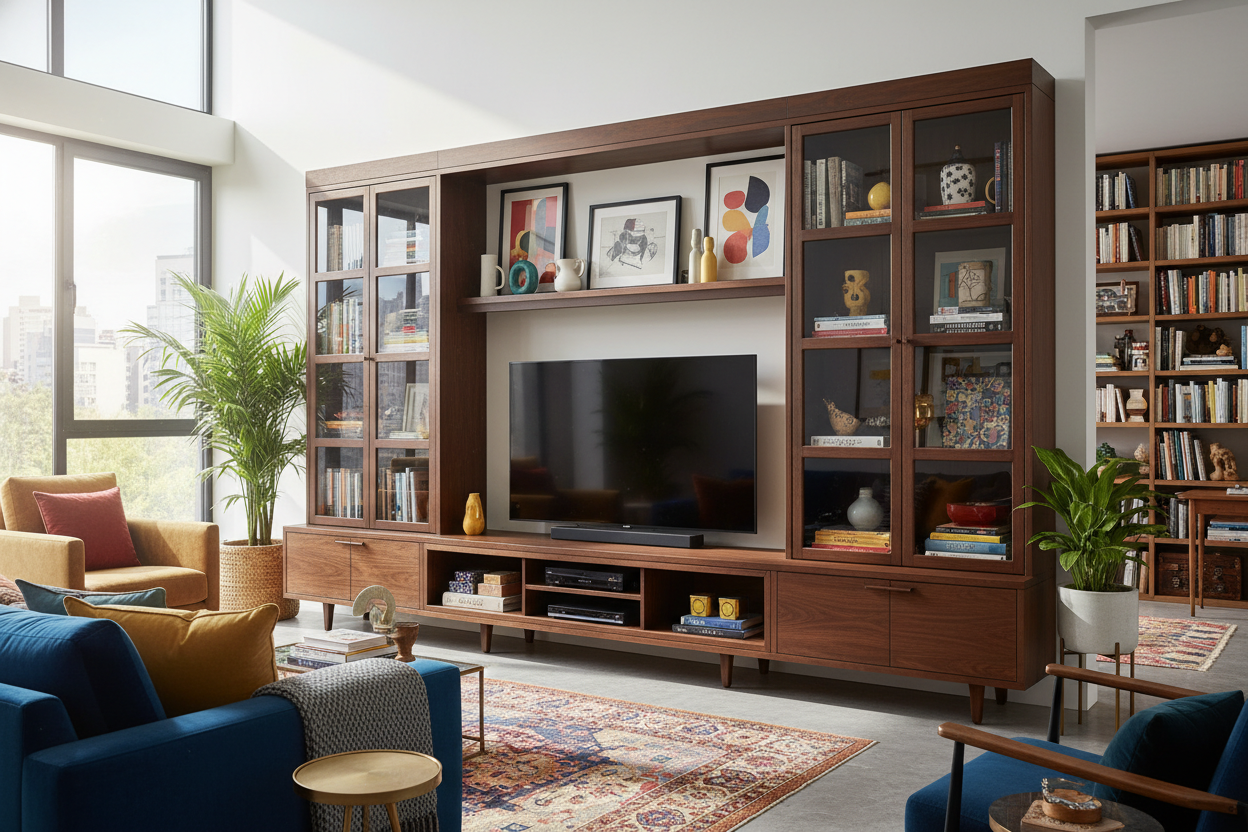
I spent three years staring at a low-profile, white lacquer slab that was supposed to be the 'ultimate' minimalist media unit. It was sleek, sure, but it also felt like a surgical tray. Every time I bought a cool ceramic vase or a vintage art book, I had to shove it onto a crowded bookshelf in the hallway because my TV area was a 'no-clutter zone.'
Eventually, I realized my living room didn't feel like me; it felt like a tech showroom. I needed a display cabinet tv stand that actually let me live with my stuff. I wanted my favorite things front and center, not tucked away in a closet or competing with a mess of wires.
- Glass doors keep the dust off your ceramics while keeping them visible.
- A taller profile (around 30 inches) helps ground a large TV better than a tiny, low-slung console.
- Framed glass adds a layer of architectural detail that plain wood lacks.
- Closed drawers are non-negotiable for hiding the plastic tech junk.
The 'Black Box' Dilemma in My Living Room
The problem with most modern media setups is that they treat the TV like a sacred object that shouldn't be touched by decor. My old console was barely 15 inches off the ground. It left a massive, awkward gap of dead air between the top of the stand and the bottom of the screen, making the whole wall look unfinished and sterile.
I tried leaning a few frames against the wall, but they just looked cluttered. The 'black box' of the TV sucked the life out of the room. I wanted a piece of furniture that felt substantial—something with height and character that could hold its own against a 65-inch screen without looking like a flimsy afterthought.
Why a Display Cabinet TV Stand Finally Clicked
I used to think open shelving was the answer, but after a month of dusting my thrifted pottery every three days, I gave up. Moving to a tv stand and display cabinet combo was the middle ground I didn't know I needed. It offers that 'curated museum' vibe but keeps the maintenance low because everything is sealed away.
In my search, I realized I’d been making a lot of tv stand and cabinet mistakes, like choosing units that were too narrow for my TV's footprint. The display cabinet style solves this by providing a wider, more stable visual base. It turns the media wall into a feature wall instead of just a place where you watch Netflix.
The Magic of Framed Glass Doors
There is something about framed glass that instantly makes a piece of furniture look expensive. When you use a tv stand with display cabinet, the glass acts as a literal frame for your life. It signals that whatever is inside—even if it's just a stack of old National Geographics—is worth looking at.
I’m particularly partial to a black cabinet with glass doors. The dark frame creates a high-contrast outline that makes colorful objects pop. It’s moody, it’s sophisticated, and it hides the internal shadows better than a light-colored wood would. It makes a $20 thrifted bowl look like a gallery piece.
How to Keep Your Setup from Looking Like a Thrift Store Shelf
The danger of a tv console display cabinet is the 'clutter creep.' If you jam every single souvenir you've ever bought behind that glass, it’s going to look like a chaotic antique mall booth. You have to be ruthless with your editing to maintain a high-end feel.
I follow the rule of thirds: one-third books, one-third ceramics or 'objects,' and one-third negative space. This allows the eye to rest. If you need more help with the layout, you should definitely learn how to style a display cabinet tv stand to avoid that overstuffed look. Remember, the TV is already a huge visual weight; the stuff underneath needs to balance it, not compete for airtime.
What to Put on Display (And What to Hide in Drawers)
Not everything belongs behind glass. My rule is simple: if it’s made of organic materials like clay, paper, or wood, put it on display. If it’s made of injection-molded plastic or has a blinking LED light, hide it. Your PlayStation controllers and tangled HDMI cables do not count as 'decor.'
If you have more tech than treasures, look for a modern tv console cabinet that features both glass doors and solid drawers. This hybrid approach is a lifesaver. I keep my beautiful stoneware bowls in the glass section and my messy power strips and extra remotes in the solid drawers. It’s the only way to stay sane in a small apartment.
My biggest mistake? I once bought a unit with non-adjustable shelves. I had this gorgeous oversized art book that was exactly half an inch too tall to fit. I ended up having to lay it flat, which took up way too much real estate. Always check that the shelves can move before you click 'buy'.
FAQ
Is it hard to keep the glass clean?
Honestly, just hit it with a microfiber cloth once a week. Because the items are behind the glass, they don't get dusty, which actually saves you time in the long run compared to open shelves.
Will my remote work through the glass doors?
Most modern IR remotes work fine through clear glass. If you have older tech or radio-frequency gear, you might need to leave the door a crack open during use, but for 90% of people, it’s a non-issue.
How much wider should the stand be than the TV?
Aim for at least 3-6 inches of clearance on either side. A TV that overhangs the edges of a display cabinet looks top-heavy and unstable. Give it some room to breathe.

Leave a comment
This site is protected by hCaptcha and the hCaptcha Privacy Policy and Terms of Service apply.