

















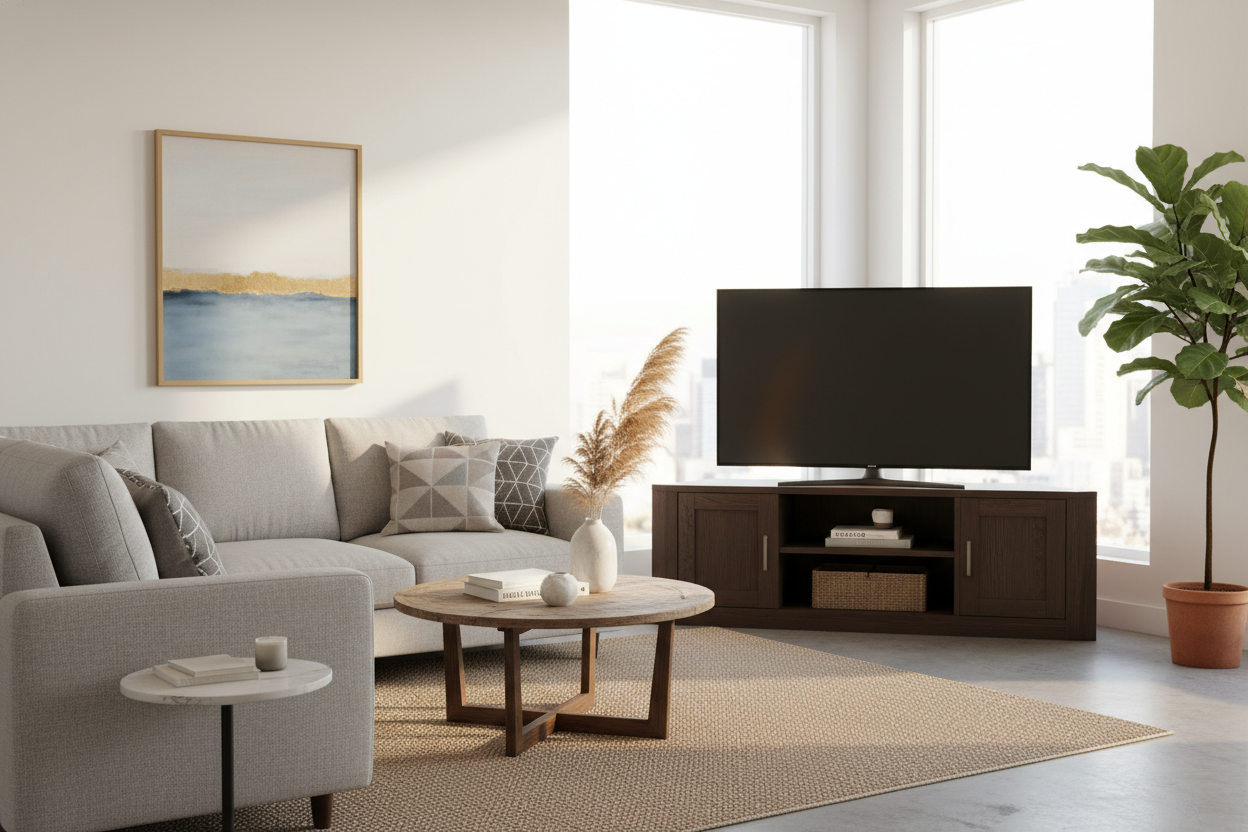
I spent three years in a Brooklyn walk-up staring at a corner that only existed to collect dust bunnies and a dead fiddle leaf fig. My sofa was pushed against the only long wall, leaving me with zero options for a TV unless I wanted to mount it over a radiator—which is a great way to melt your electronics. I spent weeks browsing standard flat-wall tv stands, but everything was too long, too deep, or blocked the closet door. I finally realized that my obsession with mid-century credenzas was the problem. I needed a 48-inch corner tv stand to actually make the room functional.
- Space Efficiency: It turns dead corners into the focal point without blocking walkways.
- The 48-Inch Rule: It is the ideal size for 43 to 55-inch screens without looking like a toy.
- Cable Chaos: Corner units naturally hide the mess of wires that usually hang off the back.
- Height Matters: For bedrooms or high-back sofas, going tall is better than going wide.
The 'Dead Corner' Epidemic in Small Apartments
We have all done it. You move into a place with an awkward layout, realize your 70-inch sofa only fits on one specific wall, and suddenly the corner across from it becomes 'the spot where the floor lamp goes to die.' Most people treat corners as secondary storage or a place to shove a wobbly bookshelf. This is a massive waste of square footage. In a 600-square-foot apartment, every inch is a premium, and leaving a 3x3 foot corner empty is essentially throwing away money on rent.
The problem is that most media furniture is designed for a sprawling suburban living room with perfectly flat, 15-foot walls. When you try to angle a standard rectangular console into a corner, you end up with this bizarre, cavernous triangle of wasted space behind it. It looks temporary, like you just moved in and haven't figured out where the furniture goes yet. A dedicated corner unit is built with a tapered back that sits flush against both walls, making the piece look like it was custom-built for the architecture of the room. It anchors the space instead of just floating in it.
Why Exactly 48 Inches? The Goldilocks Rule
When I started shopping, I debated between a tiny 32-inch unit and something massive. I quickly learned that the 48 corner tv stand is the absolute sweet spot for most real-world living rooms. If you go smaller, the piece looks like a nightstand that got lost. If you go much larger, you start losing the benefit of the corner because the front edge begins to jut out into your walking path, creating a 'stubbed toe' hazard every time you go to the kitchen.
A 48-inch width gives you enough surface area to hold a modern TV with a wide stand base while still leaving room for a soundbar or a few decorative items. Before I settled on this size, I spent hours browsing standard flat-wall tv stands and feeling defeated because they all required at least five feet of clear wall space. The 48-inch footprint is substantial enough to feel like a real piece of furniture—something with weight and presence—without dominating the entire room. It’s the difference between a 'dorm room' look and a 'grown-up' apartment.
Don't Make This Rookie Measurement Mistake
Measuring for a 48" corner tv stand isn't as simple as measuring a flat wall. The biggest mistake people make is only looking at the width of the front. You need to measure the 'depth' from the very back corner out to where the front of the stand will sit. If you buy a unit that is too deep, it will push your TV four feet into the room, making your living area feel half its actual size. You want a unit where the back is clipped or angled at a 45-degree angle to minimize that 'triangle gap.'
I learned this the hard way when I tried upgrading to a larger 55 inch corner unit in my last place. I didn't account for the baseboard heaters, and the stand ended up sitting six inches away from the wall, looking like a total afterthought. Always measure from the baseboard, not the drywall. Also, check the clearance for your cables. Some cheap MDF units don't have enough room behind the shelves for a power strip, which forces you to pull the whole thing forward, defeating the purpose of a flush-fit corner unit.
Going Vertical: When to Ditch the Low Profile
In a standard living room, we're told that the TV should be at eye level when seated. But corners change the math. If you're putting a TV in a bedroom or a room with high-clearance furniture, a 48-inch tall corner tv stand is a much better move than the trendy low-slung versions. A taller unit—usually around 30 to 35 inches high—allows you to see the screen over the footboard of a bed or the back of a stray armchair.
Low-profile units in a corner often look 'sunken.' Because the corner is naturally darker and more recessed, a low stand can make the TV feel like it's hiding. A taller piece of furniture brings the screen up into the light and provides way more storage. You can get three levels of shelving for gaming consoles, books, or those baskets of 'mystery cords' we all keep. Plus, a taller unit feels more like a traditional hutch, giving the room some much-needed verticality if you have high ceilings.
Will It Look Weird if I Upgrade My TV Later?
The fear of 'outgrowing' furniture is real. You don't want to buy a corner tv stand for 48 inch tv screens today only to find out it's useless when you buy a 55-inch OLED next year. Here is the secret: most 48-inch stands can easily handle a TV that is slightly wider than the stand itself. Since modern TVs have such thin bezels, a 55-inch screen is only about 48 inches wide anyway. It will sit perfectly flush with the edges of the stand.
However, there is a limit. You don't want a massive overhang where the TV looks like it's about to tip over. If you eventually plan on going huge, you might want to look at a massive corner tv stand for 65 inch tv, but be warned—those require a serious amount of wall clearance on both sides. For most of us in apartments or standard-sized homes, the 48-inch unit is the most future-proof choice. It’s big enough to be useful but small enough to fit in your next apartment, too.
How do I know if my TV will fit a 48-inch stand?
Don't look at the screen size (like '50-inch'); look at the actual physical width of the TV and the distance between its feet. Most 50-inch and 55-inch TVs are actually less than 48 inches wide, meaning they will fit perfectly on a 48-inch stand without hanging over the edges.
Are corner TV stands harder to assemble?
Slightly. Because of the angled back panels, the geometry can be a bit more confusing than a standard box. My advice: don't tighten any screws until the very end. You need that extra wiggle room to get the top piece to align with the angled sides.
What material should I look for?
Avoid the super-thin 1/2-inch particle board if you can. Look for 'engineered wood' with a high-pressure laminate or, better yet, a unit with a solid wood frame. A 48-inch TV plus a soundbar and some books can easily weigh 60-80 pounds, and you don't want the shelves sagging after six months.

Leave a comment
This site is protected by hCaptcha and the hCaptcha Privacy Policy and Terms of Service apply.