

















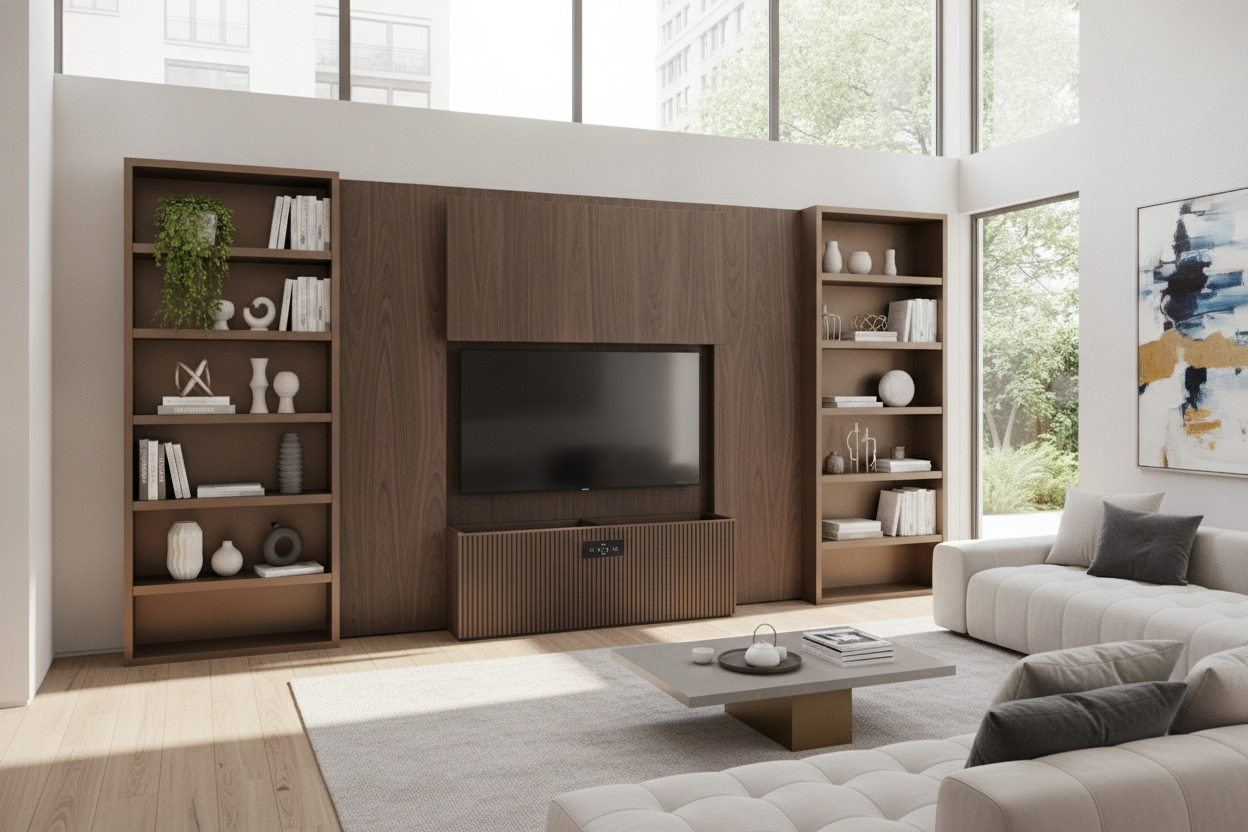
I spent three months trying to convince myself that a 'Frame' TV was the answer. You know the one—the screen that pretends to be art but still glows like a haunted painting at 2 AM. Eventually, I realized I didn't want my TV to look like art; I wanted it to look like it didn't exist. That led me down a rabbit hole of motorized furniture until I landed on a 63 inch tv stand.
Quick Takeaways
- Hides the 'black hole' effect of a large screen in open-plan rooms.
- A 63-inch width is the sweet spot for housing most 55- to 65-inch screens.
- Motorized lifts are surprisingly quiet but require careful cord management.
- You lose some top-surface decorating space compared to static units.
The 'Giant Black Hole' Ruining My Living Room
Modern floor plans are a nightmare for designers. We want light, airy spaces with low-profile furniture, but we also want to watch prestige TV on a screen the size of a billboard. In my house, the TV was the first thing you saw when you walked in. It didn't matter how many plants I bought; that massive black rectangle dominated the vibe and sucked the soul out of the room.
I tried traditional media consoles for a while. They look great in photos, but in reality, they just act as a pedestal for the very thing I was trying to de-emphasize. If you have a 65-inch screen, a standard console makes it the altar of the room. I wanted a space that felt like a place for conversation, not just a home theater with a couch attached. The visual weight of a powered-down screen is just too much to ignore.
Enter the James Bond Solution: A Hidden Lift Console
The solution was a motorized 63 in tv stand. This isn't just a cabinet; it's a piece of engineering that makes you feel like a secret agent every time you press 'power.' I went with this specific width because it offers enough internal clearance to house the lifting tracks without looking like a bulky industrial crate. At 63 inches wide, it’s substantial enough to feel like a real piece of furniture—more like a high-end sideboard than a tech accessory.
Specifically, I picked up a lifting TV stand dresser that actually doubles as storage. It’s a tight fit for a 65-inch screen—you really have to measure your TV's height and depth—but once it’s in, it’s magic. When the TV is down, the room feels ten times larger. When it's up, the 63 tv stand provides a sturdy, shake-free base that doesn't wobble even when the motor is working its hardest.
How the Lift Actually Operates (And Sounds)
I was worried the motor would sound like a dying blender, but it’s actually a low, mechanical hum. It takes about 20 to 30 seconds to fully emerge. It’s not instant gratification, but the 'wow' factor for guests is worth the wait. The real challenge is the cords. Since the TV moves up and down, you can't just zip-tie everything to the back. You need a dedicated cable management track—essentially a plastic spine—that keeps your HDMI and power cables from getting pinched or snapped during the descent. If you ignore this, you'll be buying a new TV in a month.
The Catch: Decorating the Top Without Breaking the Motor
Styling a moving piece of furniture is where things get tricky. Most of these units have a 'split top' where a middle flap opens up to let the TV through. This means you can't put a 20-pound coffee table book right in the center. I learned that the hard way when a stack of magazines almost jammed the lift mechanism on day two. It’s a different beast than when I styled a smaller TV stand in my guest room, where I could just pile on the tchotchkes without a second thought.
Stick to the sides. Use the outer 10 inches of the 63 tv stand for your heavy vases, lamps, or plants. I keep a small tray for remotes on one side and a bowl for keys on the other. Just make sure nothing hangs over the 'seam' where the lid opens. Also, keep your cats off the top. My cat tried to ride the TV up like an elevator; it was a heart-stopping moment that could have ended in a very expensive vet bill or a broken screen.
Is the Stealth Look Worth the Extra Cash?
Let’s be real: a motorized unit costs significantly more than a flat-pack box from a big-box store. But you aren't just paying for a piece of wood; you're paying for the floor space and the visual peace of mind. A tv 63 setup that disappears when not in use allows your living room to be a living room again. It’s the ultimate upgrade for people who love tech but hate the aesthetic of it. No more staring at a blank screen when you're trying to have a nice dinner.
If the price tag makes you flinch, you could look into fitting a 70 inch corner TV stand to tuck the screen away in a less central spot. But for me, the hidden lift is the only way to go. It’s the difference between living in a media room and living in a curated home. I’d spend the money again in a heartbeat just to see the look on people's faces when the cabinet starts moving. It’s functional, it’s sleek, and it finally killed the black hole in my living room.
FAQ
Will a 65-inch TV fit in a 63-inch stand?
Usually, yes. Most 65-inch TVs have an actual width of around 57-58 inches. The 63-inch exterior width of the stand gives you just enough room for the internal lift mechanism and the screen itself. Always check your TV's bezel thickness first.
Is the motor loud?
Not really. It sounds like a quiet electric toothbrush or a high-end window motor. It’s a low-frequency hum that won't wake up the house, though you'll definitely hear it if the room is silent.
Can I use this for a bedroom?
Absolutely. In fact, these are great at the foot of a bed. Since it hides the TV, you don't have to look at a screen while you're trying to wind down, but it's there for your Sunday morning movie marathons.

Leave a comment
This site is protected by hCaptcha and the hCaptcha Privacy Policy and Terms of Service apply.