




I spent three years staring at a particle-board rectangle I bought during a late-night scrolling session when I first moved in. It wasn't broken, but it was soul-crushing. Every time I walked into my living room, it felt like I was waiting for a dental cleaning. We spend thousands on OLED screens and high-end soundbars, yet we park them on unique media consoles that have the personality of a saltine cracker. I finally realized that hunting for something unconventional wasn't just about vanity; it was about making the largest wall in my house actually look like I lived there.
- Most generic stands are too small for modern TVs, creating a top-heavy 'lollipop' effect.
- Unusual textures like fluted wood or tambour doors hide tech while adding visual depth.
- Artistic pieces can still offer professional-grade cable management if you know what to look for.
- Styling a bold console requires restraint—let the furniture do the heavy lifting so the room feels curated.
The Epidemic of Boring Living Room Furniture
We are currently drowning in a sea of sameness. If I see one more spindly-legged, mid-century modern knockoff with a faux-walnut finish, I might lose it. These pieces are everywhere because they are cheap to ship in a flat box, but they have zero presence. They are the furniture equivalent of a beige sedan. The biggest issue isn't just the style, though—it is the scale. Most people buy a stand that is barely wider than their television, and why tiny media consoles usually look cheap becomes painfully obvious once you see the lopsided proportions in your own home.
Generic furniture is designed to offend the fewest people possible. It is safe. But safe is how you end up with a living room that looks like a furniture catalog page rather than a home. When you opt for mass-produced black boxes, you are essentially telling your guests that the TV is the only thing worth looking at on that wall. A real piece of furniture should be able to hold its own even when the screen is off.
What Makes Unusual Media Consoles Actually Work?
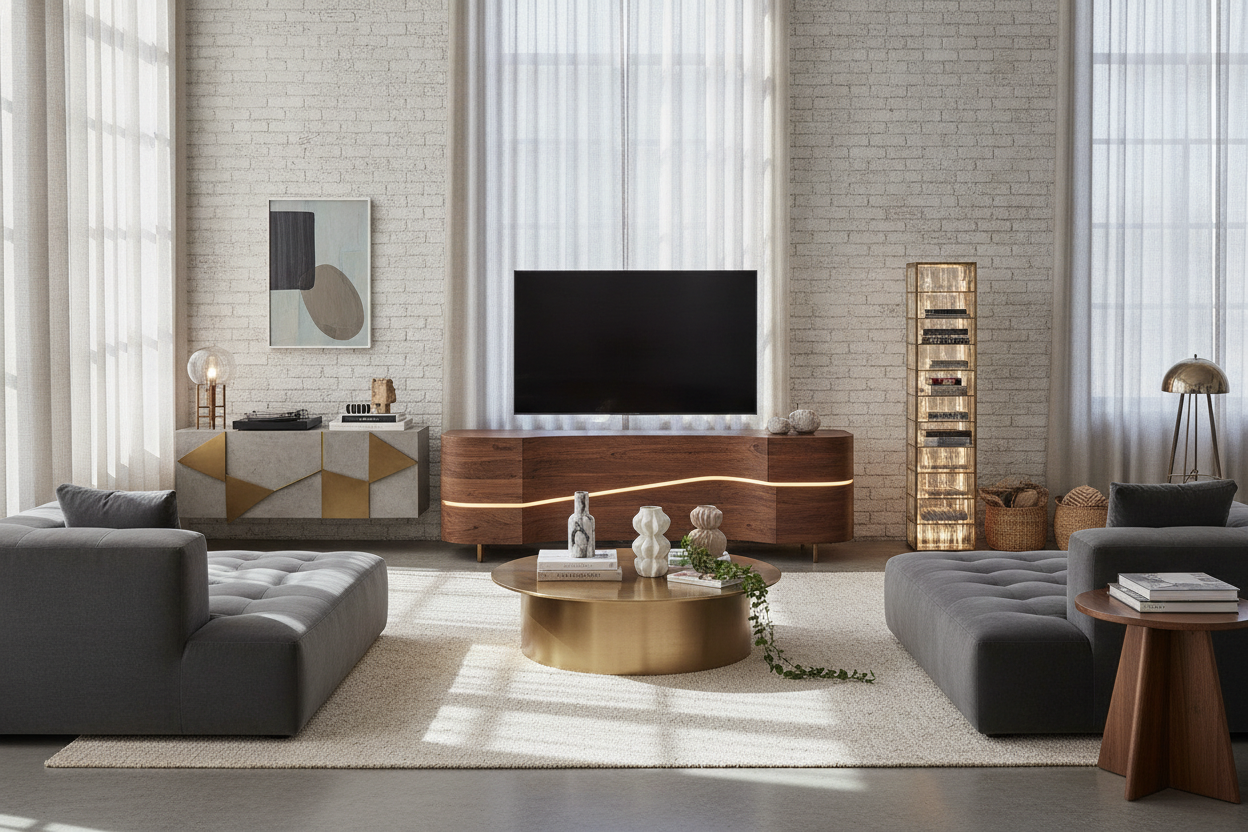
So, what qualifies as 'unusual' without crossing into 'tacky' territory? It usually comes down to tactile materials and architectural silhouettes. I am talking about fluted wood panels that create a rhythm of shadows, or unusual media consoles featuring asymmetrical shelving that breaks up the rigid horizontal lines of the room. I recently saw a unit with a concrete-skimmed top and reclaimed oak doors—the contrast between the industrial coldness and the warm grain was incredible.
You don't have to worry about these pieces clashing with your TV. In fact, a bold console acts as a visual anchor. If you have a massive 75-inch black rectangle on the wall, you need something with high visual weight underneath it to balance the composition. Look for mixed materials—think brass hardware on matte black wood, or woven cane doors that soften the hard edges of your tech. These elements pull the eye away from the cables and back to the craftsmanship.
But Can Artistic Furniture Still Hide My Ugly Tech Clutter?
This was my biggest fear. I assumed that if a console looked like a piece of art, it probably didn't have room for my PS5, my oversized AV receiver, and the tangled nightmare of HDMI cables. I was wrong. The industry has finally caught up to the fact that we have a lot of junk to hide. Transitioning from a cheap, open-shelf unit to a dedicated media storage stand for my clunky consoles was the only way I kept my sanity during my last redesign.
When shopping for unique pieces, check the internal depth. You need at least 18 inches if you are running a serious receiver. Look for 'ventilated' back panels or at least pre-drilled cord escapes. I once bought a gorgeous hand-carved mango wood cabinet that had zero holes in the back. I spent my entire Saturday with a hole-saw drill bit, sweating and praying I wouldn't splinter the wood. It worked out, but I learned my lesson: always check the 'boring' specs on the 'exciting' furniture.
How to Style a Statement Piece Without the Chaos
Once you bring home a bold piece, the temptation is to cover it in every vase and book you own. Don't. If the console has a lot of texture—like deep fluting or a vibrant wood grain—keep the top clear. I follow the 70/30 rule: leave 70% of the surface area empty. This gives the eye a place to rest and lets the furniture's design breathe.
Second, vary your heights. If you have a long, low console, place one tall sculptural object on one end and a small stack of books on the other. This creates an intentional, asymmetrical balance that complements the 'unusual' vibe. Lastly, use the space inside. If your console has glass doors, use uniform baskets to hide the plastic controllers and charging cables. It keeps the 'art' looking like art and the 'tech' looking like it belongs in a drawer.
Will a unique console look dated in two years?
Only if you go for a gimmick. Avoid 'trendy' neon colors and stick to interesting textures or architectural shapes. A fluted wood cabinet or a stone-topped unit is timeless because it relies on material quality rather than a passing fad.
Is assembly harder for unusual media consoles?
Usually, yes. If you are buying something with intricate doors or integrated lighting, expect to spend an extra hour with the hex key. It is a small price to pay for a piece that doesn't look like it came from a big-box warehouse.
How do I know if it can support my TV?
Check the weight capacity carefully. Many artistic units are designed as sideboards, not media stands. A 65-inch TV weighs about 50-60 lbs, but you want a unit rated for at least 100 lbs to account for the 'sag' factor over time.

Leave a comment
This site is protected by hCaptcha and the hCaptcha Privacy Policy and Terms of Service apply.