

















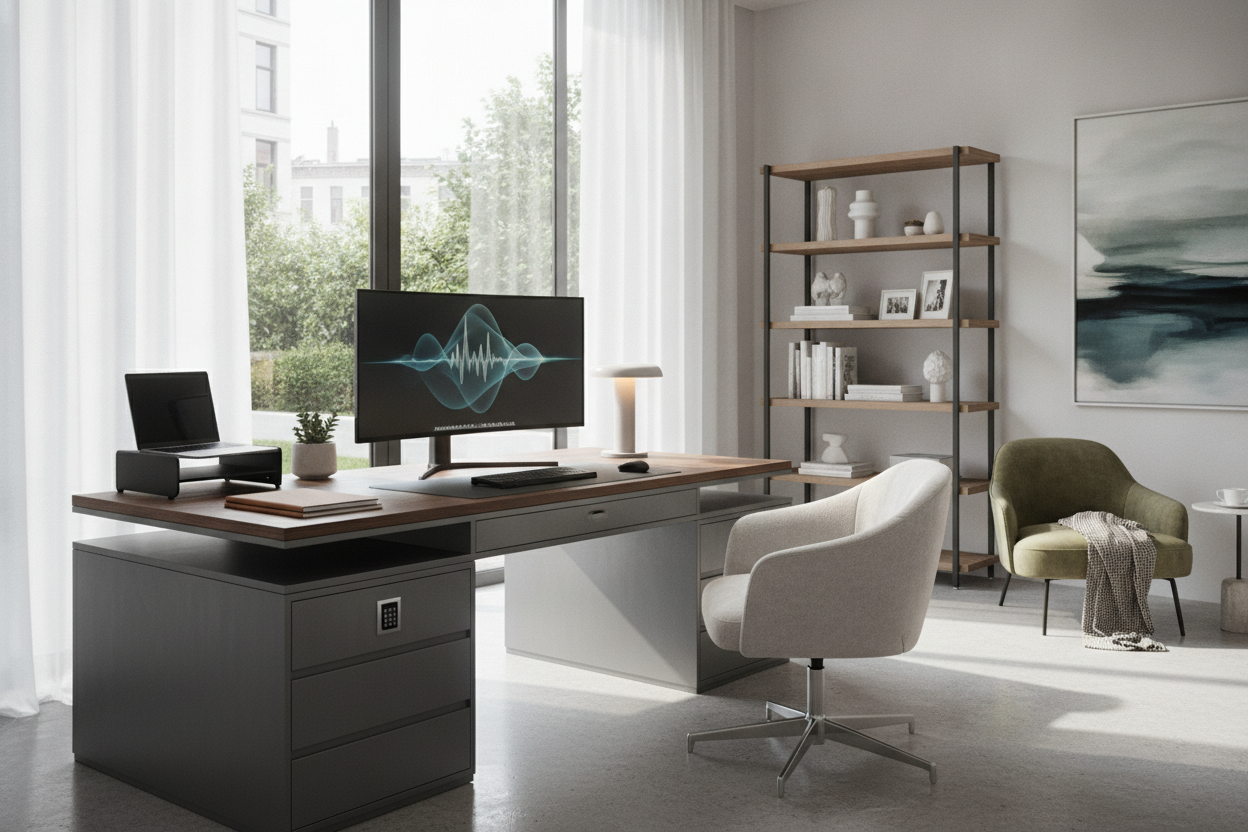
I spent three years working on a vintage teak table that looked amazing in photos but had the structural integrity of a wet cardboard box. Then my three-year-old decided my work laptop was the perfect canvas for a juice-box experiment. That was the day I realized my 'aesthetic' setup was a liability, and I finally bought a security desk.
- Physical locks create a mental boundary between 'work' and 'home.'
- Weight is your friend; heavy desks don't tip or migrate easily.
- Integrated cable management prevents 'yank-and-crash' accidents with expensive gear.
- A 'safety desk' protects sensitive data from more than just thieves—it protects it from life.
The Dark Side of the Aesthetic Open-Concept Workspace
Minimalist tables are the Instagram lie of the decade. We’ve all seen those setups: a thin slab of oak, two spindly legs, and absolutely zero drawers. They look great until you actually have to live in your house. If you share a space with roommates, kids, or even a particularly chaotic cat, an open desk is just an invitation for disaster.
A standard writing computer desk is fine if you're just scrolling through recipes or paying a quick bill. But the moment you handle confidential client contracts or expensive hardware, that open-concept vibe becomes a liability. I learned the hard way that 'out of sight, out of mind' is the only way to keep my pens from disappearing and my hard drives from being used as coasters.
Wait, What Actually Qualifies as a 'Security Desk' at Home?
When I started looking for a security desk, I was worried my office would end up looking like a mall security hub. Thankfully, residential versions have come a long way. We aren't talking about bolted-down steel podiums here.
A real home safety desk is defined by its build quality. It features reinforced drawer glides, tamper-proof locks, and often a heavy modesty panel that doubles as a structural anchor. It’s built to be heavy. If I can lift the whole desk by myself, so can anyone else. You want something with enough heft to stay put and enough locking storage to keep your valuables behind a key, not just a magnetic latch.
The Features You Actually Need (and the Gimmicks to Skip)
Don’t get fooled by those cheap silver cam locks you see on big-box store furniture. Most of those can be bypassed with a sturdy flathead screwdriver and thirty seconds of effort. Look for desks with deadbolt mechanisms or high-quality wafer locks. If you're really serious, look for a unit where the locking bar secures multiple drawers at once.
Another thing I learned: wire routing is a security feature. If your laptop is locked in a drawer but the power cable is hanging out the back, a toddler can still pull the whole thing off the desk. You need internal grommets. If you can’t find a single unit that does it all, you can pair a high-quality ergonomic home office sit stand up desk with a separate, heavy-duty locking file cabinet under the surface. It’s a hybrid approach that keeps the ergonomics while adding the vault.
How to Hide Massive Storage Without Ruining Your Decor
The biggest hurdle is the 'bulky' factor. Secure furniture is naturally larger because thin materials don't hold locks well. To keep your living room from looking like a corporate cubicle, go vertical. A 6 drawer computer desk with hutch is a lifesaver here. It uses the wall space instead of eating up the whole floor, and the hutch usually offers higher-level storage that's naturally out of reach for small children.
Choose finishes that match your existing wood tones. Dark walnut or matte black can make a heavy, secure piece look like an intentional design choice rather than a piece of office equipment. I went with a dark oak finish, and it actually anchored the room better than my old 'invisible' glass desk ever did.
Is the Peace of Mind Worth the Bulky Look?
The best part isn't even the theft protection—it's the mental shift. When I turn that key at 5:00 PM, my brain registers that work is over. I don't have to worry about what's happening to my laptop while I'm cooking dinner. finding the right desk changed how I inhabit my home. It’s not just a piece of furniture; it’s a physical boundary. If you're tired of the 'open-concept' chaos, it’s time to get something with a lock.
FAQ
Are security desks harder to assemble?
Yes, usually. Because they use thicker panels and more hardware for the locking mechanisms, they are heavier and more complex than a basic table. Budget about three hours and have a friend on standby to help with the heavy lifting.
Can I just add a lock to my current desk?
If your desk is solid wood, maybe. But if it’s made of particle board or thin MDF, the material will likely splinter the first time someone pulls on the locked drawer. It is almost always better to buy a desk designed for the stress.
Do these desks come with a master key?
Most residential units come with two identical keys. Don't lose both! I keep my spare in a kitchen drawer so I am never locked out of my own career.

Leave a comment
This site is protected by hCaptcha and the hCaptcha Privacy Policy and Terms of Service apply.