

















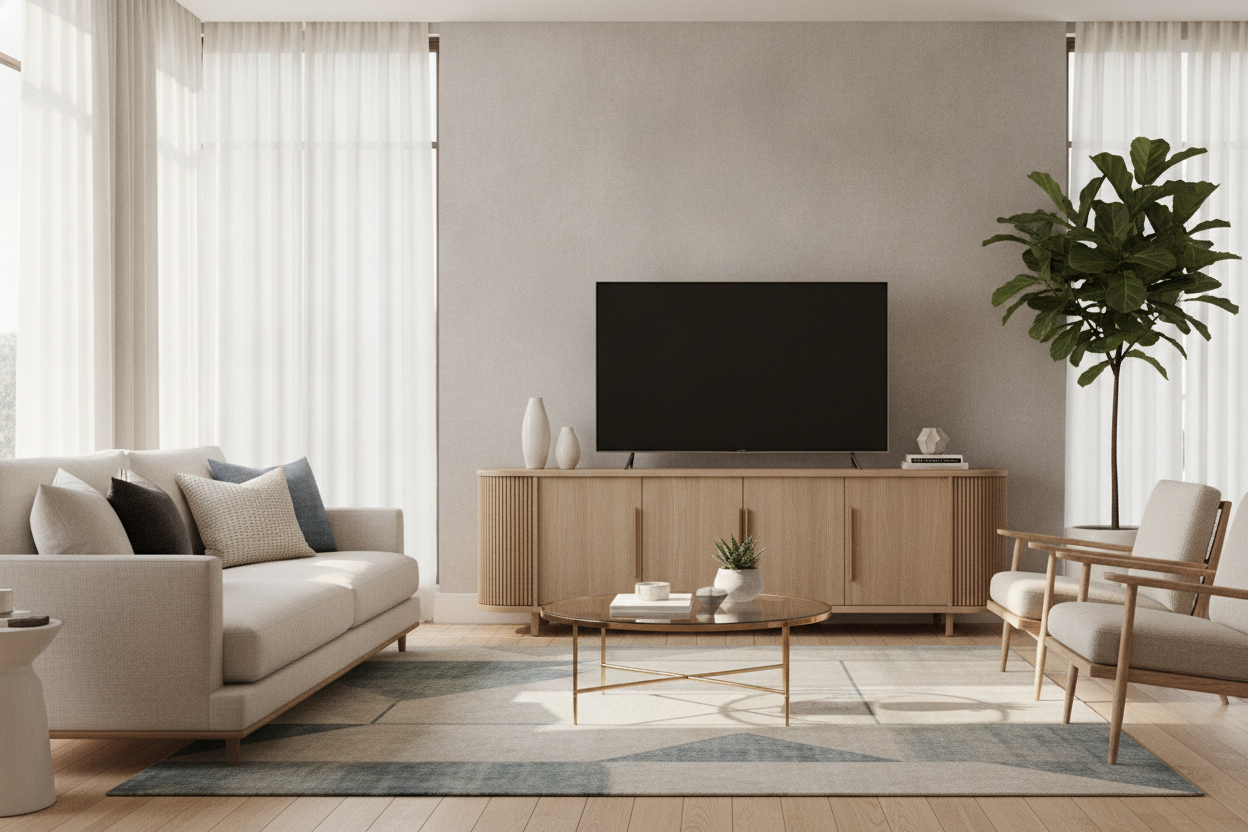
I spent three years staring at the top of my own toes every time I watched Netflix. I’d bought this 'designer' media console that sat about 16 inches off the floor, thinking it looked sleek and modern. In reality, it felt like I was back in a college dorm, hunched over a laptop on a coffee table. Finding the right table for tv in living room setups shouldn't be this hard, but the furniture industry is obsessed with low-profile blocks that force you into a permanent slouch.
I finally snapped when I realized my neck hurt more after a weekend movie marathon than it did after a 40-hour work week. I ditched the 'standard' stand for something with actual height, and the difference was immediate. My living room suddenly felt like a grown-up space rather than a basement hangout. If you are tired of your furniture making your room feel cramped and your neck feel old, it is time to look upward.
- Eye Level is Key: Your screen center should be at eye level when seated, not three feet below it.
- Visual Airflow: Taller, leggier tables stop your living room from feeling 'bottom-heavy.'
- Multi-functional: Sideboards and buffets offer way better storage than thin media shelves.
- Safety First: Always verify the weight capacity of a non-media table before plopping a 65-inch OLED on it.
The Problem With 'Standard' TV Stands (They're Way Too Low)
Most big-box media consoles are designed for a world that doesn't exist anymore. They are built at heights of 18 to 22 inches, a carryover from the days of massive, heavy tube TVs that needed a low center of gravity so they wouldn't tip over and crush the carpet. Today’s screens are paper-thin and light, yet we are still sticking them on these low-slung blocks that anchor the entire room to the floor.
When I finally downsized to a small wood TV table with some actual height, I realized how much those chunky consoles were ruining my room's flow. A low, heavy console acts like a visual vacuum, sucking all the light and space out of the lower half of your wall. It makes your ceilings feel shorter and your floor space feel cluttered, even if the rest of the room is empty. It is a heavy focal point that drags everything down with it.
Beyond the looks, there is the sheer awkwardness of the viewing angle. Unless you are sitting on a beanbag chair, a 20-inch stand is simply too low. You end up tilted forward, chin to chest, which is the exact opposite of how you want to relax after a long day. It’s time to stop treating our TVs like coffee tables and start treating them like the focal points they are.
Why a Taller Table for TV in Living Room Setups Actually Works
Switching to a taller tv table for living room use isn't just about ergonomics; it is a total design cheat code. When you raise the height of the furniture, you change the way your eye moves through the space. Instead of looking down at a dark mass of wood and electronics, your gaze stays at chest level, which makes the room feel more open and intentional. It feels less like a 'TV room' and more like a curated living space.
I’ve found that pieces between 30 and 36 inches tall are the sweet spot. This height allows the TV to sit naturally in your line of sight while leaving room underneath for the furniture to actually have some style. You aren't just buying a bracket for your screen; you’re adding a piece of furniture that contributes to the architecture of the room. It’s a simple swap that makes a $500 TV look like a $2,000 integrated media system.
Saving Your Neck (The Ergonomics)
Let’s talk about the '42-inch rule.' Generally, the center of your TV screen should be about 42 inches from the floor to align with the average person's eye level when sitting on a sofa. If your stand is only 20 inches tall, and your TV is 30 inches tall, the center is sitting at roughly 35 inches. You’re constantly looking down. By moving to a 30-to-36-inch table, you hit that ergonomic bullseye perfectly. Your neck muscles will thank you by the third episode of whatever you're bingeing.
Faking High Ceilings with Leggy Furniture
There is a specific kind of magic that happens when you can see the floor underneath your furniture. Heavy, floor-hugging consoles block light and stop the eye. When you use a taller table with tapered legs, light passes underneath it. This creates a sense of continuity across the floorboards, which tricks your brain into thinking the room is much larger than it is. It’s the oldest trick in the small-apartment playbook, and it works every single time.
How to Choose the Right TV Table for Living Room Spaces
When you start shopping for a table for tv in living room areas, my biggest piece of advice is to leave the 'Living Room' section of the store entirely. Most of the best TV tables aren't marketed as TV tables at all. I spent weeks scrolling through specialized media units before I realized the dining room section was hiding exactly what I needed. Sideboards, buffets, and entry consoles are naturally taller and often built with much higher quality materials than the particle-board media stands you find in the electronics aisle.
You want to look for solid wood or high-grade MDF with a weight capacity that exceeds your TV by at least 20 pounds. While modern TVs are light, their weight is often concentrated in a small central pedestal or two wide-set legs. You need a surface that won't bow over time. Check the specs for 'static weight limit'—if it can hold a stack of heavy ceramic dinner plates, it can probably handle your 55-inch screen.
Depth is Everything (Don't Ignore the Base)
This is where most people mess up. They find a beautiful, tall console table, but it’s only 12 inches deep. While your TV screen might only be 3 inches thick, the factory legs that come with it often have a footprint of 14 or 15 inches. Always measure the distance between the front and back of your TV's stand before you buy. There is nothing more stressful than realizing your expensive screen is teetering on the edge of a table because the base is too wide for the surface.
Sneaking in Storage Without the Bulk
The main reason people stick with those ugly low consoles is the storage. They think they need those open cubbies for the DVR, the PlayStation, and the tangled mess of HDMI cables. But you can get that same utility from a piece like a modern brown sideboard buffet. These pieces are designed to hide clutter behind solid doors while providing enough internal height for vertical gaming consoles or mesh routers. You get the clean look of a high-end table without the 'Best Buy' showroom vibe.
My Favorite Non-Traditional TV Tables
If you want to break away from the boring, low-profile look, start looking at entry tables and mid-century credenzas. These pieces offer a verticality that standard furniture lacks. For those of us in tight city apartments, a versatile console table is a lifesaver. It provides the height needed for comfortable viewing but keeps a slim profile so it doesn't eat up your entire walkway. It’s about finding that balance between 'big enough to hold the tech' and 'small enough to let the room breathe.'
I personally prefer pieces with adjustable interior shelves. Being able to move a shelf up or down by an inch makes all the difference when you're trying to fit a bulky receiver or a stack of board games. Don't be afraid to drill a small 2-inch hole in the back panel of a non-media cabinet for cable management; a hole saw attachment for your drill costs ten bucks and opens up a world of furniture possibilities.
Personal Experience: My 'Media Bench' Disaster
I once bought a 60-inch 'media bench' that was so low my coffee table actually blocked the bottom two inches of the screen. I spent a month leaning to the side to see subtitles. I eventually swapped it for a vintage-style tall cabinet, and the relief was instant. Not only did my living room look twice as big, but I also stopped getting that dull ache in the back of my skull after watching a movie. My only regret was waiting so long to make the switch because I was 'supposed' to use a TV stand.
FAQ
Is a console table too high for a TV?
Not usually. Most console tables sit at 30 inches, which is actually the ideal height for a TV if you are sitting on a standard-height sofa. It keeps the screen at a natural eye level rather than forcing you to look down.
Can a sideboard hold the weight of a large TV?
Yes, but check the specs. Most dining sideboards are built to hold heavy stacks of dishes and stone serving platters, so they are often sturdier than dedicated TV stands made of thin laminate.
How do I hide cables on a table with legs?
Use adhesive cable clips to run the wires down the back of one of the legs. If you have a lot of gear, a small cable management box tucked behind the TV can house a power strip and all the excess cord length.

Leave a comment
This site is protected by hCaptcha and the hCaptcha Privacy Policy and Terms of Service apply.