

















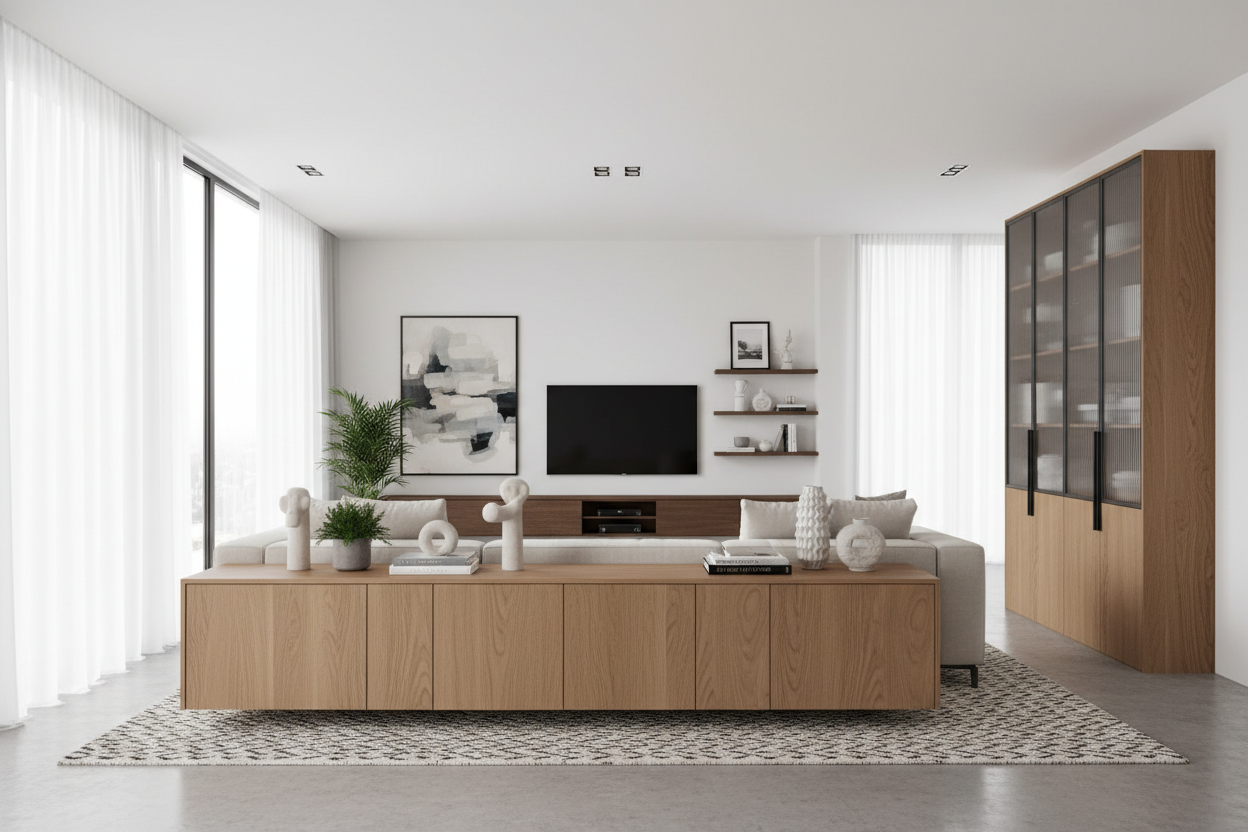
I remember standing in my first 'great room' apartment, staring at my expensive 84-inch sofa sitting in the middle of a 30-foot void. It looked like a lonely island in a sea of hardwood. No matter how I angled the rug, the room felt like a gymnasium rather than a home. It wasn't until I started experimenting with long cabinets that the space finally clicked into place.
If you have an open floor plan, you know the struggle. You want that airy feel, but you end up with a 'bowling alley' effect where furniture just floats aimlessly. The back of a sofa is rarely its best angle; usually, it is just a flat expanse of fabric or some sagging Velcro. Adding a low-profile storage piece behind it changes the entire geometry of the room.
- Define the Zone: It creates a physical boundary between the 'relaxing' zone and the 'eating' zone.
- Hide the Ugly: It masks the unfinished look of sofa backs and hides cord clutter.
- Functional Surface: You gain a spot for lamps, drinks, or books without needing a bulky coffee table.
- Depth: It adds a layer of furniture that makes the room look professionally designed, not just moved into.
The 'Bowling Alley' Living Room Problem
The biggest mistake I see in modern builds is the 'floating sofa' without an anchor. When you walk into a room and the first thing you see is the back of a couch, it feels closed off and accidental. In my old place, the sofa faced the TV, but the back was exposed to the dining table. It felt like I was sitting in a waiting room.
This layout nightmare creates a visual vacuum. Without something to stop the eye, the room feels like one long, echoing hallway. It lacks the architectural grounding that makes a house feel like a home. You need something with weight and horizontal presence to act as a 'pony wall' without actually building a wall.
Enter the Sofa-Back Storage Hack
The fix is surprisingly simple: slide a long, low sideboard or credenza right up against the back of the couch. This acts as a functional room divider that doesn't block your line of sight. I personally prefer a modern storage cabinet with doors because it keeps the visual noise to a minimum.
Open shelving behind a sofa is a trap. Unless you are a professional stylist, those shelves will eventually just hold random mail, dog leashes, and dust. Doors are your best friend here. They allow the piece to look like a clean architectural element from the dining side while swallowing all the chaos of a busy household on the inside.
Getting the Proportions Right (Don't Mess This Up)
I have made the mistake of buying a cabinet that was too tall. I thought the extra storage would be great, but it ended up looking like a bar counter in a dive mall. The golden rule: the cabinet should be one to two inches shorter than the top of your sofa's back cushions. You want it to feel like an extension of the sofa, not a hurdle behind it.
Width is just as vital. If your cabinet is too short, it looks like a pimple on the back of the couch. Aim for a piece that spans at least two-thirds of the sofa's total width. When you are shopping for storage cabinets, bring a tape measure. If you have an 84-inch sofa, look for something in the 60-to-70-inch range. Anything smaller looks dinky; anything wider than the sofa itself looks like a mistake.
What to Actually Hide Inside Them
In my house, these cabinets are the 'junk drawers' of the living room, but way more organized. I use mine to stash heavy board games that don't fit in standard bookshelves and my ugly mesh router that I don't want to look at. If your sofa is near the dining area, contemporary storage cabinets with doors are perfect for holding extra linens, candles, or the 'fancy' plates you only use twice a year.
I once tried putting my printer in one of these. It was a disaster because I forgot about ventilation, and the poor thing nearly melted. Now, I stick to things like extra throw blankets and my collection of oversized art books. It is the ultimate transitional storage zone—stuff you need nearby but don't want to see every day.
The Aesthetic Shift: From Dorm to Grown-Up
There is a specific moment when an apartment stops feeling like a collection of stuff and starts feeling like a designed space. For me, that happened when I ditched the flimsy plastic bins and moved to enclosed, horizontal storage. Switching to modern storage cabinets with doors transformed my chaotic open floor plan into something that felt intentional.
It is about architectural grounding. A long, heavy piece of furniture provides a 'base' for the room's design. It stops the eye, provides a surface for a beautiful lamp (which, let's be honest, provides much better light than those overhead recessed cans), and makes the room feel 'finished.' It is the difference between living in a room and actually owning the space.
FAQ
Can I use a bookshelf instead of a cabinet?
You can, but I wouldn't. Bookshelves behind a sofa often look messy from the back or side. If you do go that route, use baskets to hide the clutter. A cabinet with solid doors is much more forgiving and looks cleaner in an open-concept layout.
What if my sofa is against a wall?
Then you don't need this! This trick is specifically for 'floating' sofas that are positioned in the middle of a room. If your sofa is against a wall, a long cabinet is better suited for the entryway or under a TV.
Should the cabinet match the sofa color?
Not necessarily. In fact, I like a bit of contrast. If you have a grey fabric sofa, a wood-toned cabinet adds warmth. If you have a leather sofa, a matte black or white cabinet provides a nice modern edge. Just make sure the 'vibe' matches—don't put a rustic farmhouse cabinet behind a sleek velvet mid-century couch.


Leave a comment
This site is protected by hCaptcha and the hCaptcha Privacy Policy and Terms of Service apply.