

















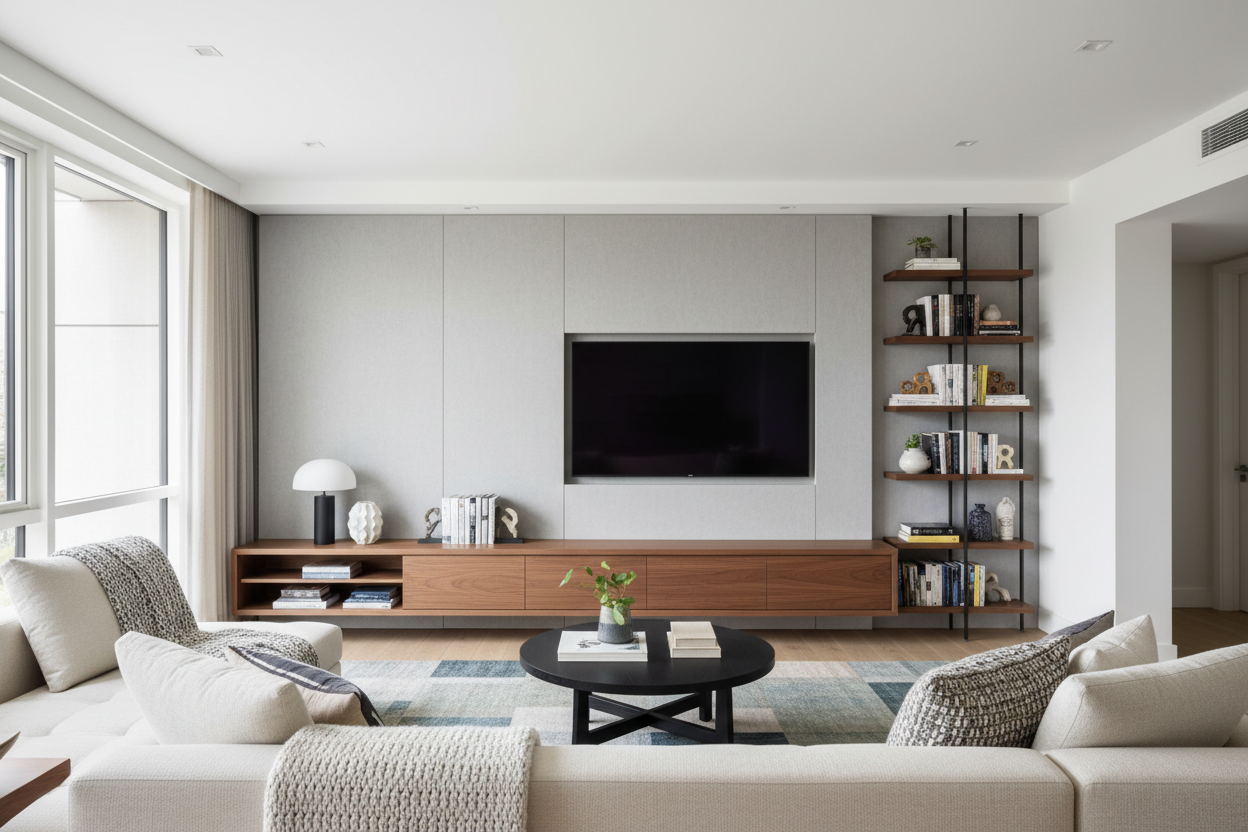
I spent three hours last night staring at a wall. Not because I am losing my mind, but because I was trying to figure out why my friend’s living room felt like a sterile hospital waiting room. The culprit? A massive 65-inch screen perched exactly in the middle of the wall, staring back at us like a giant, unblinking eye. If you are hunting for television cabinet ideas, stop trying to find the 'center' of the room. You are building a home, not a Cineplex.
- Asymmetry creates visual interest and makes a room feel lived-in.
- Extra-wide consoles allow for styling space that balances the screen's weight.
- Dark finishes help camouflage the 'black hole' effect of a powered-off TV.
- Open shelving on one side provides a necessary counterweight to the hardware.
The Problem With the 'Shrine to the Screen'
When you center a television, you are telling everyone who enters that the most important thing in your life is Netflix. It turns the room into a shrine. The couch faces the TV, the chairs face the TV, and the TV sits right in the middle of the only wall that matters. It is a layout that kills conversation. I have seen beautiful, $4,000 Italian leather sofas ruined by being pointed at a plastic rectangle like they are in a trance.
A massive black rectangle is a heavy visual object. In design terms, it has a lot of 'weight.' When that weight is centered, it demands all the attention. By shifting it, you reclaim the room for human interaction. You want people to walk in and see your books, your art, or that weird vintage lamp you found at a flea market—not just a 4K panel.
What Does Asymmetrical TV Placement Actually Look Like?
Asymmetrical placement means sliding that screen to the left or right. It sounds chaotic, but it is actually liberating. By moving the TV off-center, you suddenly have a 'blank' half of the wall to play with. This is where you put the tall floor plant or the gallery wall that actually reflects your personality. Rethinking your layout opens the door to better living room cabinet ideas that prioritize aesthetics over just holding a box.
The trick is to ensure the TV still feels tethered to something. You do not just bolt it to a random spot on the wall. It should still sit over or within a piece of furniture, but that furniture should extend far beyond the edges of the screen. This creates a sense of intentionality rather than a mistake.
Using Extra-Long Units to Cheat the Eye
If you have a 60-inch TV, do not buy a 62-inch stand. It looks cramped and cheap. I always tell people to go as wide as the wall allows. A low, long plinth makes the room feel wider and more expensive. When you use a large TV cabinet spacious storage unit—something in the 94-inch range—you create a stage. You can put the TV on the far left and use the remaining three feet of surface for a tray of brass objects, a stack of oversized coffee table books, or a sculptural vase.
This 'offset' look is how high-end designers make a space look custom. I once used a 100-inch floating shelf for a 50-inch TV in a studio apartment. Everyone thought it was a custom build, but it was just two IKEA units pushed together. The extra length provides a horizontal line that draws the eye across the room, making a small space feel significantly larger than it is.
Balancing the Weight With Open Shelving and Art
The biggest fear people have with off-centering a TV is that the room will feel 'lopsided.' It will—unless you balance it. Think of it like a seesaw. If the heavy TV is on the left, you need something with visual height or texture on the right. A tall fiddle-leaf fig or a floor lamp with a large drum shade usually does the trick. A modern TV cabinet table works perfectly here because its clean lines do not compete with the decor you are placing next to it.
I personally love a 'partial' gallery wall. Hang three or four framed prints to the side of the TV. It blends the screen into the art, making it just another rectangle on the wall rather than the main event. Just make sure the frames are matted; the white space in the art helps counteract the solid black of the screen.
Dark Furniture as Camouflage
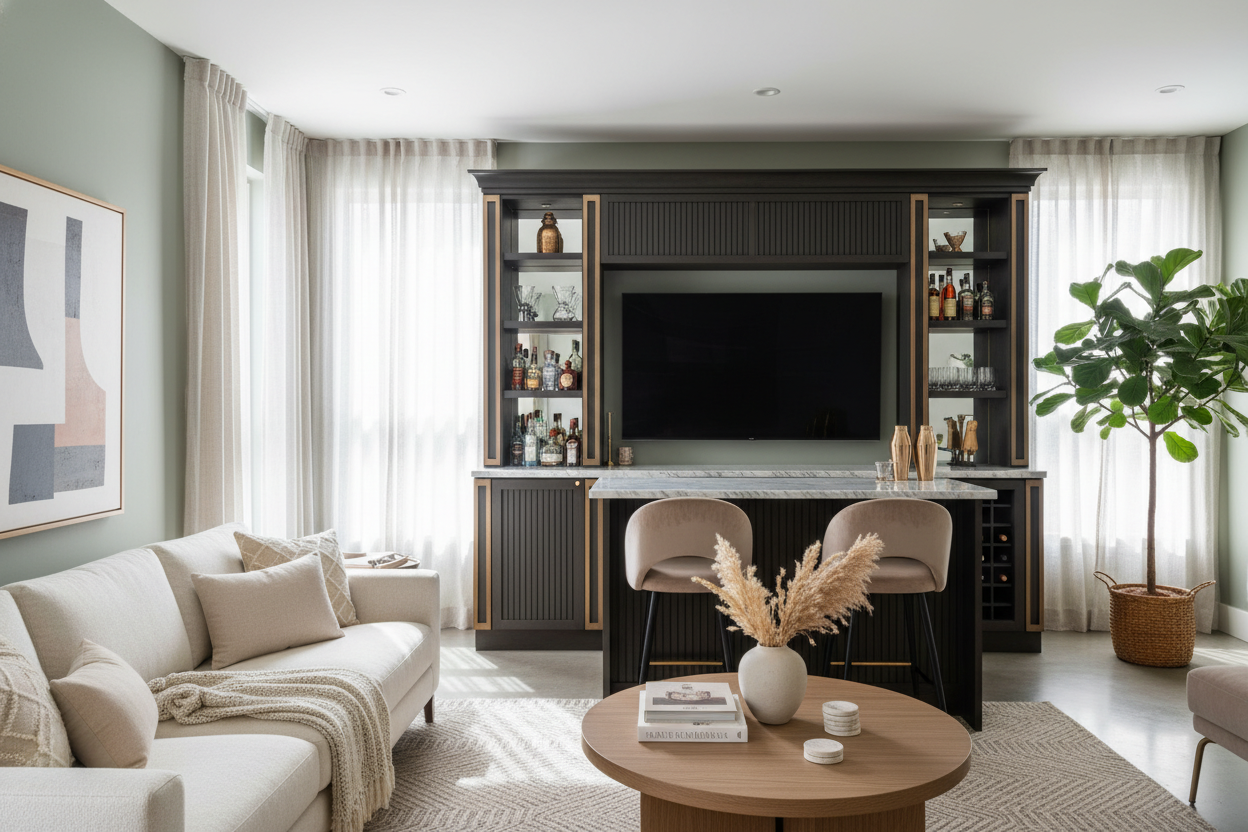
Here is a specific tv cabinet idea that I swear by: if you hate how the TV looks when it is off, go dark. A black or charcoal gray console allows the screen to melt into the furniture. When the TV is off, the whole setup reads as one cohesive architectural element. I recently installed a black cabinet with glass doors in a client's den, and the transformation was instant. The fluted glass reflected just enough light to keep the corner from feeling like a cave, while the dark frame hid the messy wires and the black bezel of the TV.
If you go this route, mix your textures. Use a matte black wood with a shiny glass door or a metal handle. If everything is the same flat black, it looks like a cheap dorm room. You want depth. The goal is to make the technology disappear when you are not using it.
When You Actually Should Break the Rules
I am not a zealot; sometimes symmetry is the only way. If you have a fireplace flanked by two identical built-in alcoves, putting the TV off-center will make you feel like you are living in a funhouse. In those cases, lean into the symmetry but soften it. Use 'The Frame' TV or a decorative cover so it does not look like a tech graveyard between your beautiful bookshelves. Symmetry works best when the TV is not the only thing in the 'box.'
Personal Experience: The Sagging Stand Incident
Years ago, I bought a gorgeous mid-century 'inspired' stand for $150. It was 48 inches wide, and my TV was 45 inches. It looked like a hat that was two sizes too small. Within three months, the weight of the TV caused the center to sag because it was made of cheap 1/2-inch particle board. Now, I never buy anything with a span over 60 inches unless it has a center support leg or is made of solid wood or high-density MDF. It is worth the extra $200 to not have your furniture literally buckle under the pressure of a Sunday night football game.
FAQ
How much wider should my cabinet be than my TV?
At least 6 to 10 inches on each side is the minimum for a standard look, but for the asymmetrical look I love, aim for the cabinet to be at least 1.5 to 2 times the width of the screen.
What is the best height for a TV cabinet?
The center of your TV should be at eye level when you are sitting down. For most sofas, that means a cabinet height of 18 to 22 inches. If you buy a tall 'buffet' style cabinet, you will be craning your neck like you are in the front row of a theater.
Can I put a TV on a dresser?
You can, but dressers are usually 30-35 inches tall. Unless you have an unusually high sofa or like looking 'up' at your shows, it is usually a recipe for a neck ache. Stick to dedicated media units or low sideboards.

Leave a comment
This site is protected by hCaptcha and the hCaptcha Privacy Policy and Terms of Service apply.