




A 50-inch TV is big enough for a living room when your seat is about 5 to 7 feet from the screen. That range is plain arithmetic from published viewing guidance: sit 1.2 to 1.6 times the screen's diagonal away (50 x 1.2 = 60 inches, or 5 feet; 50 x 1.6 = 80 inches, or about 6.7 feet), and at 7 feet a 50-inch screen still fills about 29 degrees of your view, close to SMPTE's 30-degree baseline for everyday viewing.
Sit farther back than about 7 feet and a 50 inch TV starts to look small; at 8 to 10 feet, most guidance points to a larger screen. Picking the right TV size matters for your new TV: too small and you lose detail and the cinematic feel, too big for the distance and you may end up with tired eyes. This post shows the math, a seating distance to TV size table, 50 vs 55, bedroom vs living room, and what TV stand a 50-inch screen needs, with picks from the FUFU&GAGA entertainment center collection.
Key takeaways
- Viewing distance decides it: a 50-inch TV fits seating about 5 to 7 feet away.
- Actual size: the screen is about 43.6 inches wide and 24.5 inches tall; with the frame, a typical model is about 44 inches wide.
- Room size: LG puts 50- to 55-inch TVs in medium rooms of about 4.3 by 4.3 m (roughly 14 by 14 feet).
- 50 vs 55: a 55-inch screen has about 21% more picture area and suits seating about half a foot farther back.
Is 50 inch TV big enough for living room viewing?
Yes, in a small or medium living room where the sofa is no more than about 7 feet from the screen. LG's size guide lists a 50-inch TV for "smaller living rooms and apartments", with an immersive distance of 1.5 m (5.0 feet) and a relaxed distance of 2.0 m (6.7 feet) (LG). Those are the same numbers the 1.2x and 1.6x multipliers give.
In a large, open living room where everyone watches from 9 or 10 feet, a 50-inch screen will feel small. TCL calls a 55-inch TV "commonly regarded as the baseline size for a living room setup" and recommends 55 to 75 inches for living rooms (TCL). Distance matters more than square footage, because room size mainly sets where the sofa can go. For larger rooms, LG matches 60- to 65-inch TVs with spaces of about 4.9 by 4.9 m and 70 inches and up with rooms above 5.5 by 5.5 m.
How far should you sit from a 50 inch TV?
The optimal viewing distance comes from field of view: how much of your vision the screen fills. RTINGS explains that SMPTE recommends a screen fill at least 30 degrees of your field of vision for mixed use, that 40 degrees is recommended for a more cinematic feel, and that 62 degrees is SMPTE's maximum (RTINGS). LG attributes the 40-degree figure to THX and notes that 1.6x the diagonal gets you close to 30 degrees and 1.2x gets you to 40.
For a 50-inch screen, RTINGS gives a recommended viewing distance of 6 feet 9 inches for mixed use (30 degrees), 5 feet 0 inches for cinema (40 degrees) and 3 feet 0 inches as the immersive distance (62 degrees), the closest you would want to sit.
You can check the math yourself. A 16:9 screen's width is 0.872 times its diagonal, so a 50 inch TV screen is 50 x 0.872 = 43.6 inches wide. Half of that is 21.8 inches. At 84 inches (7 feet), the screen spans 2 x arctan(21.8 / 84), or about 29 degrees. At 60 inches (5 feet), it spans about 40 degrees.
Resolution matters less than it used to. RTINGS notes that with 4K and higher resolution you can sit a bit closer without seeing pixels, while a lower resolution such as full HD needs more viewing distance before picture quality looks smooth. With a 4K set, distance is mostly about comfort and the immersive viewing experience.
Sitting too close: eye strain at close range
LG warns that if a TV is too big for how close you're sitting, you might end up with tired eyes or keep turning your head to follow the action, which tires you over a long film. RTINGS adds that sitting close won't make you go blind; SMPTE's 62-degree maximum marks the point where you'd keep turning your head. If you watch TV from a certain distance that you can't change, such as a small room, a slightly smaller screen is the safer choice.
Seating distance to TV size: which screen size fits your room?
Measure from your eyes on the sofa to where the screen will be. The size range is your distance in inches divided by 1.6 (smallest comfortable size) and by 1.2 (most immersive size). The last column shows how much of your view a 50-inch screen fills at that distance.
| Seating distance | Suggested screen size (distance / 1.6 to / 1.2) | Field of view of a 50-inch TV | Is 50 inches enough? |
|---|---|---|---|
| 5 ft (60 in) | 38 to 50 in | About 40 degrees | Yes, cinematic |
| 6 ft (72 in) | 45 to 60 in | About 34 degrees | Yes |
| 7 ft (84 in) | 53 to 70 in | About 29 degrees | Just under the 30-degree baseline; fine for everyday viewing |
| 8 ft (96 in) | 60 to 80 in | About 26 degrees | Small; consider 55 to 65 in |
| 9 ft (108 in) | 68 to 90 in | About 23 degrees | Too small for most people |
| 10 ft (120 in) | 75 to 100 in | About 21 degrees | Too small; look at 65 in and up |
What size TV should you look at if you're 8 feet away? About 60 inches or more by the 1.6x rule. What size TV is best for 10 feet away? About 75 inches or more. These are guides, not limits; personal preference, how much you watch movies or sports, and the space you have are the key factors. To get a sense of the right size before you buy, RTINGS suggests marking the TV's outline on the wall with painter's tape.
How big is a 50 inch TV? Full dimensions
TVs are sold by the screen's diagonal. For a 16:9 screen, multiply the diagonal by 0.872 for the width and by 0.490 for the height: 50 x 0.872 = about 43.6 inches wide and 50 x 0.490 = about 24.5 inches tall.
The frame adds a little. Samsung lists its 50-inch Q60D at 1118.3 mm wide and 644.1 mm tall without the stand, about 44.0 by 25.4 inches, and 681.7 mm (about 26.8 inches) tall on its stand (Samsung). Check your own model's spec sheet, because frames and stands vary.
50 vs 55 inch TV: when a larger TV makes sense
Is there a noticeable difference between a 50 and 55 inch TV? Yes. A 55 inch TV screen is about 47.9 by 27.0 inches, so it is about 4.3 inches wider and 2.5 inches taller than a 50-inch screen. In picture area, that's about 1,293 square inches against 1,068, or about 21% more.
| Size | Screen (W x H) | Picture area | LG immersive to relaxed distance | RTINGS 30-degree distance |
|---|---|---|---|---|
| 43 in | 37.5 x 21.1 in | About 790 sq in | Not listed | 5 ft 10 in |
| 50 in | 43.6 x 24.5 in | About 1,068 sq in | 5.0 to 6.7 ft | 6 ft 9 in |
| 55 in | 47.9 x 27.0 in | About 1,293 sq in | 5.5 to 7.3 ft | 7 ft 5 in |
Which TV size is better, 50 or 55? Choose 55 inches if your sofa is 7 feet or more from the screen, or if you watch a lot of movies and sports and want a bigger TV for a more cinematic feel. Choose the smaller TV if you sit 5 to 6.5 feet away, the wall or stand is narrow, or the TV shares a bedroom. Is a 55 inch TV too big? Not at a normal sofa distance: LG says that if your sofa is about six feet from the wall, a 55-inch TV should feel just right.
The same math explains 43 vs 50 inch: a 50-inch screen has about 35% more viewing area than a 43-inch one (1,068 / 790 = 1.35), which is why smaller screens like 43 inches often look small in a living room, and why a 50 inch TV can feel large in a bedroom.
50 inch TV in a bedroom vs a living room
A bedroom usually puts you closer to the screen, so a 50 inch TV is often the best TV size there. TCL recommends 32 to 50 inches for bedrooms and says a 50-inch TV is "typically regarded as the maximum size for bedroom setups". In a small bedroom, a 43-inch set may suit you better if the bed is only a few feet from the wall.
Height is the other difference. On a sofa, the center of the screen should sit near seated eye level. In bed, propped on pillows, your eyes are higher, so a taller stand or an adjustable one helps. Measure from the floor to your eyes in your usual watching position, then subtract half the screen height (about 12.3 inches for a 50-inch TV) to find roughly where the bottom of the picture should be.
In a living room setup, room layout comes first: put the TV opposite the main seat. If the only wall that works is in a corner, our guide on how to mount a TV in the corner covers the options.
What TV stand does a 50 inch TV need?
A stand for a 50 inch TV has to get four things right: width, feet placement, weight and height. Our TV stand size chart has the numbers for every size; here is how they apply to a 50-inch screen.
Width
The stand should be wider than the TV. The size chart suggests about 48 inches as a minimum for a 50-inch TV and about 56 inches for a roomier look, which is the screen width plus 2 to 6 inches on each side.
Feet placement
Measure from the outside of the left foot to the outside of the right foot, and check that both feet sit fully on the flat top. Feet vary a lot: Samsung lists the 50-inch Q60D's stand footprint at 756.4 by 224 mm, about 29.8 inches wide and 8.8 inches deep. If the TV's feet don't fit, a wall mount or a stand with an integrated mount solves it.
Weight
The stand's weight capacity must cover the TV plus everything else on top. Samsung lists its 50-inch Q60D at 11.2 kg with the stand, about 25 lb. Add your own TV, sound bar and devices, then compare the total with the stand's limit. A stand's maximum TV size and its weight limit are separate numbers; check both.
Height
For sofa viewing, the size chart works out to a stand about 28 inches tall for a 50-inch screen, which puts the center of the picture near 42 inches from the floor. A lower stand suits low seating or a wall mount above it.
Anchor the TV and the stand
CPSC reports that from 2013 to mid-2023, 217 tip-over deaths were reported and most involved TVs and furniture (CPSC). Its Anchor It guidance says to place televisions only on furniture designed to hold a TV, to mount flat-screen TVs to the wall or to the furniture, and to anchor TVs that are not wall mounted (CPSC Anchor It). If anchoring isn't possible, CPSC advises a sturdy, low base with the TV pushed back as far as possible. Our guide to anchoring furniture to the wall covers the steps, and the same idea applies to a tall entertainment center.
Our picks: TV stands that fit a 50 inch TV
Each listing states a maximum TV size of 50 inches or more; sizes and limits below come from the listings.
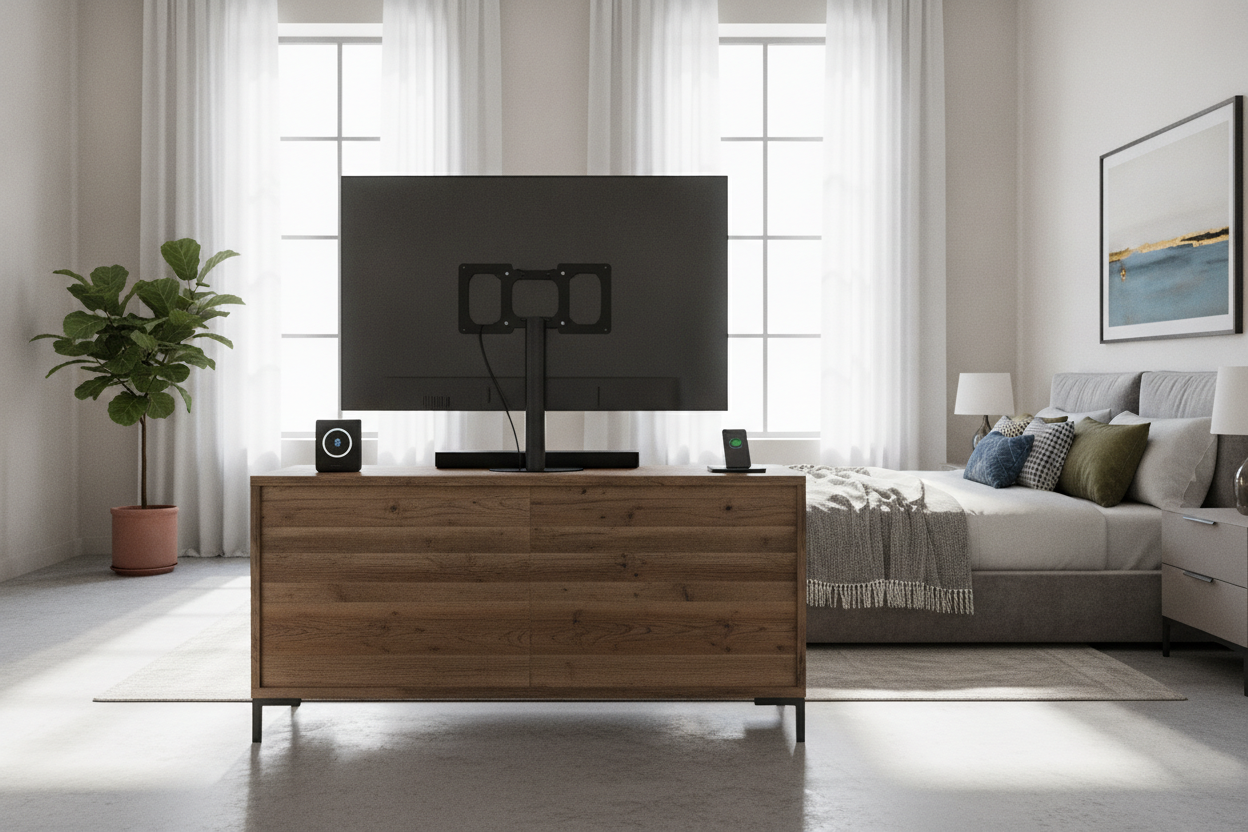
50.4" Lifting TV Stand with Motorized Vertical Lift
It holds a TV of up to 50 inches on an integrated mount and a remote-controlled lift that raises the screen anywhere from 28.7 to 68 inches high, with four memory presets. It measures 39.3" H x 50.4" W x 15.7" D, is finished on all sides so it can stand at the foot of a bed, and includes a TV anti-tip kit. The listing says no tipover restraint is included for the cabinet itself, so add a furniture anchor kit.
Best for: a bedroom or studio where you want the screen out of sight when it's off.
Skip it if: your TV is larger than 50 inches. The listing gives no TV weight limit or mounting pattern, so confirm your TV fits the mount with customer service before ordering.

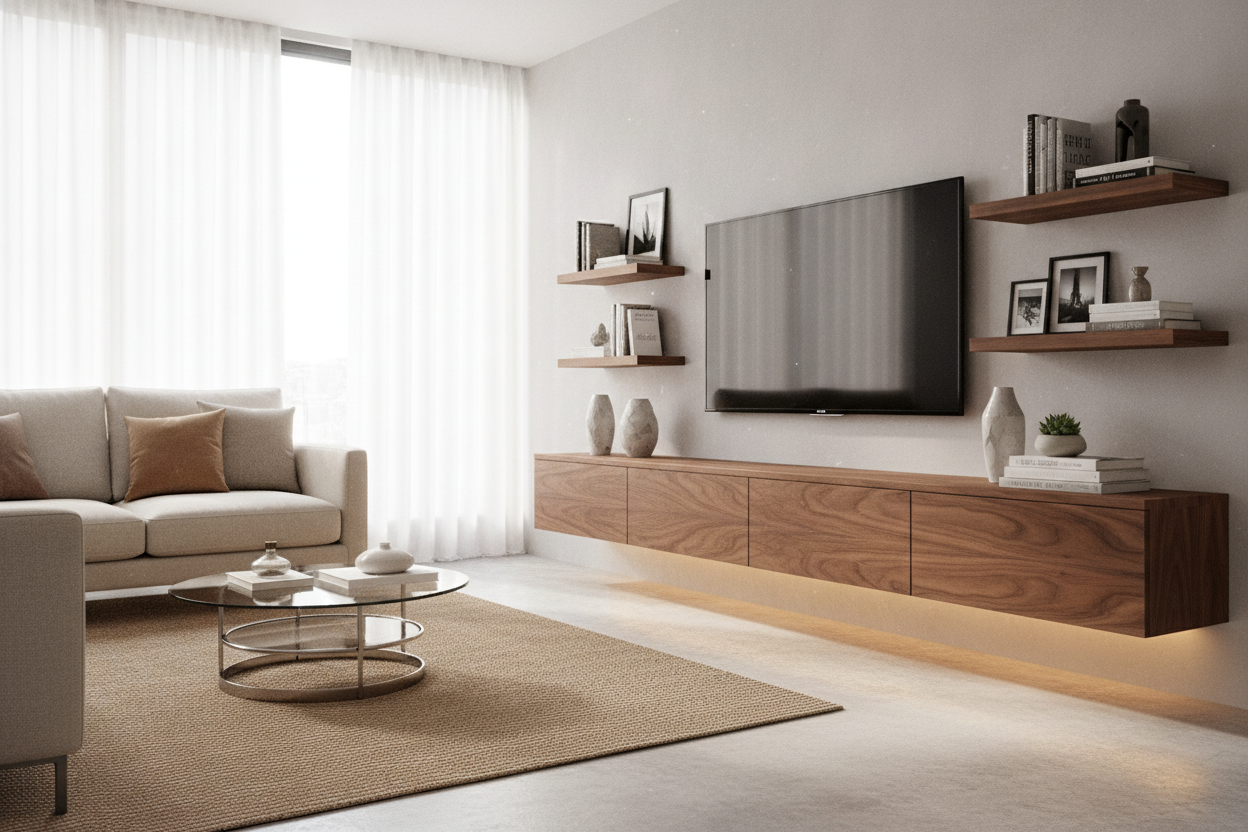
63" Floating TV Stand with LED Lights and 3 Drawers
A wall-mounted console, 63" W x 13.8" D x 9.8" H, listed for TVs up to 70 inches with a 55 lb weight capacity. Three drawers hold remotes and cables, LED strips switch between warm and cool light, and a tipover restraint is included.
Best for: a small living room where floor space is tight and the TV is wall mounted above.
Skip it if: you can't drill into the wall, or your TV, sound bar and devices together would exceed 55 lb.
71" High Gloss TV Stand with LED Ambiance
A low, 70.9" W x 15.7" D x 11.8" H console listed for TVs up to 70 inches and 150 lb. Four drawers hold consoles and cables, and a plug-in LED strip has three colors.
Best for: a wall-mounted TV over a low console, low seating, or a planned upgrade to 55 to 65 inches.
Skip it if: you want a 50-inch TV on its own feet at sofa eye level: 11.8 + about 2 + 12.3 puts the picture's center near 26 inches, about 16 inches below a 42-inch eye height. The listing also says no tipover restraint is included, so buy an anti-tip kit.

82.7" Marble-Look TV Stand with Built-In Power Outlet
At 21.7" H x 82.7" W x 15.7" D, this stand is close to the sofa-height sweet spot for a 50-inch screen: 21.7 + about 2 + 12.3 puts the center of the picture near 36 inches. It is listed for TVs up to 85 inches with a 120 lb weight capacity and a tipover restraint included. A power outlet is built into the top panel.
Best for: a medium or large living room, or a 50-inch TV now with a bigger one planned.
Skip it if: your wall is under about 83 inches wide, or you want a stand scaled to a 50-inch screen; at 82.7 inches it is almost twice the TV's width.
TV Hutch Large Entertainment Center with Storage Cabinets
A four-piece wall unit: a 57-inch console that fits TVs up to 55 inches, two tall piers with glass-door display cabinets, and an overhead bridge shelf. Overall it is 82.3" H x 104.3" W x 17.4" D, with 5 drawers, 5 cabinets, 6 interior shelves, an 800 lb total weight capacity and tipover restraint hardware included.
Best for: a living room home theater wall that frames a 50- or 55-inch TV with books and display space.
Skip it if: you might move to a TV larger than 55 inches, since the opening caps the size, or your wall is narrower than 104.3 inches. Plan for four people to assemble it.

Compare the picks
| Stand | W x D x H | Max TV size | Weight capacity | Best for |
|---|---|---|---|---|
| 50.4" lifting TV stand | 50.4 x 15.7 x 39.3 in | 50 in | Not listed | Bedroom, hidden TV |
| 63" floating stand | 63 x 13.8 x 9.8 in | 70 in | 55 lb | Small living room |
| 71" LED high-gloss stand | 70.9 x 15.7 x 11.8 in | 70 in | 150 lb | Low setup, future upgrade |
| 82.7" marble-look stand | 82.7 x 15.7 x 21.7 in | 85 in | 120 lb | Sofa-height viewing |
| TV hutch entertainment center | 104.3 x 17.4 x 82.3 in | 55 in | 800 lb total | Full media wall |
FAQ: more answers on 50 inch TVs
Is a 50 inch TV considered a big screen TV?
Not by today's standards. TCL treats 55 inches as the living room baseline and 50 inches as the top of the bedroom range. A 50-inch TV is a mid-size screen: large in a bedroom or small apartment, and small in a big living room where you sit 9 feet or more away.
What is the recommended room size for a 50 inch TV?
LG puts 50- to 55-inch TVs in medium rooms of about 4.3 by 4.3 m, roughly 14 by 14 feet, with seating about 1.7 to 2.2 m (5.6 to 7.2 feet) from the screen.
How big of a TV can I put on a 50 inch stand?
Check the stand's listed maximum TV size and weight limit first. As a width guide, keeping 2 inches of stand on each side leaves 46 inches for the TV, and 46 / 0.872 = about 52.8, so a 50-inch TV fits comfortably. The TV's feet must also sit fully on the top.
Ready to set up your next TV? Compare stands, consoles and wall units in the FUFU&GAGA entertainment center collection, and use the distance table above to choose between 50 and 55 inches.

Leave a comment
This site is protected by hCaptcha and the hCaptcha Privacy Policy and Terms of Service apply.