

















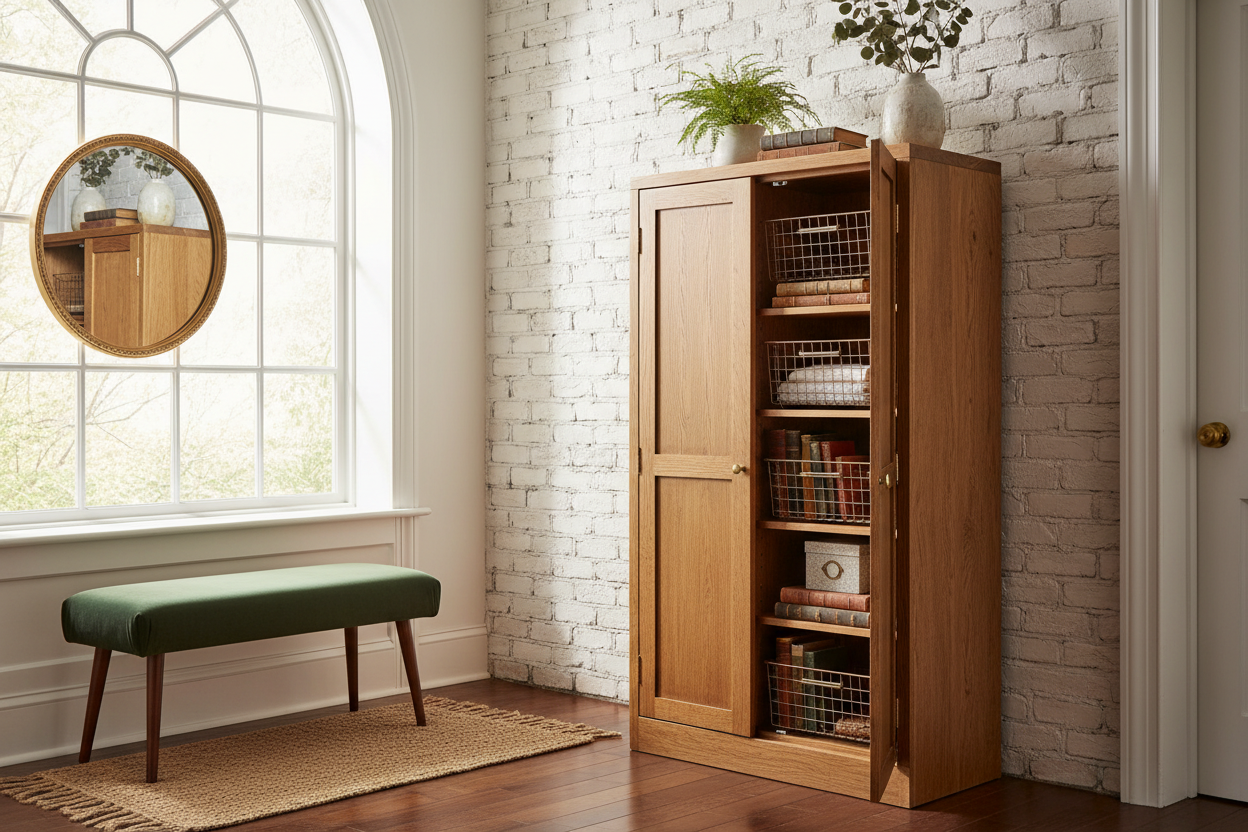
I spent three hours last Saturday trying to wedge a 'standard' 24-inch pantry into a corner that measured exactly 24 inches on my tape measure. By the time I finished, I had a gouged baseboard, a scratched cabinet side, and a pantry that sat at a jaunty, terrifying 5-degree angle because the floor wasn't level. It was a mess.
If you live in a house built before the era of laser levels and drywall, you know the struggle. Right angles are a myth, and those beautiful, chunky baseboards are basically furniture-repellent. I finally learned my lesson: in an old house, if you have a 24-inch gap, you actually have a 23-inch gap. Finding a 23 inch wide cabinet is the ultimate cheat code for making a space look intentional instead of cramped.
Quick Takeaways
- Standard 24-inch furniture rarely fits in 24-inch alcoves due to baseboards and wonky walls.
- A 23 in wide cabinet provides the 'breathing room' needed for a flush fit.
- You lose negligible storage space but gain a massive amount of visual 'breathing room.'
- Darker finishes or glass doors help these narrow units feel like high-end built-ins.
The Two-Foot Trap: Why Standard Sizes Never Work
The furniture industry is obsessed with the two-foot increment. Go to any big-box store and you'll find endless 24-inch options. It makes sense on paper, but in reality, a 24-inch cabinet is a trap. I've personally ruined a perfectly good set of door casings trying to slide a 'standard' unit into an entryway nook.
The problem is that a 24-inch measurement doesn't account for the 3/4-inch baseboard at the bottom or the way old plaster walls tend to bulge in the middle. If your floor has even a slight dip—which, let's be real, every floor does—that 24-inch unit will lean and hit the wall before it's even halfway in. You end up with a piece of furniture that looks like it's being squeezed by a giant, and it makes the whole room feel smaller.
Enter the 23 Inch Wide Cabinet (My Holy Grail)
The first time I sourced a 23 in wide storage cabinet for a client's 1920s bungalow, it was a revelation. That single inch of clearance is magic. It allows you to actually level the piece using shims without the top corner digging into the wall. Instead of fighting the architecture, you're working with it.
I’ve stopped looking at expensive custom built-ins for these weird gaps. Instead, I look for high-quality freestanding storage cabinets that come in these 'off' sizes. A 23 wide cabinet feels substantial enough to hold your life together, but it doesn't demand the structural perfection of a 24-inch unit. It’s the difference between a suit that’s too tight and one that’s perfectly tailored.
What Can You Actually Fit Inside?
You might worry that dropping down to a 23 inch cabinet means sacrificing utility. In my experience, you don't even notice the difference. A 23 inch wide cabinet with doors is still plenty wide for standard 12-inch bins or a row of folded hoodies. I use one in my mudroom for dog leashes, winter hats, and those awkwardly sized boot trays that never seem to fit anywhere else.
If you need more organization, a 23 inch wide cabinet with drawers is a beast for kitchen overflow. You can fit a surprisingly large stack of dinner plates or a whole collection of heavy cast-iron pans. Even a 23 inch deep cabinet provides enough volume to act as a secondary pantry. I’ve found that 23 cabinets are often built with slightly better proportions for small rooms, avoiding that 'bulky' look that wider pieces suffer from.
Styling the Awkward Gap So It Looks Intentional
Once you have your 23-inch wide storage cabinet in place, you’ll have a tiny gap on either side. Don't panic. The goal isn't to hide the gap; it's to make it look like a design choice. I always swap out the generic factory hardware for something beefier—think unlacquered brass or heavy matte black iron. It draws the eye to the piece and away from the wonky wall behind it.
If the room is tight, like a hallway or a landing, a black cabinet with glass doors is my go-to move. The dark finish hides the shadows in the corners, making the gaps disappear, while the glass fronts keep the piece from feeling like a heavy block of wood. If you're dealing with a 23 inch tall cabinet as a side piece, lean a large piece of art behind it. The angle of the art distracts the eye from any unlevel lines between the cabinet and the ceiling.
When You Actually Just Need to Clear a Bigger Wall
I’ll be the first to admit that I’ve spent way too much time obsessing over 23 inch wide storage cabinet options for a corner that was probably better left empty. Sometimes, we get so focused on filling every nook that we create a cluttered mess. If you find yourself measuring a 23 in cabinet for a spot that makes the room feel like an obstacle course, stop.
Take a step back. Sometimes the better move is to leave that awkward alcove alone and find a completely different wall for a wide storage cabinet. A single large, well-placed piece often looks better than three small cabinets shoved into every available corner. But if that alcove is truly the only spot you’ve got, the 23-inch route is your best friend.
FAQ
Is a 23 inch wide cabinet harder to find than a 24-inch one?
A little bit. You won't find as many at the big-box hardware stores, but they are common in 'apartment-scale' furniture collections and office supply catalogs. Search for 'office storage' or 'narrow pantry' to find the best selection.
Will a 23-inch cabinet look too small in a large room?
Not if it has height. A storage cabinet 23 inches wide that stands 60 or 72 inches tall has plenty of presence. It’s all about the verticality.
Can I use two 23-inch cabinets side-by-side?
Absolutely. This is actually a great trick for a 47-inch or 48-inch wall. It gives you a tiny bit of wiggle room at the ends so you aren't fighting the corner trim, and it looks much more custom than one massive unit.


Leave a comment
This site is protected by hCaptcha and the hCaptcha Privacy Policy and Terms of Service apply.