

















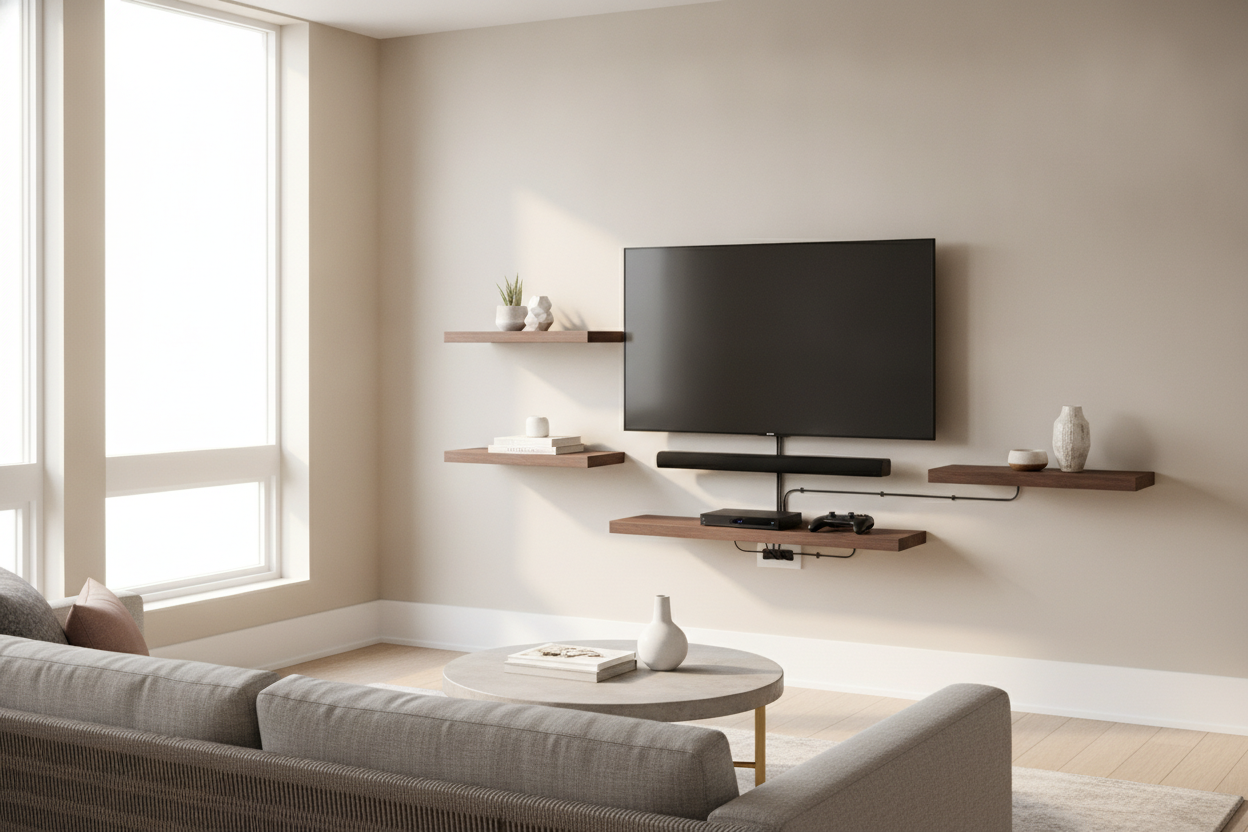
I remember the first time I successfully hit two studs with a heavy-duty bracket. I felt like a DIY god until I realized my Apple TV and soundbar were literally dangling from the back of the screen like a pair of sad tech-pendulums. I had achieved the minimalist look, but at the cost of having my expensive hardware resting on a cardboard box on the floor.
If you are tired of the 'floating screen, stranded gear' look, you have probably started googling tv wall mounts with shelves. It is the middle ground between a bulky media console and a bare wall that leaves your electronics homeless. It is about reclaiming your floor space without sacrificing your PlayStation.
Quick Takeaways
- A unified bracket saves you from drilling twice as many holes in your drywall.
- Integrated cable management is the only way to avoid the 'spaghetti wall' look.
- Always check the weight capacity of the shelf separately from the TV bracket.
- Tempered glass shelves look sleek but show every speck of dust—keep a microfiber cloth handy.
The 'Floating Screen, Stranded Tech' Dilemma
We have all seen the Pinterest photos: a perfectly centered 65-inch screen on a pristine white wall. What they do not show you is where the PlayStation 5 goes or how the soundbar is receiving power. Modern TVs are thinner than a stack of pancakes, but the peripherals we love are still physical boxes that need a flat surface.
When you ditch the floor-standing media cabinet, you create a logistical nightmare for your peripherals. I have seen people try to Velcro their streaming sticks to the back of the TV, only to have the heat from the panel fry the remote sensor. You need a dedicated spot that does not involve a messy trip to the floor or a precarious balancing act on top of a picture frame.
What Actually Are All-in-One Bracket Shelves?
These are not just a TV mount and a random floating shelf bought separately. All-in-one wall mounts with shelves for tv's use a central vertical spine. The TV attaches to the top, and one or two tempered glass or steel ledges clip directly into that same spine. This means you only have to find your studs once.
The biggest benefit is the vertical alignment. If you buy a separate shelf, you are almost guaranteed to make a spacing mistake ruining your tv wall mount by mounting it too low for your cables to reach or too high for your soundbar to breathe. A unified system locks those distances in place, usually allowing you to slide the shelf up or down the track to get the gap exactly right.
Wait, Can You Just Mount TV to Shelf Directly?
I get this question a lot: 'Can I just mount tv to shelf hardware I already have?' The short answer is a hard no. Standard floating shelves are held up by small brackets or internal pins meant for books and candles, not the 40-pound dynamic load of a modern LED screen. Even the 'heavy duty' ones are not designed for the leverage a TV exerts on a wall.
You need a VESA-compliant steel bracket. Anything else is a recipe for a shattered screen and a security deposit nightmare. The shelf should be an accessory to the mount, not the foundation of it. Trust me, I have seen a 'reinforced' ledge bow under the weight of a 55-inch TCL, and it is not a stress you want in your living room.
3 Things to Check Before You Pick Up a Drill
First, find your studs. If you are mounting a TV and a shelf full of heavy tech into just drywall with plastic anchors, you are asking for a structural failure. Use a real stud finder—the magnetic ones are often more reliable than the cheap electronic ones that beep at every pipe. You want that central spine bolted into solid wood.
Second, do the math on weight. A soundbar might only weigh 10 pounds, but a PS5 and a cable box add up fast. Most of these units are rated for about 15-20 pounds per shelf. Don't push it. I once overloaded a glass shelf with a vintage receiver and watched the bracket slowly tilt forward over a week. It was a slow-motion disaster.
Third, plan your wire route. I finally fixed my dangling cord nightmare by choosing a mount with a hollow central column. You feed the HDMI and power cables through the top and they pop out right at the shelf level. It is the difference between a professional install and something that looks like a high school science project.
Do You Still Need a Media Console Down Below?
If you are a true minimalist with just a soundbar and a remote, the wall mount with a shelf is your endgame. It clears up floor space, making your room feel significantly larger. It is a lifesaver for small apartments where every square inch of rug matters for your walking path.
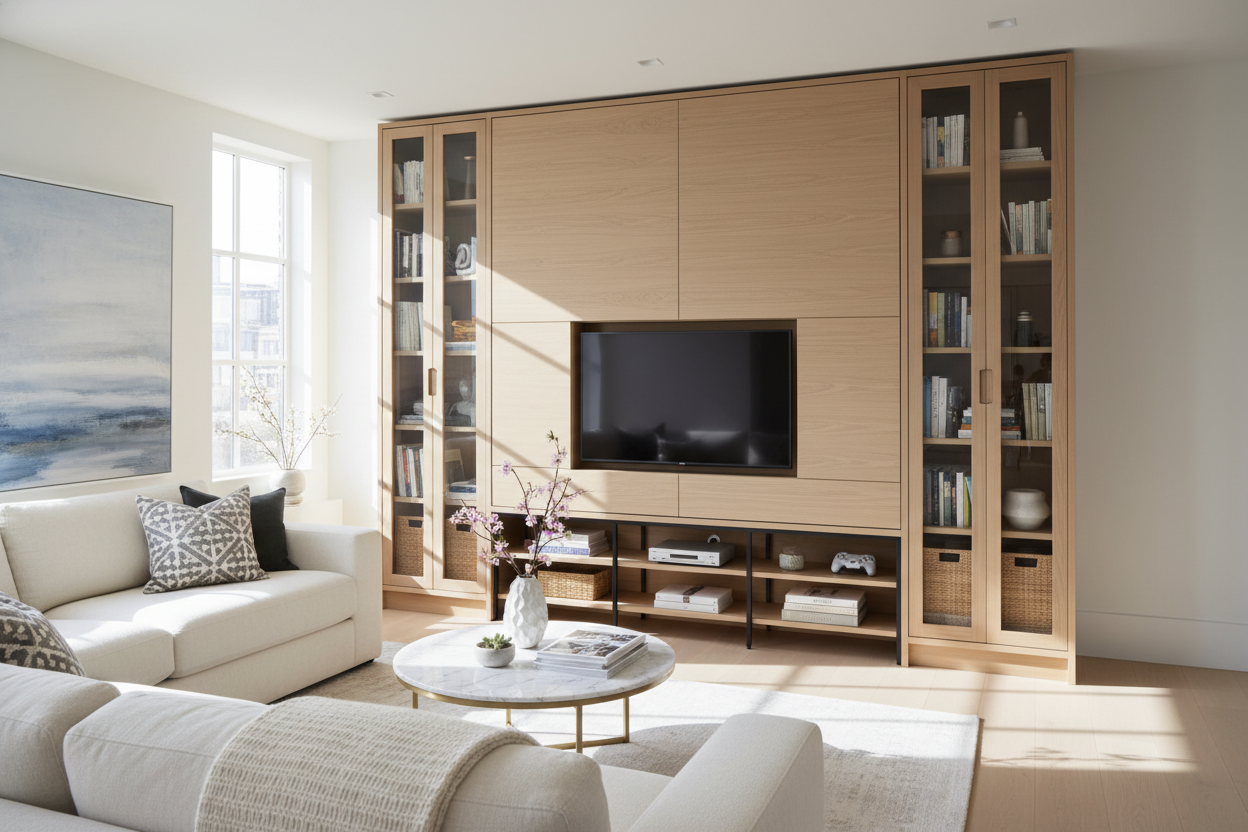
However, if you have a massive record collection or a stack of 4K Blu-rays, you will still need adjustable shelf storage nearby. A single glass ledge is not going to hold your physical media library. In larger rooms, a wall-mounted TV can sometimes look like it is 'drifting' in space. To ground the look, I often suggest placing a mid century modern tv stand with slatted doors underneath. You do not put the TV on it, but you use it to hide the bulky stuff and keep the room feeling balanced.
FAQ
Will my soundbar fit on the shelf?
Most shelves are about 15-18 inches wide. If you have a massive 48-inch soundbar, it will overhang the sides. It is structurally fine as long as the weight is centered, but it might look a bit top-heavy. Measure your soundbar's 'feet' to ensure they actually sit on the glass.
Are these renter-friendly?
They require drilling into studs, so you will have 2-4 holes to patch when you move. However, it is much better than the 8-10 holes you would need for a separate mount and two floating shelves. Always check your lease before drilling.
Can I add more shelves later?
Usually, no. These systems are sold as 1-shelf, 2-shelf, or 3-shelf units. The central spine is cut to a specific length, so buy the one with more capacity than you think you need today. You can't easily 'extend' the spine later.


Leave a comment
This site is protected by hCaptcha and the hCaptcha Privacy Policy and Terms of Service apply.