

















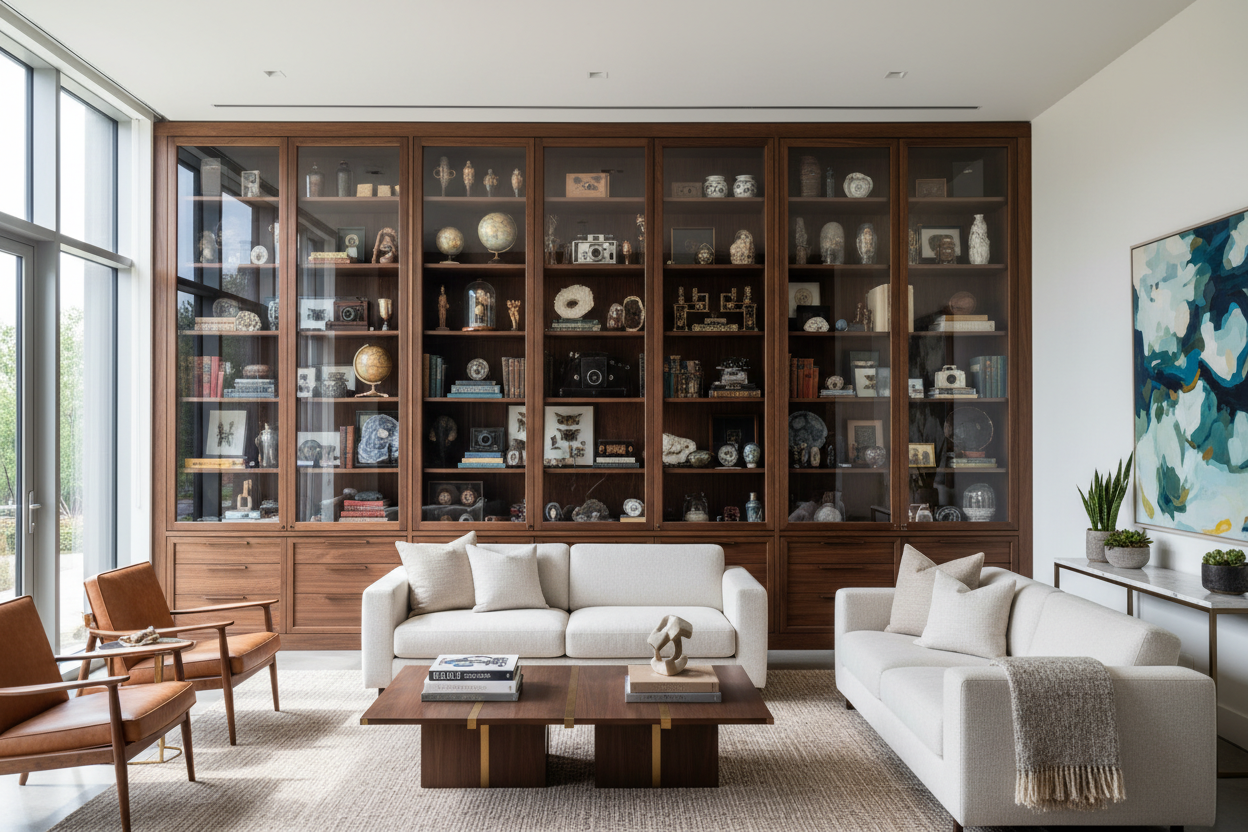
I spent three years convincing myself that floating shelves were the minimalist way to show off my collection of vintage cameras and oversized art books. In reality, my living room looked like a high-end thrift store that had just been hit by a tornado. Every time I walked past, I noticed a new layer of gray fuzz on a lens or a leaning stack of books that felt one sneeze away from a disaster. I finally admitted I needed a proper glass display case cabinet to contain the madness.
- Floating shelves create visual noise; one large cabinet creates a single, clean focal point.
- Integrated lighting is non-negotiable for deep shelves to avoid dark 'dead zones.'
- Glass doors are the only real defense against the endless cycle of dusting delicate items.
- Black frames provide a modern, gallery-like contrast that wood often lacks.
The Floating Shelf Delusion (Why I Finally Snapped)
The breaking point came when I realized I was spending forty minutes every weekend with a microfiber cloth and a can of compressed air. Floating shelves look great in a staged photo with exactly three items on them, but for a real collector, they are a logistical nightmare. My wall looked cluttered and chaotic, more like a messy stockroom than a curated home. Every time I added a new piece, the whole 'aesthetic' crumbled further into disarray.
I needed a boundary. A door display cabinet doesn't just hold your stuff; it frames it. It says 'this is a collection' rather than 'this is a pile of things I haven't put away yet.' Realizing that my open shelving was actually making my room feel smaller because of the visual clutter was the 'aha' moment I needed to go big on a single enclosure.
Why Going Massive Actually Saves Space
It sounds counterintuitive, but one massive piece of furniture actually makes a room feel larger than five small, scattered ones. A 94-inch unit provides a single vertical plane that mimics the wall itself. When I finally installed the 94 4 Wide Glass Door Led Lights Display Case Curio Cabinet, the room suddenly felt anchored. Instead of my eyes jumping to ten different 'hot spots' of clutter, they rested on one intentional, organized display.
The visual weight of a large door display cabinet creates a sense of permanence. It fills the height of the room, drawing the eye upward and making the ceilings feel taller. I made the mistake of trying to 'save space' with small units before, and it just resulted in a choppy, fragmented room layout that felt like a waiting room. Go big or you'll just end up buying a second cabinet in six months anyway.
The Magic of Built-In Lighting (No Ugly Wires)
If you buy a deep glass cabinet case without lights, the back half of your collection will disappear into a dark abyss. I used to mess around with those cheap battery-powered puck lights, but they always fall off at 2 AM or run out of juice right when you want to show off your setup. Integrated LEDs change everything. They provide a crisp, even glow that makes even a random ceramic bowl look like a museum artifact.
For those with slightly less wall real estate who still want that professional glow, the 78 7 Wide Glass Door Display Case Curio Cabinet With Led Lights is the sweet spot. It offers that same built-in illumination without requiring an aircraft-hangar-sized living room. Having the wiring tucked neatly into the frame means you don't have 'spaghetti' cords hanging off the shelves, which is the fastest way to make expensive furniture look cheap.
Black Frames vs. Wood: Grounding the Room
I am officially over the 'honey oak' look that makes every display case cabinet look like it was salvaged from a 1992 Sears catalog. Stark, dark frames act like a picture frame for your belongings. They provide a high-contrast border that makes the glass and the items inside pop. It's a more industrial, moody aesthetic that fits modern homes much better than the 'grandma's antique shop' vibe of traditional door display cases.
Choosing a Black Cabinet With Glass Doors was the best design move I made. It grounds the piece against light-colored walls and prevents it from looking like a giant block of wood. If you have a lot of colorful items—like sneakers, glass art, or comic figures—the black frame acts as a neutral border that doesn't compete with the contents. It’s about making the collection the star, not the wood grain.
Wait, Should I Have Used a Corner Unit Instead?
I wrestled with the idea of a corner unit for a while. If you have a weird architectural bump-out or a tiny studio apartment where every square inch is a battleground, a corner unit makes sense. But for most standard living rooms, a flat wall unit is more of a statement piece. It feels intentional rather than like you're trying to hide your hobby in the shadows.
If you're genuinely on the fence about your floor plan, I’d check out Is A Corner Cabinet Display Case Worth It A Designers Take before you commit. I found that a flat unit against a main wall actually improved the 'flow' of my room more than tucking a unit into a corner, which often creates awkward dead space behind the cabinet itself.
The Relief of Never Dusting Again
The best part of this entire transition? I haven't picked up a duster in three weeks. Closing those glass doors for the first time felt like finishing a marathon. A dedicated glass display case cabinet keeps the air out and the aesthetic in. My cameras stay clean, my books stay upright, and my sanity remains intact. It is the ultimate hack for a clean-looking home without actually having to clean your shelves every Sunday. If you're drowning in 'stuff,' stop buying more shelves and start buying one really good cabinet.
Is tempered glass really necessary?
Absolutely. If you have kids, pets, or even just a vacuum cleaner, non-tempered glass is a disaster waiting to happen. Tempered glass is much stronger and, if it does break, it crumbles into small chunks rather than dangerous shards.
How do I stop the shelves from sagging?
Always check the weight rating per shelf. For heavy collections like hardcover books or stone sculptures, look for cabinets with reinforced glass or thicker 8mm shelving. If you're pushing the limit, distribute the weight toward the edges of the shelf where the supports are.
Can I add my own lighting later?
You can, but it's a pain. Aftermarket light strips often have visible wires and bulky battery packs. Buying a unit with integrated LEDs is worth the extra cost just to avoid the headache of trying to hide cords behind glass panels.


Leave a comment
This site is protected by hCaptcha and the hCaptcha Privacy Policy and Terms of Service apply.