

















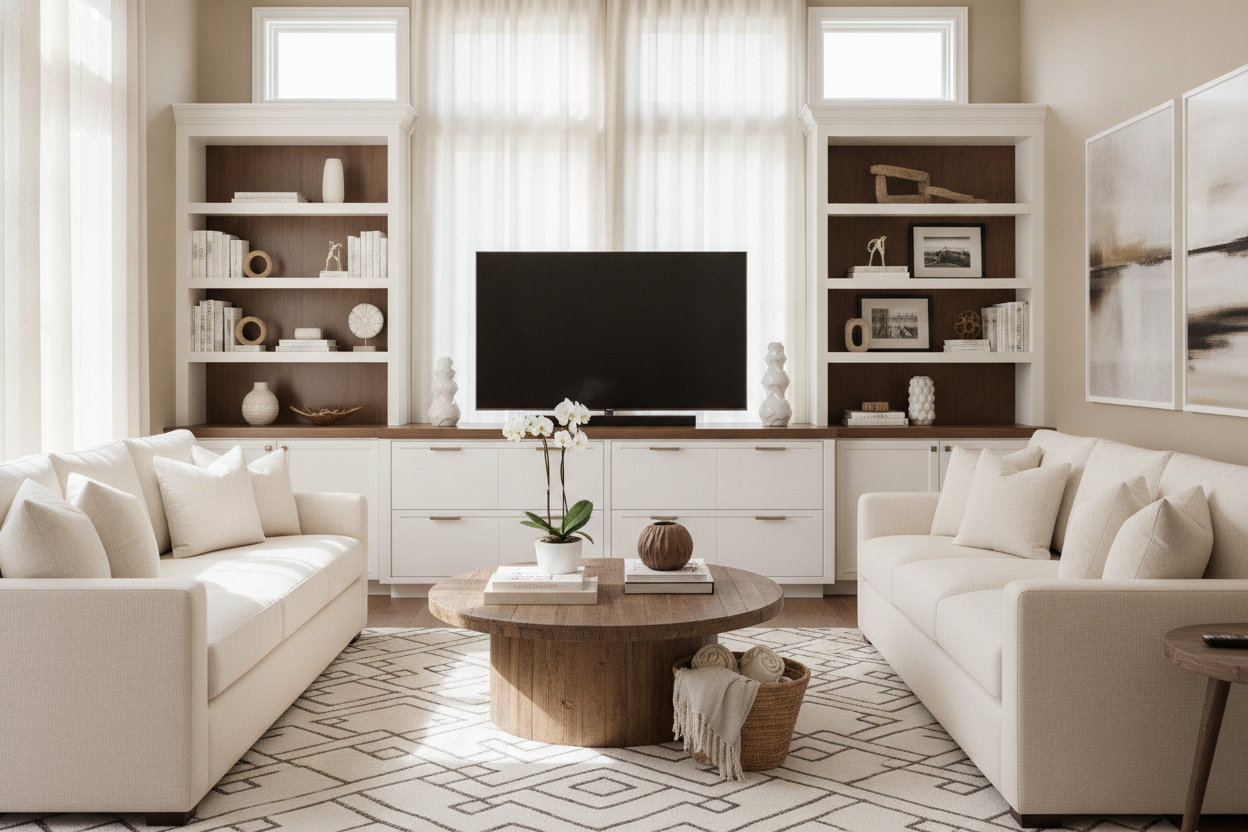
I remember staring at a mountain of cardboard boxes in our first shared apartment at 2 AM, feeling the first real sting of 'decor incompatibility.' My partner wanted the living room to look like a high-end medical clinic—all glossy white, chrome, and sharp edges. I, on the other hand, wanted to live in a Nancy Meyers movie, surrounded by warm oak and lived-in textures. We were stuck until we realized that a white and brown tv stand was the only thing that would keep us from sleeping in separate bedrooms.
- Two-tone furniture bridges the gap between sterile minimalism and heavy traditionalism.
- A wood top is much more forgiving with dust and remote control scratches than high-gloss white.
- White bases help large furniture pieces 'disappear' against light walls, preventing a cramped feel.
- Mixing finishes makes your room look like it evolved over time rather than being a 'room-in-a-box' delivery.
The 'Yours, Mine, and Ours' Decor Dilemma
Moving in together is a romantic milestone that quickly turns into a logistical nightmare when you realize your partner’s idea of a 'vibe' is your idea of a 'headache.' The media console is usually where this battle peaks. It is the focal point of the room; you stare at it for hours while binging Netflix, so neither person wants to compromise on the aesthetic.
If you go full mid-century walnut, the minimalist partner feels like they are living in a dusty library. If you go full IKEA-white, the traditionalist feels like they are in a dorm room. The two-tone approach isn't just a design choice; it is a peace treaty. It allows both styles to exist in the same six-foot footprint without looking like a mistake.
Why the Two-Tone Look Actually Works So Well
Visual balance is all about weight. A solid dark wood unit can feel like a black hole in a small room, sucking up all the light. Conversely, an all-white unit can feel cheap and flimsy if the material isn't top-tier. I’ve written before about why a modern white TV stand looks cheap, and usually, it comes down to a lack of soul. Adding a wood element provides that soul.
A white tv stand with brown top perfectly anchors your tech. The white base keeps the room feeling airy and 'clean,' while the brown top provides an organic, grounding element. It mimics the way we see the world—bright sky above, earthy ground below. Plus, from a practical standpoint, a wood-grain top hides the inevitable layer of dust that settles under your TV much better than a flat white surface ever could.
Finding the Right Balance (Because Ratios Matter)
Not all two-tone pieces are created equal. You have to decide which 'personality' you want to lead with. Before you start browsing for new TV stands, take a look at your existing larger pieces. If you have a dark leather sofa, your TV stand needs more white to balance the 'heavy' seating. If you have a light gray or cream linen sofa, you can afford to go heavier on the wood tones.
When to Go Heavy on the Wood Tones
If your apartment has those standard 'renter white' walls and cool-toned LVP floors, the space can feel cold fast. In this case, look for a tv stand white and brown that uses wood for the majority of the frame, with white only on the door fronts or drawers. This adds much-needed warmth to the room while the white accents still tie into your trim and walls.
When to Let the Crisp White Dominate
In a tight 12x12 living room, you want the furniture to recede. A mostly white base with a thin, honey-toned wood top is the way to go here. The white blends into the wall, making the unit look smaller than it actually is, while the wood top provides just enough 'pop' to keep the room from looking like a blank canvas. I personally prefer a matte white finish over high-gloss; it looks more expensive and handles fingerprints better.
What If You Have a Massive Living Room Wall?
If you are lucky enough to have a 15-foot wall to fill, a standard 60-inch console is going to look like a postage stamp. You need scale, but a solid dark wood unit of that size is visually oppressive. This is where a white and brown entertainment center shines. By breaking up the colors, you break up the visual bulk.
I recently helped a friend spec out an extra long barn door TV stand for her new build. Because the main body was white, the nearly 95-inch length didn't overwhelm the room. The wood accents on the top and doors gave it that farmhouse-modern 'edge' without making the living room feel like a literal barn. It’s about presence without the 'clutter' feel.
Pulling the Room Together So It Doesn't Look Accidental
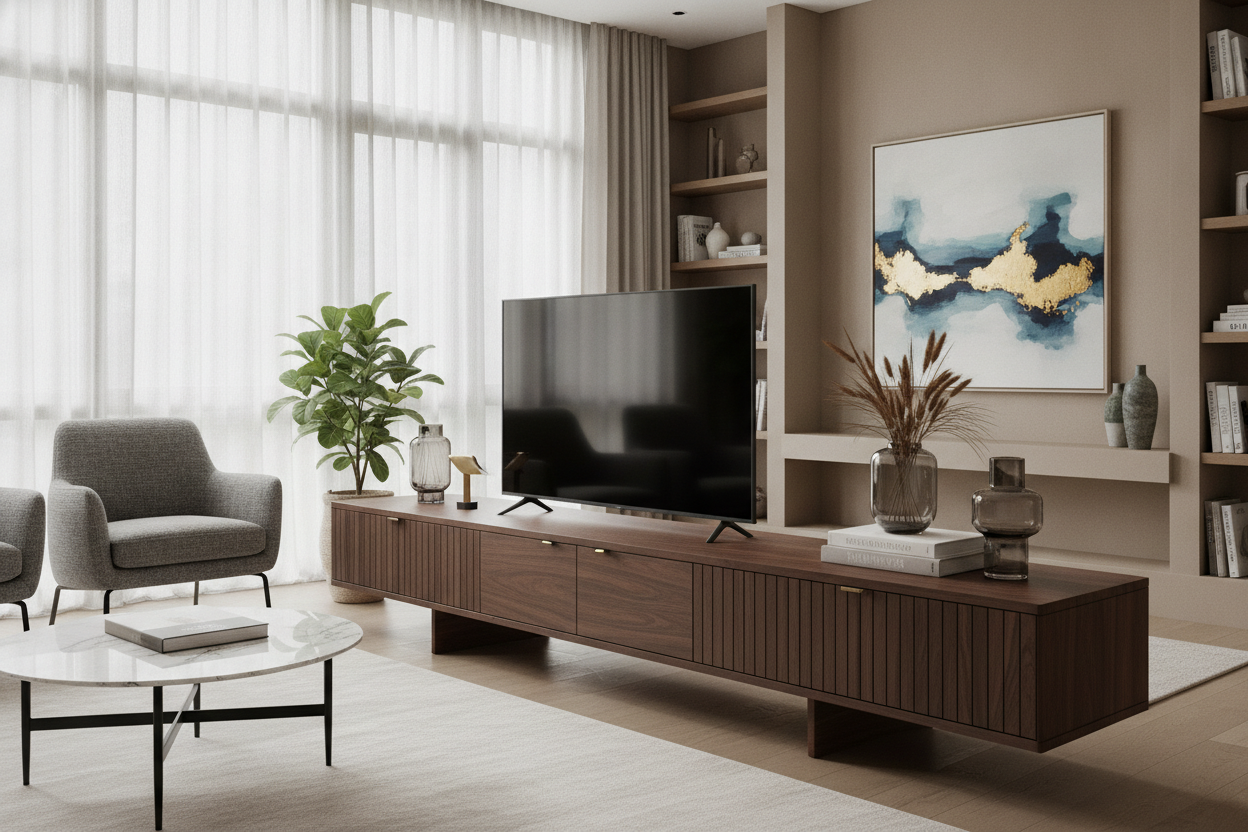
The biggest risk with mixed-material furniture is that it can look like you couldn't make up your mind. To avoid this, you need to 'echo' the materials elsewhere. If your stand has a walnut top, get a walnut coffee table or a couple of walnut picture frames. This makes the two-tone look feel intentional rather than a lucky find at a scratch-and-dent sale.
I learned this the hard way when I first started styling a gold and white TV stand in my old place. I didn't have any other gold in the room, so it looked like a stray piece of furniture that wandered in from a different house. Use woven baskets for storage in the cubbies to add a third texture—the natural fiber bridges the gap between the painted white and the stained wood perfectly.
FAQ
Will a white and brown stand match my gray sofa?
Absolutely. Wood is a natural neutral. As long as the wood tone isn't too orange-red (like old-school cherry), it will look great against gray, navy, or cream upholstery.
Is the wood top hard to maintain?
Most modern stands use a high-quality laminate or a veneer. Just use a coaster for your drinks and a damp cloth for spills. Unlike solid wood, these won't warp if the AC kicks on.
What if I want to change my style later?
That is the beauty of two-tone. If you go more modern, the white is already there. If you go more rustic, the wood is already there. It is the most future-proof furniture choice you can make.


Leave a comment
This site is protected by hCaptcha and the hCaptcha Privacy Policy and Terms of Service apply.