

















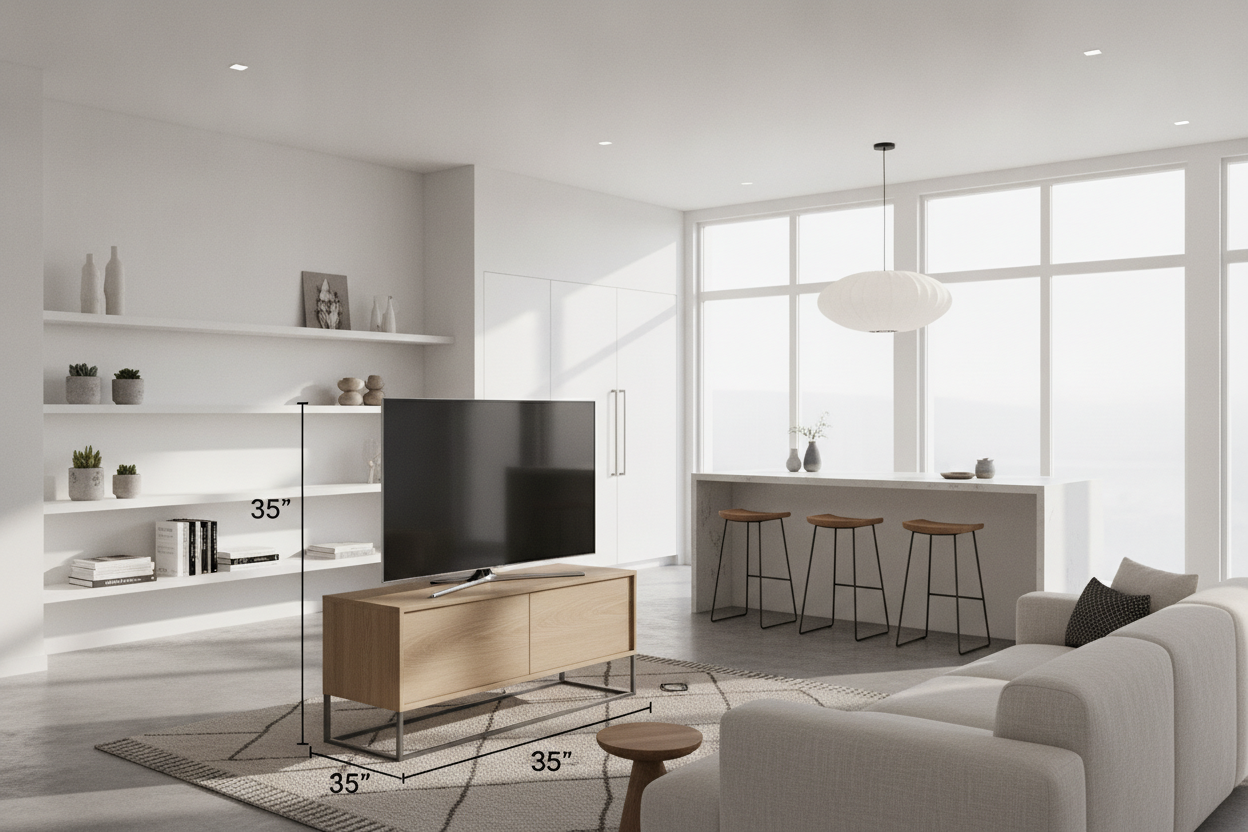
I spent three months scouring vintage shops for the 'perfect' mid-century media console, only to realize I’d made a massive ergonomic mistake the moment I sat down at my kitchen island with a bowl of pasta. From my bar stool, all I could see was the top six inches of the TV screen peeking over the back of my West Elm sofa. It turns out, that low-slung, 22-inch high aesthetic is great for a dedicated theater room, but it’s a total disaster for open-concept living.
If you find yourself constantly craning your neck or standing up just to see the score of the game while you're prepping dinner, you don't need a bigger TV. You need a 35 inch height tv stand. Moving the screen up just a few inches changes the entire physics of the room, turning a frustrating layout into a functional space where you can actually see the screen from every zone.
Quick Takeaways
- Standard consoles are usually 24 inches high, which is too low for viewing over furniture.
- A 35-inch height clears the average 32-inch sofa back with ease.
- Be careful not to confuse height with width when searching for '35 tv stand' options.
- Taller stands often offer better storage for actual household items, not just tech.
The Open-Concept Line of Sight Problem
Modern floor plans promised us 'flow,' but they forgot to mention the furniture hurdles. In an open-concept home, your living room isn't a vacuum. It’s a thoroughfare. When your sofa sits between the kitchen island and the TV, that sofa back becomes a literal wall. Most standard media units are designed for people sitting directly in front of them on a low couch, but that doesn't account for the person chopping onions thirty feet away.
I’ve seen people try to fix this by wall-mounting their TV six feet high, which leads to the dreaded 'TV too high' neck strain when you actually do sit down to watch a movie. It’s a lose-lose. A taller console solves the line-of-sight issue without making your living room look like a sports bar. It provides that crucial lift so the screen clears the 'horizon line' of your furniture, making the kitchen and dining areas feel like part of the entertainment zone rather than the cheap seats.
The Magic Geometry of a 35 Inch Height TV Stand
Let’s talk about the math, because furniture is just geometry you can sit on. The average sofa back hits somewhere between 30 and 32 inches. If your TV is sitting on a standard 20-inch console, the bottom third of your screen is essentially invisible to anyone behind the couch. By jumping up to a 35 inch height tv stand, you’re placing the base of the TV above the sofa’s silhouette.
This height is the 'Goldilocks' zone. It’s high enough to clear the furniture but low enough that you aren't looking up at a sharp angle when you're lounging. It also happens to align perfectly with standard counter heights (usually 36 inches), creating a visual continuity across the room. If you’re tired of looking at the back of a polyester cushion instead of the news, it's time to browse taller tv stands that actually respect your floor plan.
Don't Mix Up Height and Width (The 35 TV Stand Trap)
Here is where people usually mess up their online orders. When you type '35 tv stand' into a search bar, the algorithm often thinks you’re looking for a tv stand 35 inches wide. Let me be clear: a 35-inch wide stand is tiny. It’s the kind of thing you put in a dorm room or a walk-in closet. If you put a modern 65-inch TV on a 35-inch wide stand, it’s going to look like a lollipop and probably tip over the first time someone sneezes.
For an open-concept room, you want the height to be 35 inches, but the width should still be substantial. Most rooms that struggle with sightlines are large enough to require designing with wide media consoles to keep the proportions in check. Always double-check the 'Product Dimensions' section before you click buy. You want that verticality for the view, but you still need horizontal weight to anchor the wall.
How to Style a Taller Console Without It Looking Awkward
The fear with a 35-inch stand is that it will look like a bedroom dresser shoved into the living room. To avoid this, stay away from units with too many small drawers, which scream 'lingerie chest.' Instead, look for pieces with long, clean lines or glass-front doors. I personally love a sideboard-style unit with adjustable shelving inside. It looks intentional, like a high-end credenza rather than a utility piece.
Since the TV is sitting higher, the space above it is more limited. Skip the massive gallery wall behind it. Instead, style the top of the console with low-profile items. A few stacked books or a tray for remotes works well. Avoid tall vases or lamps that will clip the corners of the screen. You want the furniture to feel like a solid architectural element, not a cluttered shelf.
Where Else Does This Height Work?
While the open-concept living room is the primary use case, this height is a secret weapon for the bedroom too. If you have a high mattress or a bed with a thick footboard, a standard low console is useless. You’ll find yourself staring at your own toes. Choosing a 35 inch high tv stand for your bedroom ensures the screen is at eye level while you're propped up on pillows, which is the only way to binge-watch properly.
Personal Experience: My 'Aha' Moment
I once bought a beautiful 18-inch tall teak bench to use as a TV stand. It looked incredible in photos. In reality, I hated it within 48 hours. Every time I stood up to get a glass of water, the TV disappeared. I eventually swapped it for a 34.5-inch tall acacia sideboard. The difference was night and day. Not only could I see the screen from the kitchen, but I also gained enough storage to hide my router, three game consoles, and a whole collection of board games I never use. It made the room feel finished, not just furnished.
FAQ
Is 35 inches too high for a TV stand?
Not if you have an open floor plan or a high sofa. It’s only 'too high' if you sit very close to the TV on a beanbag chair. For most modern living rooms, it's actually more ergonomic than the low-profile units that were popular five years ago.
Can I use a sideboard as a TV stand?
Absolutely. Sideboards and buffets are usually 34-36 inches tall, making them the perfect '35 inch height' solution. Just make sure the back is finished or has a hole for cable management, or be prepared to get handy with a drill bit.
What is the best width for a tall TV stand?
Rule of thumb: the stand should be at least 6-10 inches wider than the TV itself. If you're going tall, a wider base helps prevent the piece from looking top-heavy or unstable.

Leave a comment
This site is protected by hCaptcha and the hCaptcha Privacy Policy and Terms of Service apply.