

















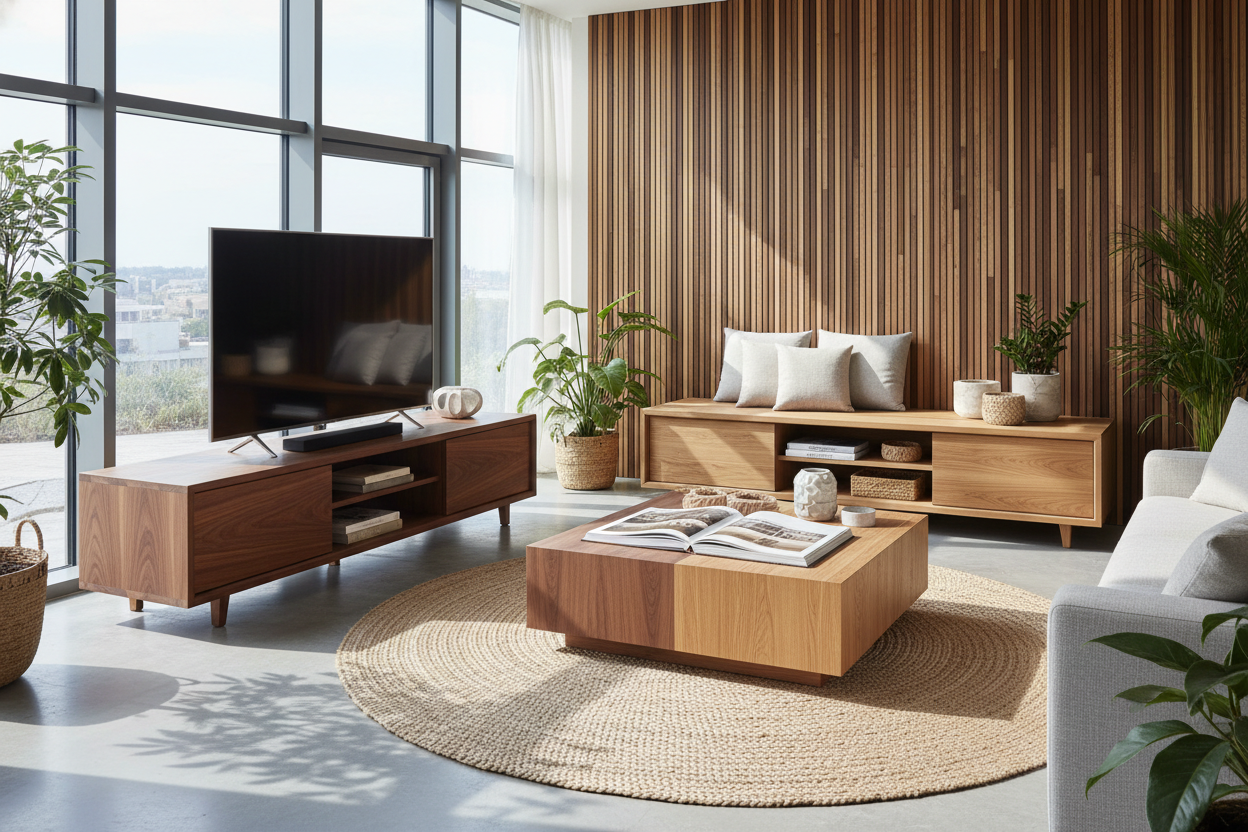
I once spent three weeks researching the perfect 65-inch OLED, only to set it on a cheap, 'wood-look' console that started sagging in the middle before the first season of my show was over. It looked like a sad smile, and every time I walked past it, I prayed the whole thing wouldn't collapse. Choosing the right wood for tv stand setups isn't just about matching your floor; it's about structural physics and heat management.
- Hardwoods like Oak and Walnut are the gold standard for weight capacity.
- Pine and other softwoods dent easily and often bow under heavy tech.
- Mango wood offers incredible density and unique textures for high-end designs.
- High-quality veneers are often more stable than solid wood in humid environments.
Why the Species of Wood Actually Matters
Your media console is the hardest-working piece of furniture in your living room. Unlike a coffee table that just holds a few books, a TV stand has to support 50 to 100 pounds of glass and electronics in a concentrated footprint. If you use a low-density wood, that weight eventually wins. The fibers compress, the center point dips, and suddenly your doors don't close right because the frame is out of alignment.
Then there is the heat. Gaming consoles and receivers are basically small space heaters. If your stand is made of cheap particle board or poorly dried timber, that constant heat-cool cycle can cause the material to crack or the glue to fail. You need a species that is dimensionally stable—meaning it won't shrink or expand drastically when your Xbox has been running for four hours.
Softwoods vs. Hardwoods: A Quick Reality Check
When you are browsing wood television stands, the first thing to check is the Janka hardness rating. Hardwoods come from flowering plants, while softwoods come from conifers. For furniture, 'hardwood' usually means it can take a beating. Oak, for instance, has a Janka rating of around 1,300 lbf, while common Pine sits way down at 380 lbf. It is a massive difference in how the piece ages.
I have seen plenty of people buy soft timber stands because they like the price tag, only to realize that the wood is so soft you can leave a permanent mark just by pressing your fingernail into it. Over five years, a softwood stand will look beat up and 'distressed' in a way that isn't intentional. Hardwoods, meanwhile, just keep getting better with age.
Why I Usually Avoid Pine for Heavy Tech
I have a love-hate relationship with Pine. It is great for a rustic bookshelf, but for a media center? It is a nightmare. I once dropped a heavy TV remote on a pine console and it left a crater. Because pine is so porous, it also reacts heavily to humidity. If you live somewhere with four seasons, a pine stand might swell enough in the summer that your media drawers start sticking. It is just too much maintenance for a piece of furniture that should be 'set it and forget it.'
The Heavy Hitters: Walnut, Oak, and Mango
If you want a piece that survives your next three moves, Walnut is my top pick. It is the king of mid-century modern design for a reason. It is strong, has a tight grain that doesn't trap dust, and the natural chocolate tones look expensive even with zero styling. Oak is the 'tank' of the group. If you have kids or pets, get White Oak. It is nearly indestructible and has a neutral tone that works with almost any color palette.
Lately, I have been recommending Mango wood more often. It is a sustainable byproduct of the fruit industry and is surprisingly dense—similar to Ash or Cherry. Because of its irregular grain, it is an excellent choice for a carved wood TV stand. The wood is sturdy enough to handle intricate patterns without splintering, which gives you that high-end, artisanal look without the fragility of softer timbers.
What About Veneers? Are They Actually Terrible?
There is a huge misconception that veneer is just a fancy word for 'cheap.' In reality, a high-quality wood veneer over a core of Baltic birch plywood or high-density MDF is often more stable than solid wood. Solid wood wants to move; it wants to warp and twist. A engineered core prevents that. If the piece uses a 'thick-cut' veneer (anything over 1mm), you can even light-sand it if it gets scratched. Just stay away from 'paper laminates'—that is essentially a sticker of wood grain over compressed sawdust, and it will peel the moment it gets wet.
How to Pick a Finish That Suits Your Living Room
The biggest mistake I see is people trying to match their TV stand exactly to their hardwood floors. It never works. It usually ends up looking like a 'near miss' that makes the whole room feel off. Instead, aim for contrast. If you have light maple floors, go for a dark Walnut or even a black stain. You can style a black wood TV stand to ground the room and make the TV screen itself feel less like a giant black hole on the wall.
If you are worried about the room feeling too heavy, look for pieces that mix materials. A console with a natural wood and black finish provides a nice visual break. The natural wood brings the warmth, while the black accents (like legs or hardware) tie in with your tech. It makes the furniture look like a conscious design choice rather than just a box to hold your cables.
Personal Experience: The 'Reclaimed' Trap
I once bought a gorgeous reclaimed wood stand made from old barn siding. It looked incredible in the shop. Once I got it home and put my TV on it, I realized the 'natural character' of the wood meant the top surface was about a quarter-inch out of level. My TV had a permanent tilt to the left. I had to hide three layers of cardboard under the left side just to level it out. Now, I always bring a small level to the furniture store. If the top isn't flat, it doesn't matter how pretty the grain is.
FAQ
Is solid wood better than MDF for a TV stand?
For the frame and legs, yes. For the large flat panels, a mix is actually better. Solid wood panels can warp over time due to the heat from your electronics, whereas a high-quality veneered core stays perfectly flat.
How do I know if a TV stand is actually solid wood?
Check the end grain. If the grain pattern continues from the top down over the edge, it is likely solid. If the edge has a perfectly uniform strip that doesn't match the top grain direction, it is a veneer edge band.
What is the most durable wood for a household with kids?
White Oak. It is incredibly hard, hides scratches well due to its busy grain, and is resistant to water damage compared to other hardwoods.

Leave a comment
This site is protected by hCaptcha and the hCaptcha Privacy Policy and Terms of Service apply.