
















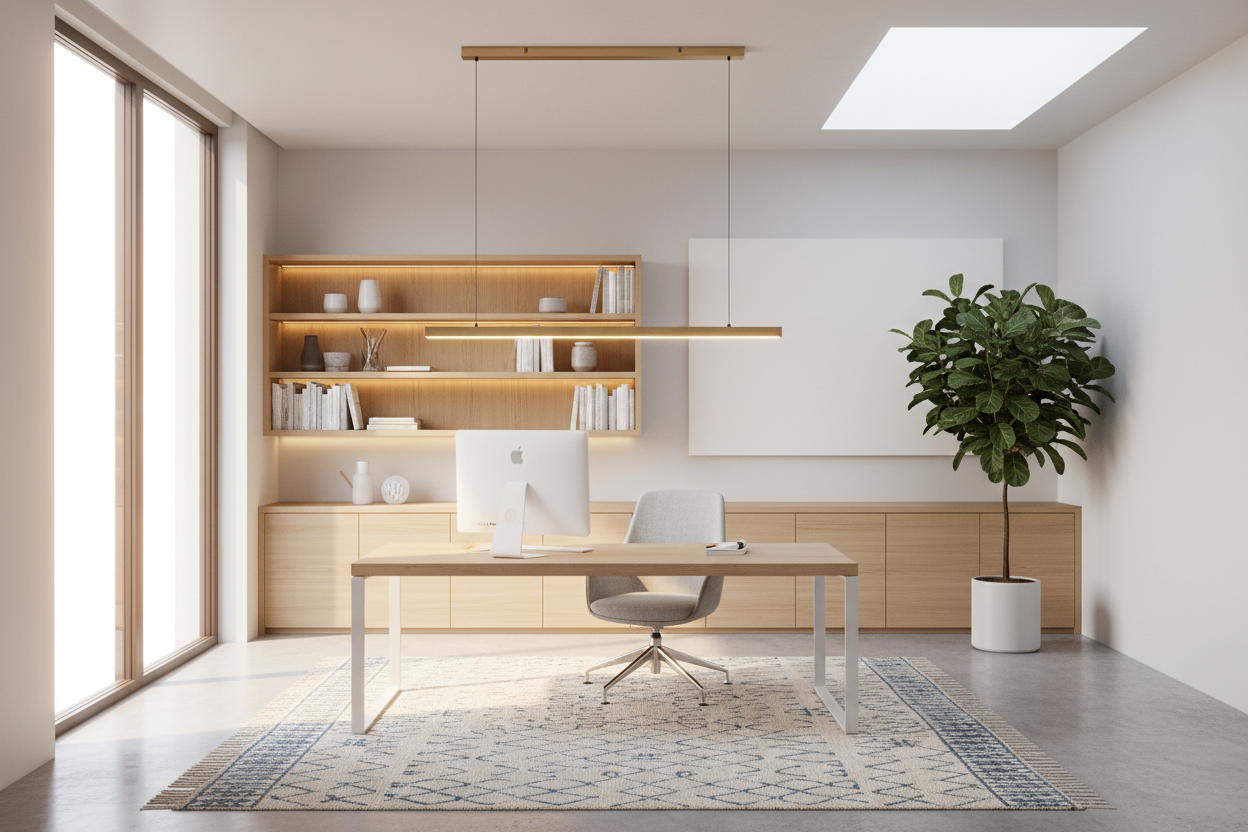
There is nothing quite as draining as trying to review blueprints or analyze spreadsheets under the hum of flickering, yellowed overheads. Poor illumination doesn't just ruin the aesthetic of a workspace; it actively hinders productivity and causes eye strain. As a designer, I see this constantly: clients invest heavily in ergonomic chairs and solid oak desks but treat lighting in the office as an afterthought. The truth is, the quality of light dictates the quality of work. This guide will walk you through curating a lighting scheme that balances corporate functionality with residential comfort.
Quick Decision Guide: Key Features to Look For
- Color Temperature: Aim for 3500K to 4000K (Cool White) for general workspaces to maintain alertness without the harshness of daylight bulbs.
- Layering: Never rely on a single source. Combine ambient (overhead), task (desk lamps), and accent (decorative) lighting.
- CRI (Color Rendering Index): Look for office lighting bulbs with a CRI of 90+. This ensures finishes and documents look true to color.
- Adjustability: Dimmable fixtures and articulating arms on office lighting lamps are non-negotiable for controlling glare.
- Bulb Efficiency: LED light bulbs for office use are superior to fluorescent for longevity and lack of flicker.
Moving Beyond the Grid: Modern Corporate Strategies
In the past, corporate office lighting was synonymous with uniform, sterile fluorescent grids. Today, we approach the office as a landscape. The goal is to eliminate shadows and reduce contrast ratios between your screen and the room. If you are wondering what is the best lighting for an office, the answer is rarely a single fixture—it is a composition.
For general illumination, avoid placing office spotlights directly above the chair, as this casts shadows on your work surface. Instead, position recessed lighting or pendants to the sides or bounce light off the ceiling and walls to create a soft, diffused glow. This is particularly crucial when planning lighting for small office layouts where harsh shadows can make the room feel claustrophobic.
The Technicalities: Brightness and Bulbs
How Bright Should Office Lighting Be?
Brightness is subjective, but we measure it in lumens and lux. For a workspace, you generally want bright office lighting that hits around 500 lux on the desk surface. However, bright light for office work does not mean blinding. It means ample, uniform distribution.
Fluorescent vs. LED
While some legacy buildings still use tubes, the best fluorescent light bulbs for office retrofits are actually LED replacements. Fluorescents tend to degrade in color quality over time, turning pink or green. LED light bulbs for office fixtures offer consistent color temperature and instant-on capabilities, which is vital for a professional environment.
Curating the Layers: Fixtures and Placement
Task Lighting: The Workhorse
The best lighting for work happens at the desk level. When selecting bright lamps for office desks, look for fixtures with a hooded shade to direct light downward, preventing it from hitting your eyes directly. An articulating arm allows you to adjust the angle based on the task—whether you are sketching or typing. This is where you can introduce creative office lighting; a sculptural brass lamp can serve as jewelry for the desk.
Ambient and Decorative Options
To avoid the cave effect, you need decorative office lights to wash the walls. If you have dim office lighting currently, adding a floor lamp in the corner can instantly expand the visual space. For reception areas, first impressions matter. Reception desk lighting ideas should focus on warmth and drama—think linear pendants or a cluster of glass fixtures that act as a focal point without blinding the receptionist.
My Personal Take on Lighting in the Office
I learned the hard way that lumens aren't everything. A few years ago, I designed a home office for a client who insisted on maximum brightness. We installed high-output 5000K (Daylight) recessed cans everywhere. On paper, it was perfect. In reality, it felt like an interrogation room.
The client called me a week later complaining of headaches. The issue wasn't the lack of light; it was the direction and the temperature. The light was so cool and direct that it washed out the texture of their walnut desk and created a glare on their monitor that no amount of screen brightness could combat. We swapped the bulbs for 3500K LEDs and added a heavy linen drum pendant to diffuse the overhead light. The difference was immediate. The space felt calmer, and the glare vanished. It taught me that what is the best office lighting isn't about power—it's about control and diffusion.
Conclusion
Treating your office lighting with the same care you give your living room will fundamentally change how you work. By layering your light sources and choosing the right color temperature, you create an environment that supports focus rather than forcing it. Evaluate your current setup, banish the shadows, and invest in a view that is easy on the eyes.
Frequently Asked Questions
What is the best color temperature for office lighting?
The sweet spot for productivity is between 3500K and 4000K. This range provides a crisp, white light that promotes alertness. Anything lower (2700K) is too yellow and relaxing, while anything higher (5000K+) can feel harsh and clinical.
How do I fix lighting in an office with no windows?
In a windowless room, you must simulate daylight. Use office lighting options that bounce light off the walls to reduce claustrophobia. Incorporate bright lamps for office tasks and ensure your overhead bulbs have a high CRI (90+) to mimic the full spectrum of natural light.
Are LED bulbs better than fluorescent for eyes?
Yes. LED light bulbs for office environments are generally better because they do not flicker (which can cause subconscious eye strain) and they offer more consistent color rendering compared to traditional fluorescents.

Leave a comment
This site is protected by hCaptcha and the hCaptcha Privacy Policy and Terms of Service apply.