

















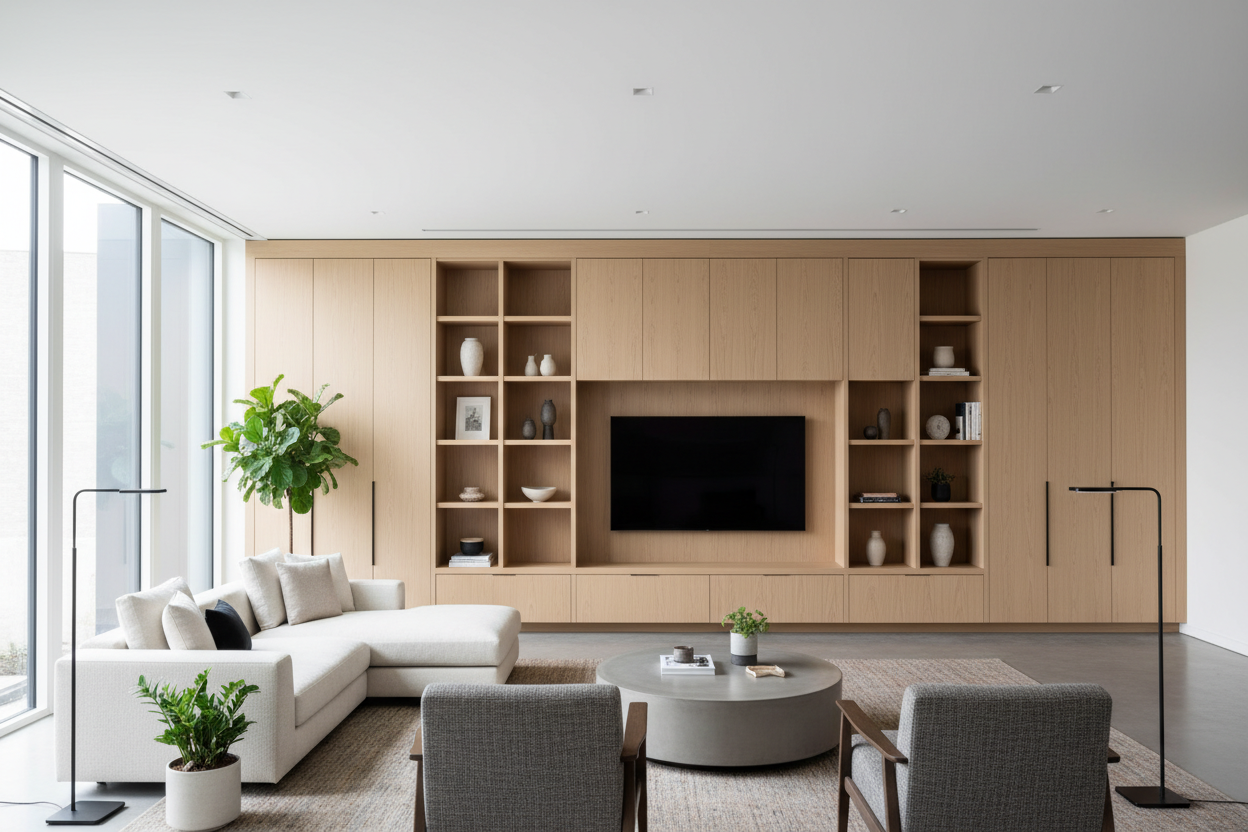
I used to be the queen of the 'bitsy' school of decorating. I had a mid-century plant stand here, a wicker basket there, and a 40-inch console table that looked like a postage stamp against my 12-foot living room wall. It looked cluttered, even when it was clean. I spent years trying to fill the gaps with more 'stuff' until I realized I was just creating visual static.
Then I discovered the power of cabinets long enough to actually anchor a room. When you stop treating your wall like a gallery for small, mismatched furniture and start treating it as a single horizontal plane, the whole room finally settles down. It is the architectural equivalent of a deep breath.
- Horizontal lines create the illusion of width in narrow rooms.
- One large piece is easier to style than four small ones.
- Closed storage hides the daily debris of life.
- A low profile keeps the room feeling airy rather than cramped.
Stop Breaking Up Your Walls With Tiny Furniture
We have been conditioned to think that big furniture makes a room feel smaller. That is a lie. What actually makes a room feel small is 'visual noise.' When you have a 48-inch TV stand flanked by a floor lamp on one side and a stack of books on the other, your eye has to jump over three different heights and three different materials. It is exhausting to look at.
I recently swapped out a client's disjointed setup—a small desk and a bookshelf—for a single 90-inch sideboard. Suddenly, the wall didn't look like a collection of chores; it looked like a deliberate design choice. By using long cupboards instead of accent tables, you eliminate those awkward 'dead zones' between pieces of furniture where dust bunnies and lost socks go to die.
If you have a wall longer than 10 feet, do not buy a standard 60-inch media console. It will look like a toy. You want something that occupies at least 75% of that wall. It grounds the space and gives the room a sense of permanence that flimsy, small-scale pieces just can't provide.
Why Making Cabinets Long Actually Tricks the Eye
There is some basic physics at play here. Horizontal lines draw the eye outward, while vertical lines draw it up and down. In a narrow apartment, you want people looking across the room, not focusing on how close the walls are. A long, low cabinet creates a continuous horizon line that pushes the walls apart visually.
However, there is a catch. When you start looking for pieces that hit the 80, 90, or 100-inch mark, you run into what furniture stores won't tell you about the logistics. Most standard delivery services aren't equipped for a 150-pound solid wood unit that doesn't come apart. I once ordered a beautiful 96-inch mango wood sideboard only to realize it wouldn't fit in my apartment's elevator. We had to carry it up four flights of stairs. It was a nightmare, but the way it transformed my narrow living room made the back pain almost worth it.
Buying oversized horizontal pieces often means dealing with 'white glove' delivery fees or assembling multiple modular units to look like one. If you go the modular route, look for units with flat sides and no overhang on the top surface. This allows them to sit flush against each other, creating that seamless 'long cupboard' look without the custom-built price tag.
The Living Room vs. The Entryway Dilemma
Not all long cabinets are created equal. In a living room, you usually have the luxury of depth. You can afford a 18-inch deep piece that holds your receiver, your board games, and that stack of magazines you will never read. An extra long barn door TV stand is a fantastic way to hide the tech clutter while providing a massive surface for a 75-inch screen.
Entryways are a different beast. Most hallways are about 36 to 42 inches wide. If you put an 18-inch deep cabinet there, you are going to be bruised from bumping into it every day. For halls, you need 'slim' cabinets—usually 12 inches deep or less. This is where you might skip the standard sideboard and look for dedicated shoe cabinets. These are often shallower because the shoes sit at an angle, allowing you to get that long, wall-spanning look without sacrificing your walking path.
I personally prefer a 'floating' long cabinet in entryways. Mounting a long unit to the wall with no legs makes the floor visible all the way to the baseboard, which makes the hallway feel twice as wide. Just make sure you are hitting studs; a 90-inch cabinet full of shoes is heavy enough to rip the drywall right off.
But What Do I Put on Top of It?
The biggest fear people have with long cabinets is the 'empty runway' syndrome. You have 8 feet of flat surface and suddenly you feel the need to cover every inch of it. Don't. That is how you end up with a dumping ground for mail, keys, and loose change.
Treat the top of a long cabinet like a landscape. You want heights to vary, but you want plenty of 'negative space' (empty areas). I like to use the 60-30-10 rule. 60% of the surface should be relatively clear. 30% can hold a large-scale anchor, like a massive piece of art leaning against the wall or a oversized lamp. The final 10% is for small, personal details like a candle or a tray for your keys.
Skip the 'row of small photos.' It looks cluttered. Instead, hang one giant horizontal mirror or a large piece of art centered over the cabinet. It reinforces that long horizontal line and makes the whole setup look like a high-end built-in rather than a piece of furniture you just bought online.
Faking the 'Custom Built-In' Look on a Budget
You do not need to spend $5,000 on a carpenter to get a high-end look. The trick is in the gaps—or rather, the lack of them. When you buy a long cabinet, try to find one that sits flat on the floor or has very short, recessed legs. This mimics the look of cabinetry that is part of the house.
If you are using this guide to hidden storage, you know that solid doors are your best friend. Glass doors or open shelving are 'busy.' Solid doors create a clean, monolithic block of color that blends into the wall. If you can match the cabinet color to your wall color, the piece almost disappears, making the room feel massive.
One pro tip: if your cabinet has a gap between the back and the wall because of your baseboards, consider removing the baseboard behind the cabinet or 'notching' the back of the cabinet. Getting that piece flush against the wall is the difference between 'I bought this at a big-box store' and 'this was designed for this home.'
FAQ
How long is too long for a cabinet?
There is no such thing as too long, only too deep. As long as you have 36 inches of clearance for walking, you can run a cabinet from one corner of the room to the other. In fact, wall-to-wall cabinets usually look better than ones that stop 12 inches short of the corner.
Will a long cabinet make my small room feel cramped?
Actually, it's the opposite. One long, low piece creates a sense of order. Five small pieces create chaos. Keep the height below 30 inches to ensure the 'sight lines' of the room remain open.
What material should I look for in an 80+ inch cabinet?
Avoid cheap particle board for pieces this long. At that span, the middle will sag under its own weight. Look for a kiln-dried hardwood frame or at least a high-quality MDF core with a real wood veneer. If it's a modular setup, make sure each section has its own support legs.


Leave a comment
This site is protected by hCaptcha and the hCaptcha Privacy Policy and Terms of Service apply.