

















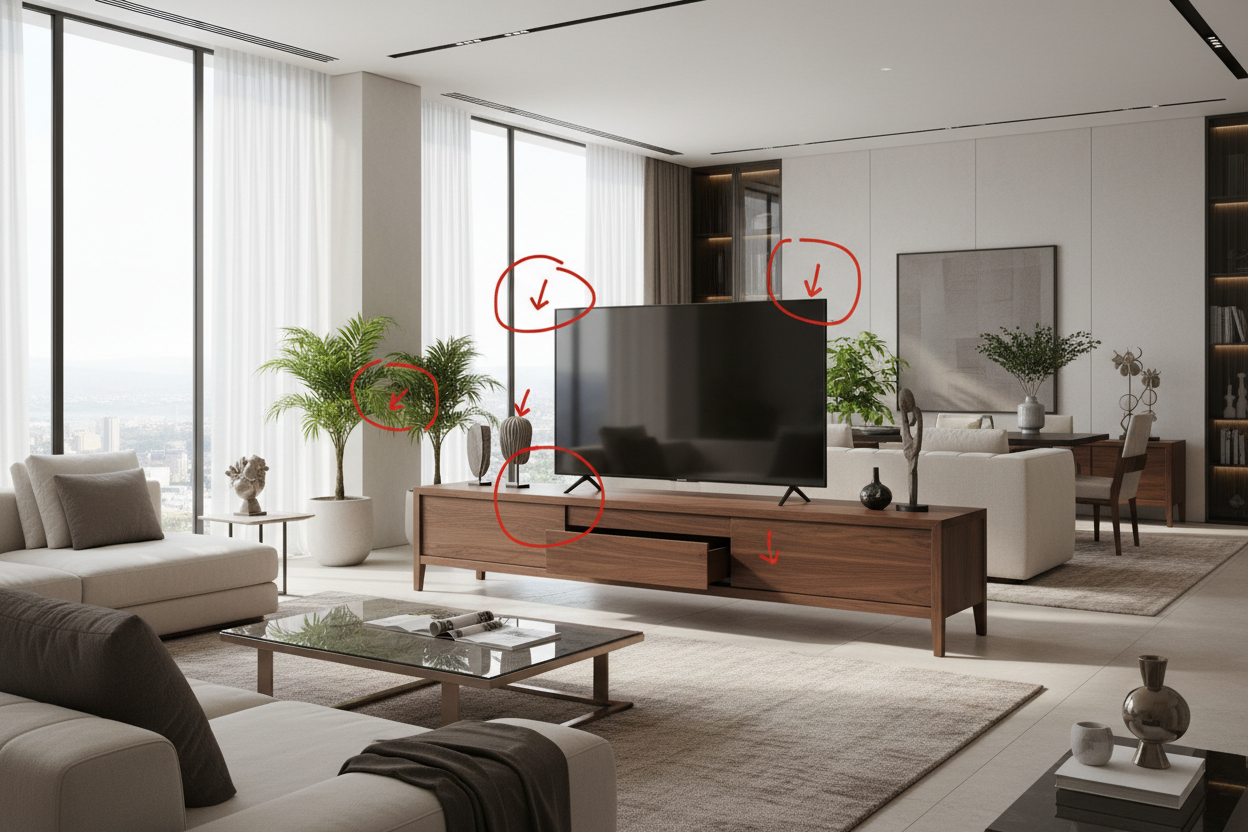
I have spent way too many nights staring at a 75-inch TV sitting on a stand that looked like it was sighing under the pressure. It is that terrifying moment when you realize your 72 inch television stands are actually bowing in the middle, and your expensive tech is one millimeter away from a disaster. Most of us just look at the finish or the door style, but at six feet wide, the physics of furniture change completely.
Quick Takeaways
- Never buy a 72-inch unit without at least one adjustable center support leg.
- Avoid 'tacked-on' cardboard back panels; they offer zero lateral stability for heavy consoles.
- Solid wood is non-negotiable for the top shelf if you plan on using the stand for more than two years.
- Check the weight rating specifically for the center span, not just the overall unit.
Yes, Furniture Physics Change at Six Feet Wide
Browsing through general Tv Stands is easy enough when you are looking for a small corner unit. But once you hit that six-foot mark, you are dealing with a massive structural span. A 72 inch wide tv stand isn't just a bigger cabinet; it is a bridge. If it is built with the same thickness and joinery as a 40-inch nightstand, it is going to fail.
Gravity is a jerk, and it loves to pull on the center of long, heavy boards. When you add the weight of a stand for 72 inch tv setups—which can weigh 60 to 80 pounds on their own—plus receivers, gaming consoles, and soundbars, a tv stand 72 inch model is under constant stress. Cheap manufacturing that works for a small end table will expose itself as a sagging mess within months at this scale.
Flaw #1: Missing Center Support Legs (The Bowing Effect)
The most common sin I see with a tv stand 72 inches long is the missing center leg. If you look under a 72 inch tv stand and only see four legs at the corners, keep walking. That unit is a ticking time bomb. Without a fifth or even a sixth leg tucked under the middle, the 72 in tv stand will develop a permanent 'smile' (a sag in the middle) before the year is out.
I always tell people to reach under the 72 tv stand and feel for an adjustable leveling foot in the center. This leg takes the weight off the long horizontal spans and transfers it directly to the floor. Even if you think your current 72" tv stand is only holding a lightweight LED, the weight of the 72" tv stands themselves—often made of heavy composite materials—is enough to cause a dip over time.
Flaw #2: Flimsy Back Panels on a Massive Console
Most people think the back panel of a 72 inch media console is just there to hide the dust bunnies and messy wires. Wrong. In a piece of furniture this long, the back panel provides essential lateral stability. If you see a 72 inch tv console with a flimsy piece of folding cardboard held on by tiny tacks, it will eventually wobble side-to-side.
For a 72 in media console to stay square, you want a back panel that is either screwed in or recessed into a groove. This prevents 'racking,' which is when the whole 72 media console starts to lean like the Tower of Pisa. A 72" media console with a rigid, structural back is the difference between a piece of furniture that feels like a rock and one that feels like a cardboard box.
Flaw #3: Particle Board Instead of Real Wood
I have seen enough particle board 72 tv console units to know they do not handle torque well. At this length, the sheer weight of the doors or the slight shift of a 72 inch tv entertainment center during a move can strip those cheap cam-lock screws right out of the 'wood.' Particle board is essentially sawdust and glue; it has no grain to hold onto a screw under pressure.
A solid wood 72 inch tv console is the only way to go if you want something that survives more than one apartment. I learned this the hard way when a 72 wide tv stand I bought for a song started peeling because the MDF underneath couldn't handle the humidity. I Trusted My 80 Inch Tv To The Grindle Solid Wood Tv Stand because I knew that at six feet long, only real timber has the internal strength to stay flat under a massive screen. If you are looking at a 72 inch tv cabinet, check the weight—if it feels suspiciously light, it is probably hollow-core or low-density fiberboard.
What About Wall-Mounted Units at This Size?
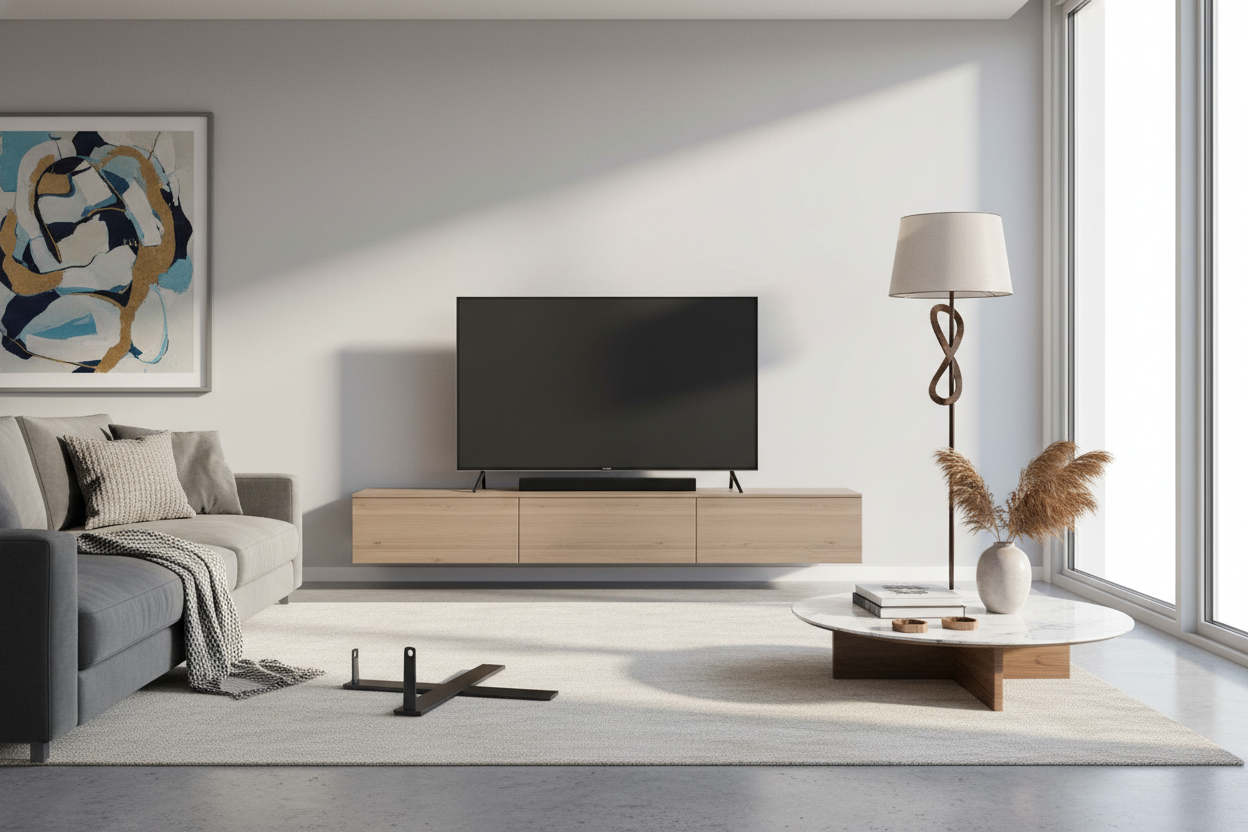
If you are going for a 72 inch wide entertainment center that floats, you better have a high-quality stud finder and a lot of patience. Taking an entertainment center 72 inches wide off the floor is a massive commitment to wall integrity. You cannot trust drywall anchors for this; you must hit at least three or four studs to distribute the load safely.
A properly engineered Floating Tv Stand Wall Mounted Media Console Entertainment Center will use a heavy-duty French cleat system. This allows the weight of the 72 inch long tv stand to be spread across the wall frame rather than pulling on a single point. If the mounting bracket looks thin or only has two holes, it is not meant for a 72 inch media cabinet.
Personal Experience: The Sagging Nightmare
I once bought a black 72 inch tv stand that looked incredible in the studio photos. It was sleek, modern, and suspiciously cheap. Three months in, I noticed the middle drawer wouldn't close quite right. Then the cabinet doors started rubbing. I took a level to the top surface and realized the middle had dropped nearly half an inch. Because it lacked that crucial fifth leg, the particle board had simply given up. I ended up having to prop it up with a stack of old magazines until I could buy a real 72 inch tv entertainment center. Never again.
FAQ
Can a 72 inch TV fit on a 72 inch stand?
It will fit, but the edges of the TV will be flush with the edges of the stand. For a better aesthetic and less risk of bumping into it, I usually recommend a stand that is at least 4-6 inches wider than the TV itself.
Is a 72 inch media console too big for a small room?
Not necessarily. Because they are usually low to the ground, a 72 inch wide tv stand can actually make a room feel wider if you don't clutter the top of it. It provides a long, clean horizontal line.
How many legs should a 72 inch tv stand have?
At minimum, it needs five. Four at the corners and at least one structural support leg in the dead center to prevent the top span from bowing under the weight of the television.

Leave a comment
This site is protected by hCaptcha and the hCaptcha Privacy Policy and Terms of Service apply.