

















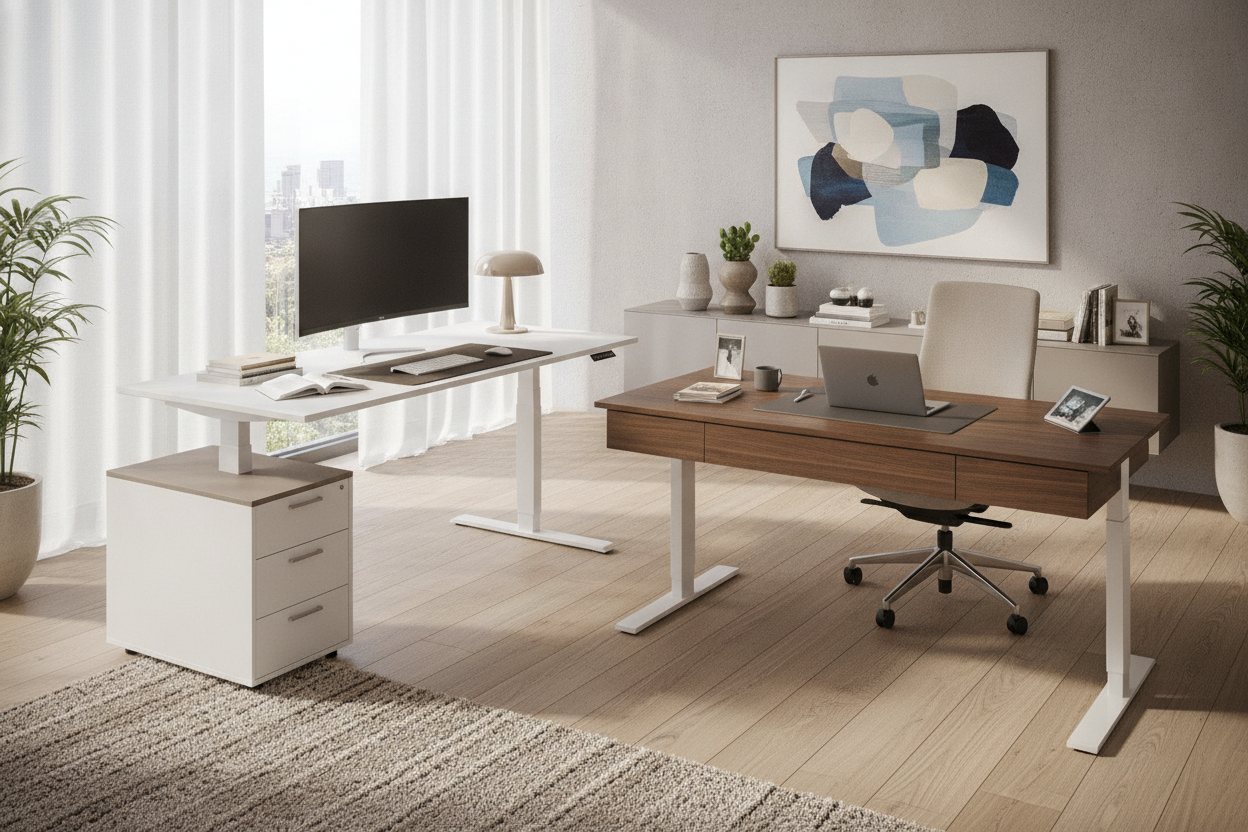
I spent three years working on a $400 slab of butcher block that looked great on Instagram but was essentially a graveyard for half-used sticky notes and rogue chargers. When I finally decided to upgrade to an electric standing desk with drawer, I thought I had solved my clutter crisis forever. Instead, I spent the first month nursing a permanent bruise on my right kneecap because I didn't respect the geometry of the thing.
- Measure your seated thigh height before looking at a spec sheet.
- Look for 'under-desk clearance' rather than just 'total height.'
- Verify the drawer depth—many are too shallow for a standard stapler.
- Check the motor placement to ensure it doesn't pinch the drawer tracks.
The Flat Slab Clutter Trap
We all want that minimalist, zen workspace, but the reality involves pens, external hard drives, and spare AA batteries. Finding a contemporary desk with drawers that actually moves up and down is a weirdly difficult engineering puzzle. Most manufacturers take the easy route by selling you a flat board on legs, leaving you to pile your life on top of it.
The urge to buy a sit stand desk with drawer is driven by the need to hide the mess, but adding a storage box to a motorized frame complicates the center of gravity. It is a delicate balance between having a place for your pens and keeping the whole unit from wobbling like a jelly bowl when it is fully extended to 48 inches.
The Knee-Banging Reality of Integrated Storage
Here is the mechanical conflict: an electric sit stand desk with drawers is a battle for space. You have the desktop, then the drawer box, then the steel crossbar that connects the legs, and finally the motor housing. If you are over 5'10', that stack of hardware often ends up exactly where your thighs need to be when you are seated.
I learned this the hard way with a budget model where the drawer box hung five inches below the surface. I had to choose between sitting with my chair so low my elbows were at my ears, or constantly slamming my knees into the bottom of the drawer. It is a miserable trade-off that most product photos conveniently hide by showing the desk at standing height.
Spec 1: Seated Knee Clearance (The Dealbreaker)
This is the absolute dealbreaker. Sit in your current office chair, get comfortable, and measure from the floor to the top of your thighs. Now, look at the desk's minimum height and subtract the thickness of the drawer unit. If the remaining space is less than your thigh measurement, the desk is essentially a torture device.
A standing table with drawers is fantastic when you are on your feet, but if you cannot sit ergonomically for at least half the day, you will end up with lower back pain that no amount of standing can fix. Look for desks that use a slim, integrated drawer design rather than a bulky add-on box.
Spec 2: The Motor Housing Gap
Check the photos of the underside—not just the glossy top-down shots. An electric sit stand desk with drawer needs a specific amount of clearance so the drawer track doesn't interfere with the wiring harness or the central motor bar. I once tested a mid-range model where the drawer would catch on the power cable every time I closed it.
You want to see a clear gap or a dedicated cable management tray that keeps the electronics away from the moving parts of the drawer. If the manufacturer doesn't show you the bottom of the desk in their marketing, assume they are hiding a rat's nest of cables and a poorly fitted drawer box.
Spec 3: True Usable Internal Depth
Many of these drawers are glorified pencil trays. Because the motor and frame take up so much vertical room, the actual storage space is often less than two inches deep. You can fit a MacBook Air and a few pens, but your favorite thick journal or a bulky laptop charger might prevent the drawer from closing.
Compared to a standard writing computer desk, which usually offers four to six inches of vertical drawer space, these motorized versions are strictly for the essentials. If you are expecting to move your entire filing system into your desk, you are going to be disappointed. Always check the 'internal drawer dimensions'—not just the exterior box size.
When to Just Give Up and Buy a Rolling Cabinet
If you have long legs or a very specific ergonomic setup, the math for an integrated drawer might never work. I eventually realized that for my 6'2' frame, a minimalist desk paired with a separate sit stand desk with file cabinet on wheels was the superior play. It keeps the legroom wide open while giving me three times the storage space.
Don't force a drawer into a space where it doesn't fit. If you find yourself looking at a desk and wondering if you can just 'not install' the drawer, that is your sign to buy a different model. Your knees will thank you three months from now when you aren't constantly dodging a sharp wooden corner every time you cross your legs.
FAQ
Can I add a drawer to a standing desk I already own?
Maybe, but you have to check the support beam. Most electric desks have a thick crossbar right under the center of the desk. You will need an 'offset' drawer kit that mounts in front of or behind that bar.
Do drawers make a standing desk more wobbly?
If the drawer is heavy and you fill it with books, yes. It shifts the center of gravity forward. Look for a desk with a heavy steel base to offset the weight of the storage unit.
Are dual-motor desks better for storage?
Generally, yes. Dual-motor systems put the lifting power in the legs, often leaving the center area under the desk more open for a wider, deeper drawer box.


Leave a comment
This site is protected by hCaptcha and the hCaptcha Privacy Policy and Terms of Service apply.