

















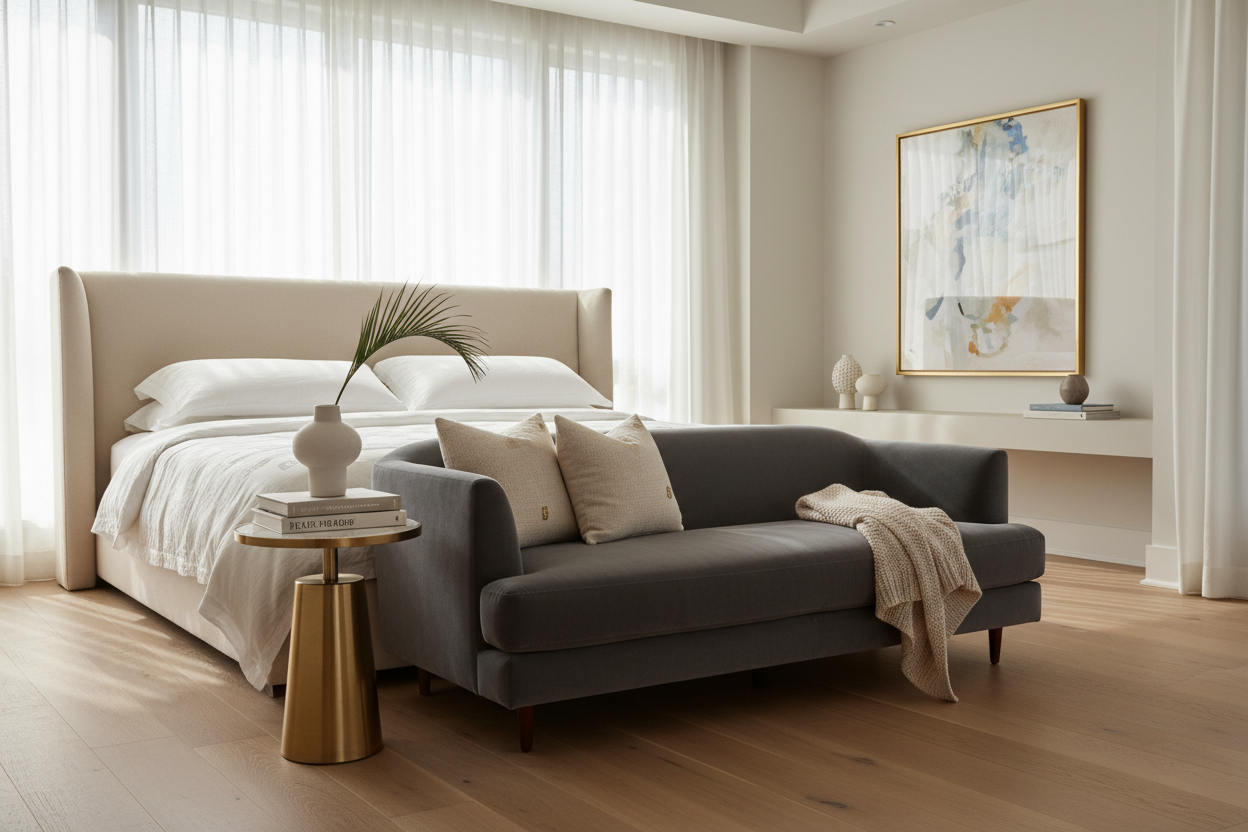
The bed naturally commands the room, but the seating defines the lifestyle. When designing a master suite, the difference between a place to sleep and a true retreat often comes down to secondary furniture. A well-placed loveseat in bedroom layouts bridges the gap between functionality and luxury, offering a spot to read, put on shoes, or simply decompress without disrupting the bed linens. However, selecting the wrong scale or silhouette can quickly turn a spacious room into a cluttered obstacle course.
Quick Decision Guide: Key Features to Look For
- Scale Relative to Bed: If placing at the foot, the loveseat should be at least 6-12 inches narrower than the bed width (3-6 inches on each side) to maintain visual balance.
- Seat Depth & Height: For end-of-bed placement, ensure the seat height aligns within 2 inches of your mattress height. Avoid deep loungers that obstruct traffic paths.
- Visual Weight: In smaller rooms, opt for exposed legs to create airiness. In large master suites, a skirted or block-base design adds necessary grounding.
- Performance Fabrics: Bedrooms are high-contact areas for skin oils and lotions. Look for Crypton or high-rub-count velvet for longevity.
Mastering the Layout and Flow
Positioning is the first hurdle in executing loveseat in bedroom ideas effectively. The most classic arrangement is at the foot of the bed. This creates an anchor for the sleeping zone and mimics the layout of high-end hospitality design. However, you must respect the circulation path. You need a minimum of 30 inches of clearance between the front of the loveseat and the dresser or wall opposite it. If your walkway is tighter than that, the room will feel choked.
For a master bedroom loveseat that serves as a reading nook, consider angling the piece in a corner near a window. This breaks the rigid grid of the room and invites natural light. Here, you can afford a higher back or a wingback silhouette, which provides acoustic dampening and a sense of enclosure.
Materiality: Texture vs. Durability
In a living room, durability against spills is key. In a bedroom, the focus shifts to tactile comfort and resistance to pilling. I often steer clients toward performance velvets or heavy-weight linens. These materials offer a sophisticated sheen that elevates the space. If you are exploring bedroom loveseat ideas for a monochromatic room, use the loveseat to introduce texture—think a bouclé wool or a channel-tufted leather to contrast against cotton bedding.
Handling Compact Spaces
Integrating loveseat in small bedroom ideas requires a keen eye for "negative space." Avoid overstuffed, rolled-arm styles that eat up visual square footage. Instead, look for track arms or armless settees. A bench-seat loveseat (one single cushion) often looks cleaner and less cluttered than a two-cushion design in tight quarters. By choosing a piece with tall, slender legs, you allow the floor to be seen underneath, which tricks the eye into perceiving the room as larger.
Lessons from My Own Projects
I learned the hard way about the importance of "shin clearance" regarding a loveseat in master bedroom layouts. Early in my career, I specified a stunning, deep-seated velvet loveseat for the foot of a client's King bed. Visually, it was a masterpiece. Practically, it was a disaster.
The loveseat was 40 inches deep. While it fit the room on paper, I hadn't accounted for the client's nightly routine of walking around the bed in the dark to get to the ensuite. The protrusion of the loveseat into the natural walkway meant they were constantly bumping their shins against the frame. We ended up having to relocate that piece to a bay window and swap in a shallower, 28-inch depth settee. Now, I always tape out the footprint on the floor and walk the path in the dark before ordering.
Conclusion
Adding a loveseat to your bedroom is an investment in your downtime. It signals that your room is not just for sleeping, but for living. By paying attention to scale, circulation, and tactile finishes, you can curate a space that feels intentional and deeply restorative.
Frequently Asked Questions
How wide should a loveseat be at the end of a King bed?
A standard King bed is 76 inches wide. Ideally, your loveseat should be between 50 and 65 inches wide. This leaves enough space on either side to prevent the composition from looking heavy or accidental.
Can I put a loveseat in a small bedroom?
Yes, but placement is critical. Avoid the foot of the bed if it blocks the walkway. Instead, try placing a petite loveseat (under 55 inches) under a window or angled in a corner. Choose a piece with legs rather than a skirt to maintain a sense of openness.
What is the best fabric for a bedroom loveseat?
Since bedrooms are lower-traffic than living rooms but involve more direct skin contact, prioritize soft, natural-feeling fabrics. Cotton velvet, linen blends, and chenille are excellent choices. If you eat or drink coffee in the bedroom, stick to performance fabrics that resist staining.

Leave a comment
This site is protected by hCaptcha and the hCaptcha Privacy Policy and Terms of Service apply.